All species › Swifts › Hummingbirds › Olivaceous Thornbill
Olivaceous Thornbill | Chalcostigma olivaceum
Olijfkleurige doornsnavel | Picoespina oliváceo | Bico-de-espinho-oliváceo
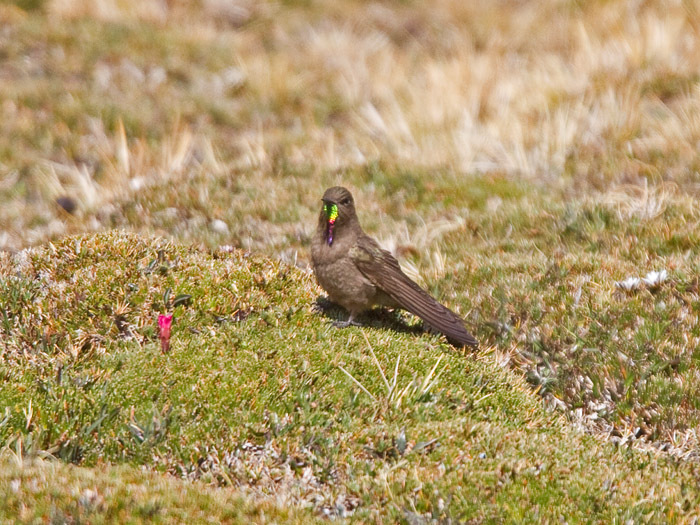
The Olivaceous Thornbill is the largest thornbill and the species of the humid puna of Peru and Bolivia. It is almost uniformly dark olive-green; only the male has a narrow, multicoloured beard. It often feeds on or just above the ground.
Voice
Hardly documented; a short tzit.
Recording: Jacob Wijpkema — CC BY-NC-SA 4.0 · xeno-canto
Identification
12–14 cm, with a short, straight black bill. The male is mostly dull dark bronzy to olive-green, including the long, slightly forked tail, with a dark sooty-grey face and a narrow beard that grades from glittering green at the top through yellow, pink and purple to blue at the bottom. The female resembles the male but has a much smaller beard or none at all. Young birds have pale feather edges. The subspecies of the western slope in central Peru is smaller and paler, with greyish upperparts.
Confusion species
Blue-mantled Thornbill Chalcostigma stanleyi is smaller, with a violet-blue back and a steel-blue tail, and lives more near woodland patches and scrub. Scaled Metaltail Metallura aeneocauda is smaller, with scaly underparts, and lives at the treeline. Andean Hillstar Oreotrochilus estella also lives on the puna, but the male has a white belly and a glittering green throat.
Habitat
Humid puna grassland, also low scrub and the edges of Polylepis and Gynoxys woodland patches, in Peru roughly between 3500 and 4700 m, in Bolivia between 3100 and 4500 m. It forages close to the ground, sometimes walking on matted grass, and takes nectar at low flowers, but probably feeds mainly on insects, caught in short sallies or gleaned from vegetation. Males defend feeding territories.
Where the bird is most at home, classified by the vegetation units of the Andes and the west coast.


Range and movements
In Peru scattered on the western slope from Áncash to Junín (a smaller, paler subspecies) and in the south-east from Apurímac and Cusco to Puno. In Bolivia in the north-west, mainly in La Paz. Absent from Colombia, Ecuador and the Galápagos. Does not occur outside the guide area.
- Resident
- dark = core range, pale = thinly spread
How and when to look
On the puna and at Polylepis patches around high passes in Cusco, such as Abra Málaga. Watch for birds flying low over the grass or perched on the ground or a stone.
Conservation status
Least Concern. The population is unknown and probably declining; in much of its range the species is scarce to fairly scarce. Human activity has little direct short-term effect.
Scientific name
Chalcostigma olivaceum | (Lawrence, 1864)
Lawrence described the species in 1864 as Ramphomicron olivaceus; because it was later moved to another genus, the author and year stand in brackets. The genus Chalcostigma was introduced in 1854 by Reichenbach. The genus name combines Greek khalkos, 'bronze', with stigmē, 'spot' or 'mark', referring to the beard of the Bronze-tailed Thornbill. The species name comes from Latin olivaceus, 'olive-green'. The specimen the first description was based on came from La Paz, Bolivia.