All species › Swifts › Hummingbirds › Blue-mantled Thornbill
Blue-mantled Thornbill | Chalcostigma stanleyi
Blauwmanteldoornsnavel | Picoespina dorsiazul | Bico-de-espinho-de-manto-azul
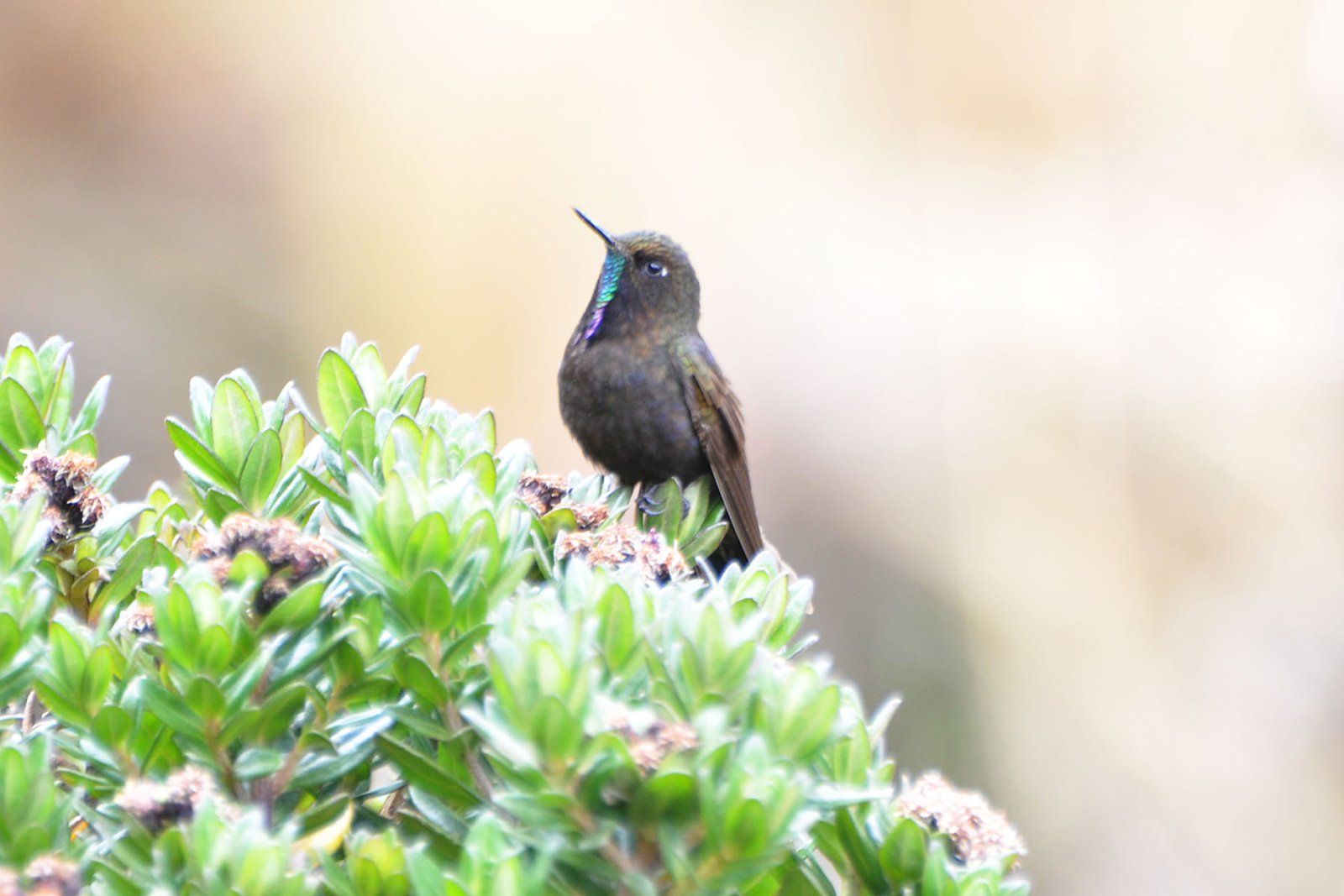
The Blue-mantled Thornbill is a dark thornbill of the high páramo, the jalca and the Polylepis woodlands from Ecuador to Bolivia. The male has a violet-blue back and a long, forked, steel-blue tail. Males defend small flower-rich territories among rocks and shrubs.
Voice
A descending, squeaky twitter followed by a softer, rising note; also series of descending notes.
Recording: John V. Moore — CC BY-NC-SA 4.0 · xeno-canto
Identification
12–13 cm, with a short, straight black bill and a small white spot behind the eye. The male is mostly sooty brown, with a bronze-green gloss on crown and nape, a violet-blue back, turquoise uppertail coverts and a forked, steel-blue tail. The narrow beard is emerald green on the chin and shades through pink to violet or violet-blue. The female resembles the male but has green only below the chin and pale tips to the outer tail feathers. In Peru and Bolivia the whole upperside is a deeper violet-blue.
Confusion species
Rainbow-bearded Thornbill Chalcostigma herrani has a rufous crown, a multicoloured beard and white tail tips. Olivaceous Thornbill Chalcostigma olivaceum is larger and plain olive-green, without a blue back, and lives on the open puna. Purple-backed Thornbill Ramphomicron microrhynchum has an even shorter bill; the male is purple above, with a glittering green throat without a narrow beard, and lives mainly at forest edges. Tyrian Metaltail Metallura tyrianthina is smaller and green, with a reddish tail.
Habitat
Steep, rocky slopes with humid páramo or jalca, especially near patches of Polylepis and Gynoxys, mostly between 3000 and 4200 m, exceptionally from 2200 to 4500 m. It takes nectar from small flowers of plants such as Berberis, Gaultheria and Ribes, and searches for small insects on the undersides of leaves, in grass and on rocks; sometimes it catches insects in flight.
Where the bird is most at home, classified by the vegetation units of the Andes and the west coast.


Range and movements
In Ecuador on both slopes of the Andes, from Carchi to Azuay. In Peru on the eastern slope south to Huánuco and on the western slope of the Cordillera Blanca, with another subspecies on the eastern slope in the south. In Bolivia on the eastern slope into Cochabamba. From Colombia there are only a few records from the south, close to the Ecuadorian border; absent from the Galápagos. Does not occur outside the guide area.
- Resident
- dark = core range, pale = thinly spread
How and when to look
In Ecuador at the Polylepis patches and scrub around Papallacta Pass. Males often perch on a projecting twig or rock near their flowers.
Conservation status
Least Concern. The population is probably declining; locally Polylepis woodland is lost and grassland is converted to pasture.
Scientific name
Chalcostigma stanleyi | (Bourcier, 1851)
Bourcier described the species in 1851 as Trochilus Stanleyi; because it was later moved to another genus, the author and year stand in brackets. The genus Chalcostigma was introduced in 1854 by Reichenbach. The genus name combines Greek khalkos, 'bronze', with stigmē, 'spot' or 'mark', referring to the beard of the Bronze-tailed Thornbill. The species name honours Edward Henry Stanley, 15th Earl of Derby (1826–1893), who travelled in North America, the West Indies, Ecuador and Bengal, among other places. The specimen the first description was based on came from Pichincha and Cotopaxi, Ecuador.