All species › Swifts › Hummingbirds › Bronze-tailed Thornbill
Bronze-tailed Thornbill | Chalcostigma heteropogon
Bronsstaartdoornsnavel | Picoespina bronceado | Bico-de-espinho-de-cauda-bronzeada
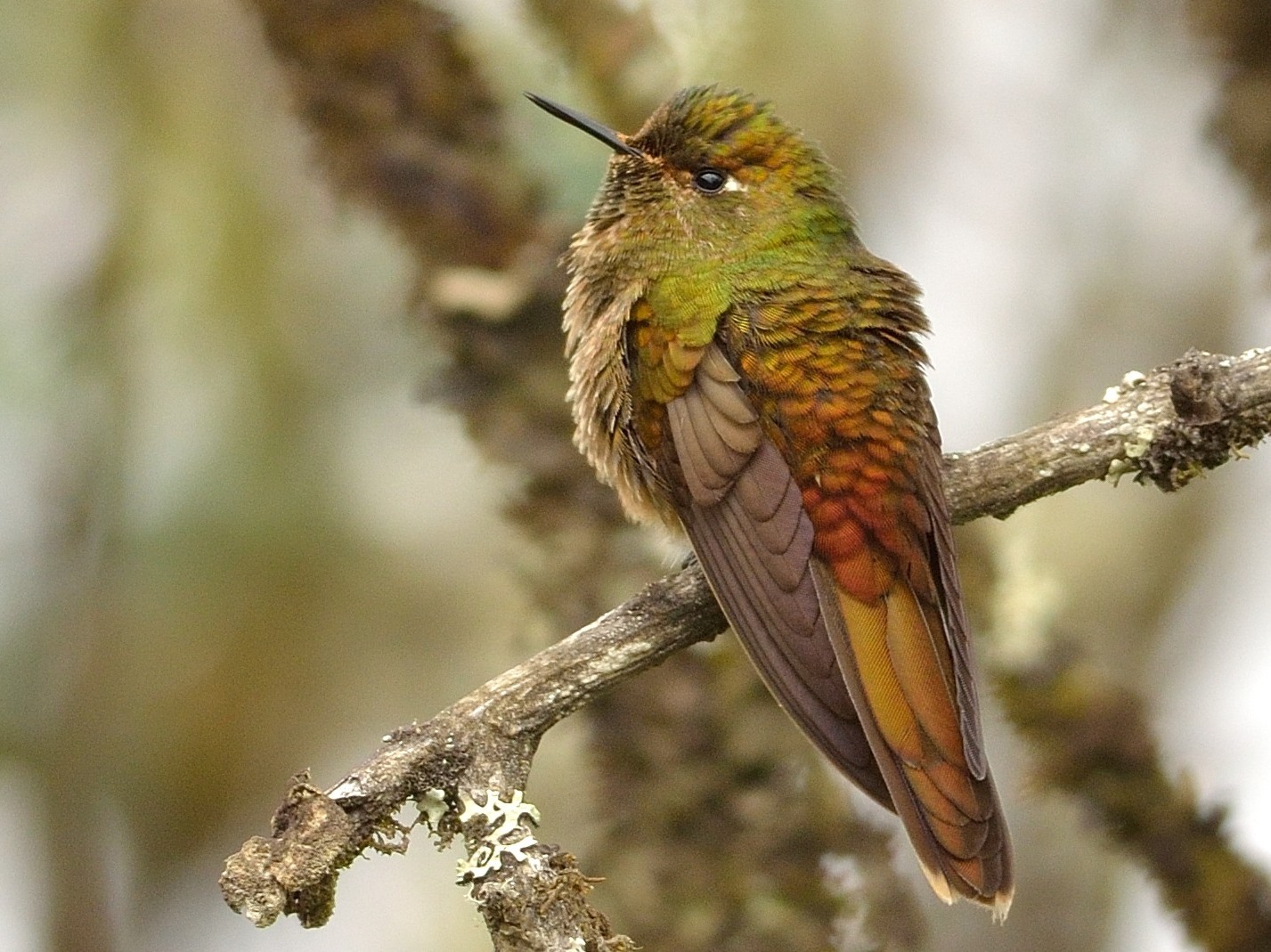
The Bronze-tailed Thornbill is the large thornbill of the páramo of the Eastern Cordillera of Colombia. It is mostly dark green, with a coppery-red rump and, in the male, a narrow green and pink beard. Unlike some relatives it feeds mainly at flowering shrubs rather than on the ground.
Voice
Little known; a dull, short tsk.
Recording: Simon Mills — CC BY-NC-SA 4.0 · xeno-canto
Identification
12–14 cm, with a short, straight black bill. The male is dark bottle-green, with coppery-red uppertail coverts and a forked, olive-green to bronzy tail. The narrow beard is emerald green, turning pink at the bottom. The female resembles the male but has a smaller, paler green beard without pink, and pale tips to the outer tail feathers. Young birds have a mahogany-red crown.
Confusion species
Green-bearded Helmetcrest Oxypogon guerinii lives in the same páramo, but has a crest, a black face bordered with white and a white beard with green in the centre. Tyrian Metaltail Metallura tyrianthina is smaller, without a beard, with a reddish tail. Rainbow-bearded Thornbill Chalcostigma herrani is smaller, with a rufous crown, a multicoloured beard and white tail tips, and is absent from the Eastern Cordillera.
Habitat
Steep, rocky slopes in dry to humid páramo and the edges of Polylepis and other elfin woodland, roughly between 3000 and 3900 m. It takes nectar at flowers of shrubs and herbs, clinging or hovering; both sexes defend flower-rich patches vigorously against other hummingbirds. It also gleans insects from vegetation and catches them in flight.
Where the bird is most at home, classified by the vegetation units of the Andes and the west coast.


Range and movements
In Colombia in the Eastern Cordillera, from Norte de Santander south to Cundinamarca. Absent from Ecuador, Peru, Bolivia and the Galápagos. Outside the guide area only in the Tamá massif in the far west of Venezuela.
- Resident
- dark = core range, pale = thinly spread
How and when to look
In the páramo of Chingaza and Sumapaz and in the Sierra Nevada del Cocuy, at flowering shrubs on rocky slopes.
Conservation status
Least Concern. Fires and the spread of pasture and fields in the páramo locally reduce its habitat.
Scientific name
Chalcostigma heteropogon | (Boissonneau, 1840)
Boissonneau described the species in 1840 as Ornismya heteropogon; because it was later moved to another genus, the author and year stand in brackets. The genus Chalcostigma was introduced in 1854 by Reichenbach. The genus name combines Greek khalkos, 'bronze', with stigmē, 'spot' or 'mark', referring to the beard of the Bronze-tailed Thornbill. The species name combines Greek heteros, 'different', with pōgōn, 'beard', referring to the differently coloured throat stripe. The specimen the first description was based on came from Bogotá, Colombia.