All species › Swifts › Hummingbirds › Rainbow-bearded Thornbill
Rainbow-bearded Thornbill | Chalcostigma herrani
Regenboogdoornsnavel | Picoespina arcoíris | Bico-de-espinho-de-barba-arco-íris
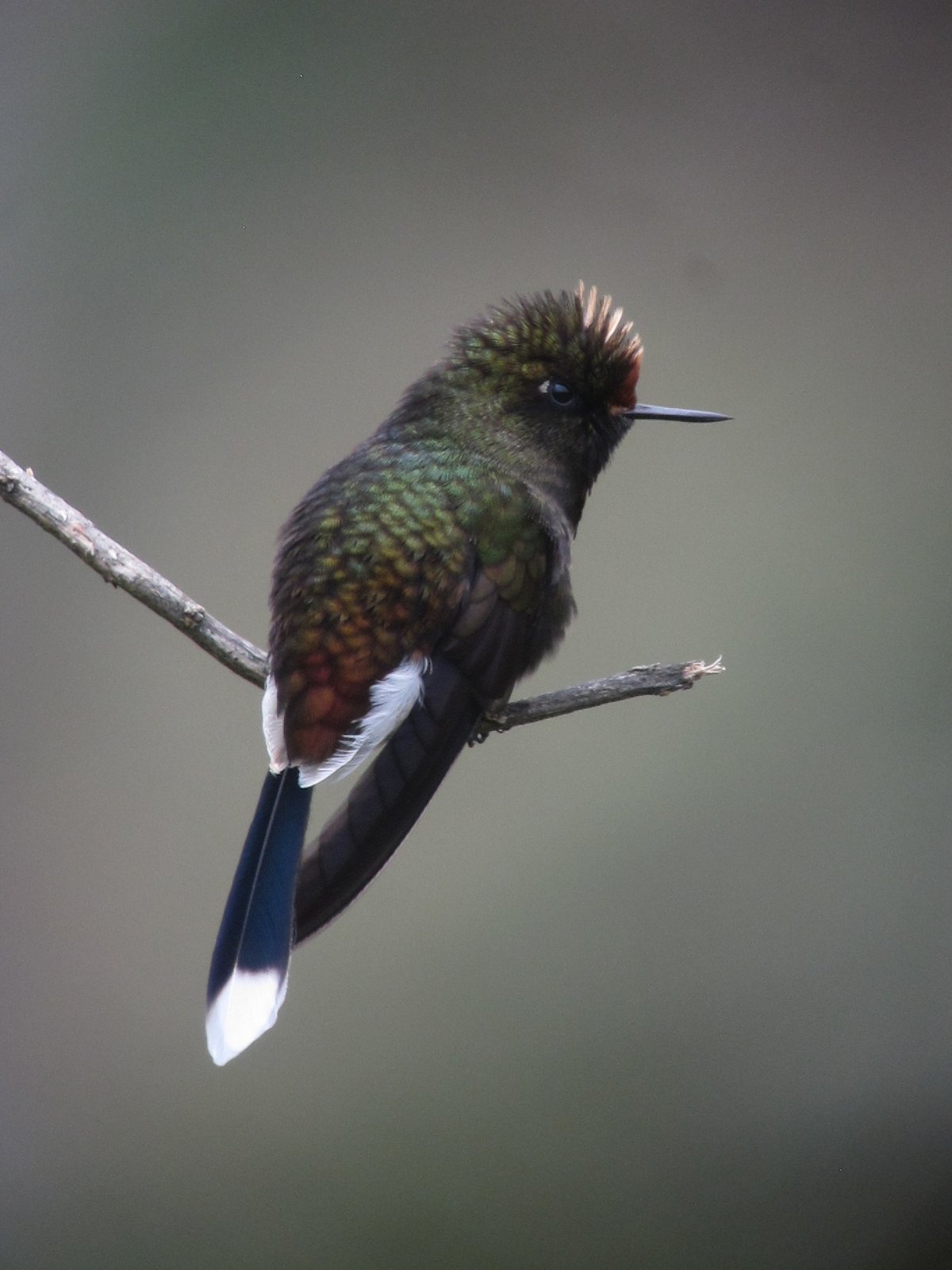
The Rainbow-bearded Thornbill is named after the male's narrow beard, which grades from green through yellow to red. It is a thornbill of the páramo and the scrub above the treeline, from Colombia to northern Peru. Both sexes show the rufous crown and the white tail corners.
Voice
Few recordings. A possible song is a repeated, low cheet-dee-dee-cheet.
Recording: David Ricardo Rodríguez-Villamil — CC BY-NC-SA 4.0 · xeno-canto
Identification
10–12 cm, with a very short, needle-like black bill and a small white spot behind the eye. The male is mostly bottle-green, with a rufous forecrown and crown, a coppery rump and white undertail coverts. The forked tail is blue-black, with white tips at the corners, best seen from below. The narrow beard grades from green and turquoise through yellow to red at the bottom. The female resembles the male but has a much smaller beard and is pale yellowish ochre from the lower belly to the undertail coverts. Young males have an entirely dark throat. The subspecies of Nevado del Tolima is slightly darker, with a longer beard.
Confusion species
Rufous-capped Thornbill Chalcostigma ruficeps also has a rufous crown, but is smaller, without white tail tips, and lives lower, in montane forest. Blue-mantled Thornbill Chalcostigma stanleyi is dark, with a violet-blue back and a steel-blue tail without white tips. Purple-backed Thornbill Ramphomicron microrhynchum has an even shorter bill, a purple back in the male, and no rufous crown. Tyrian Metaltail Metallura tyrianthina has a reddish tail without white corners.
Habitat
Mainly páramo with scrub and small woods, also gullies with ferns and bromeliads, in Colombia between 2700 and 4100 m, in Ecuador between 2800 and 3700 m. It takes nectar from small flowers of low shrubs, often clinging to the flower, and catches insects. It forages alone and defends its flowers vigorously, even against larger flowerpiercers and other hummingbirds.
Where the bird is most at home, classified by the vegetation units of the Andes and the west coast.


Range and movements
In Colombia in the southern Andes from Cauca south to Nariño, and isolated on Nevado del Tolima in the Central Cordillera. In Ecuador in the high mountains along almost the whole length of the country. In Peru only in the north, in Piura and Cajamarca. Absent from Bolivia and the Galápagos. Does not occur outside the guide area.
- Resident
- dark = core range, pale = thinly spread
How and when to look
In Colombia in Puracé National Park in Cauca; in Ecuador in shrubby páramo above the treeline, for example around Papallacta Pass. Males often perch on a projecting twig near flowering shrubs.
Conservation status
Least Concern. The population is unknown and probably declining; no specific threats are known, but the páramo is locally degraded by fires and grazing.
Scientific name
Chalcostigma herrani | (Delattre & Bourcier, 1846)
Delattre & Bourcier described the species in 1846 as Trochilus Herrani; because it was later moved to another genus, the author and year stand in brackets. The genus Chalcostigma was introduced in 1854 by Reichenbach. The genus name combines Greek khalkos, 'bronze', with stigmē, 'spot' or 'mark', referring to the beard of the Bronze-tailed Thornbill. The species name honours Pedro Alcántara Herrán (1800–1872), a Colombian general and statesman who was, among other things, president of New Granada. The specimen the first description was based on came from Pasto, Colombia.