All species › Swifts › Hummingbirds › Giant Hummingbird
Giant Hummingbird | Patagona gigas
Reuzenkolibrie | Colibrí gigante | Beija-flor-gigante
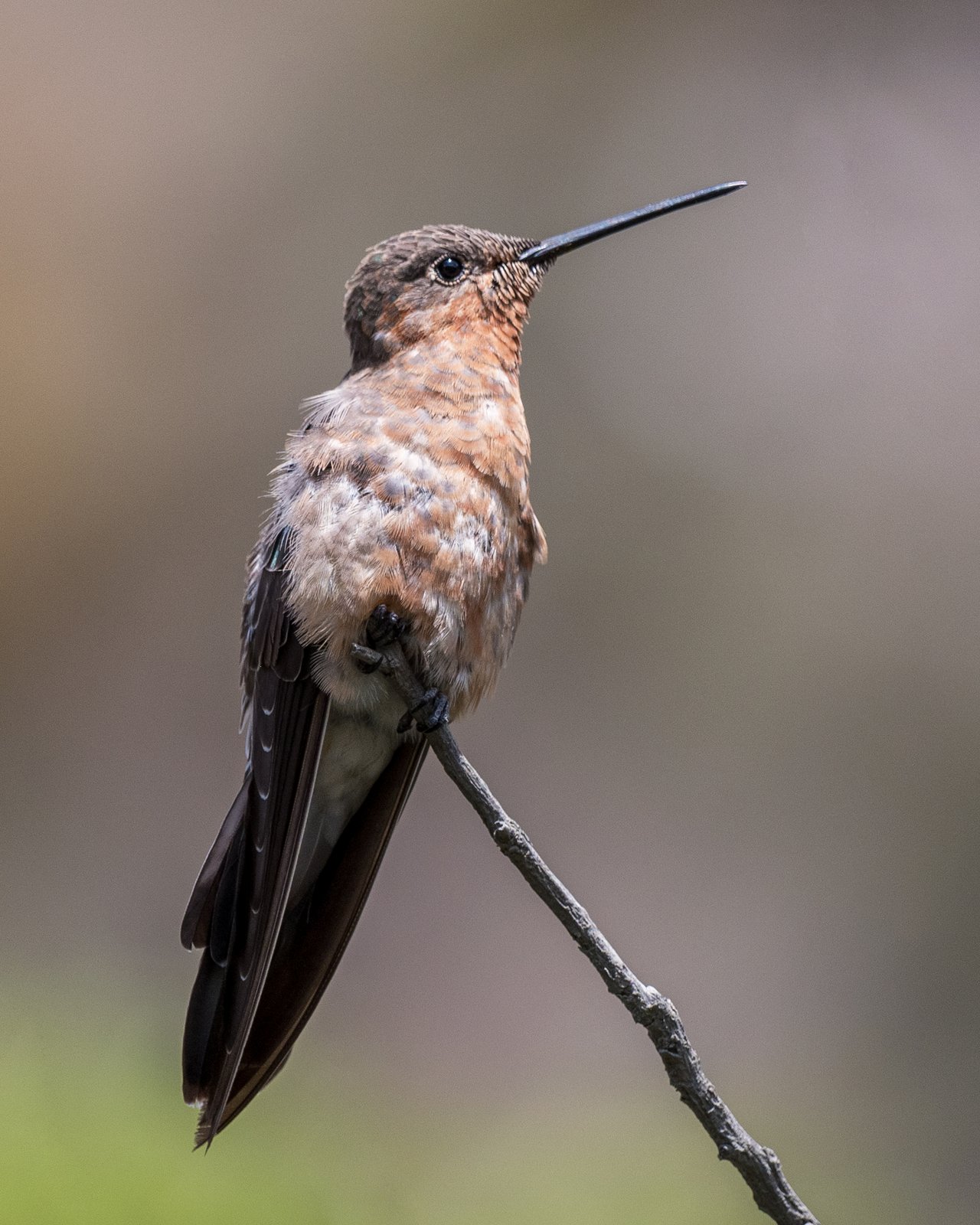
The Giant Hummingbird is the largest hummingbird in the world, as big as a starling but slimmer. It flies with slow, visible wingbeats and sometimes glides like a swallow, so that at first sight it hardly looks like a hummingbird. It belongs to the dry valleys of the Andes, where it visits the flowers of agaves and cacti.
Voice
A loud, sharp, whistled cheep, often in series, both perched and in flight.
Recording: Cristian Pinto Fernandez — CC BY-NC-SA 4.0 · xeno-canto
Identification
20–23 cm, with a long, straight, black bill and a long, slightly forked tail. The upperparts are dull olive-brown to greyish brown, with a conspicuous white rump. The underparts are cinnamon to rufous, in the female somewhat paler and finely spotted on the throat. There are no iridescent colours. In flight the long, narrow wings, the white rump and the slow wingbeats stand out. The sexes are similar.
Confusion species
Other hummingbirds in the same area are much smaller and have faster wingbeats; White-vented Violetear Colibri serrirostris and female Andean Hillstar Oreotrochilus estella are more compact and greener above, without a white rump. In flight it may briefly suggest a swallow, but it hovers at flowers.
Habitat
Dry, open mountain slopes with scrub, cacti and agaves, hedgerows along fields and terraces, riparian thickets, gardens and villages with eucalyptus and flowering shrubs, at roughly 2000 to 4000 m. It visits mainly large flowers, such as those of Agave, Puya and columnar cacti, and catches insects in flight. It often perches conspicuously on a bare branch or wire.
Where the bird is most at home, classified by the vegetation units of the Andes and the west coast.


Range and movements
In Colombia only in the far south-west. In Ecuador in the dry valleys of the Andes. In Peru and Bolivia widespread in the dry valleys and on the western slope of the Andes. Absent from the Galápagos. Outside the guide area in Chile and western Argentina. Research published in 2024 shows that the northern birds are a distinct, non-migratory form that may be recognised as a separate species; the southern form winters partly in the guide area.
- Resident
- dark = core range, pale = thinly spread
How and when to look
In the dry valleys at flowering agaves and cacti, for example in the Sacred Valley near Cusco in Peru and in the dry valleys of the Ecuadorian Andes. A bird on a bare branch above the scrub stands out by its size and loud call.
Conservation status
Least Concern. It benefits from hedgerows, gardens and plantings of agave and eucalyptus in the Andean landscape.
Scientific name
Patagona gigas | (Vieillot, 1824)
Vieillot described the species in 1824 as Trochilus gigas; because it was later moved to another genus, the author and year stand in brackets. The genus Patagona was introduced in 1840 by Gray. The genus name refers to Patagonia, in southern South America. The species name comes from Latin gigas, 'giant', after its size: this is the largest hummingbird. The specimen the first description was based on came from Valparaíso, Chile.