All species › Swifts › Hummingbirds › Long-billed Starthroat
Long-billed Starthroat | Heliomaster longirostris
Langsnavelsterkeelkolibrie | Colibrí pico largo | Bico-reto-cinzento
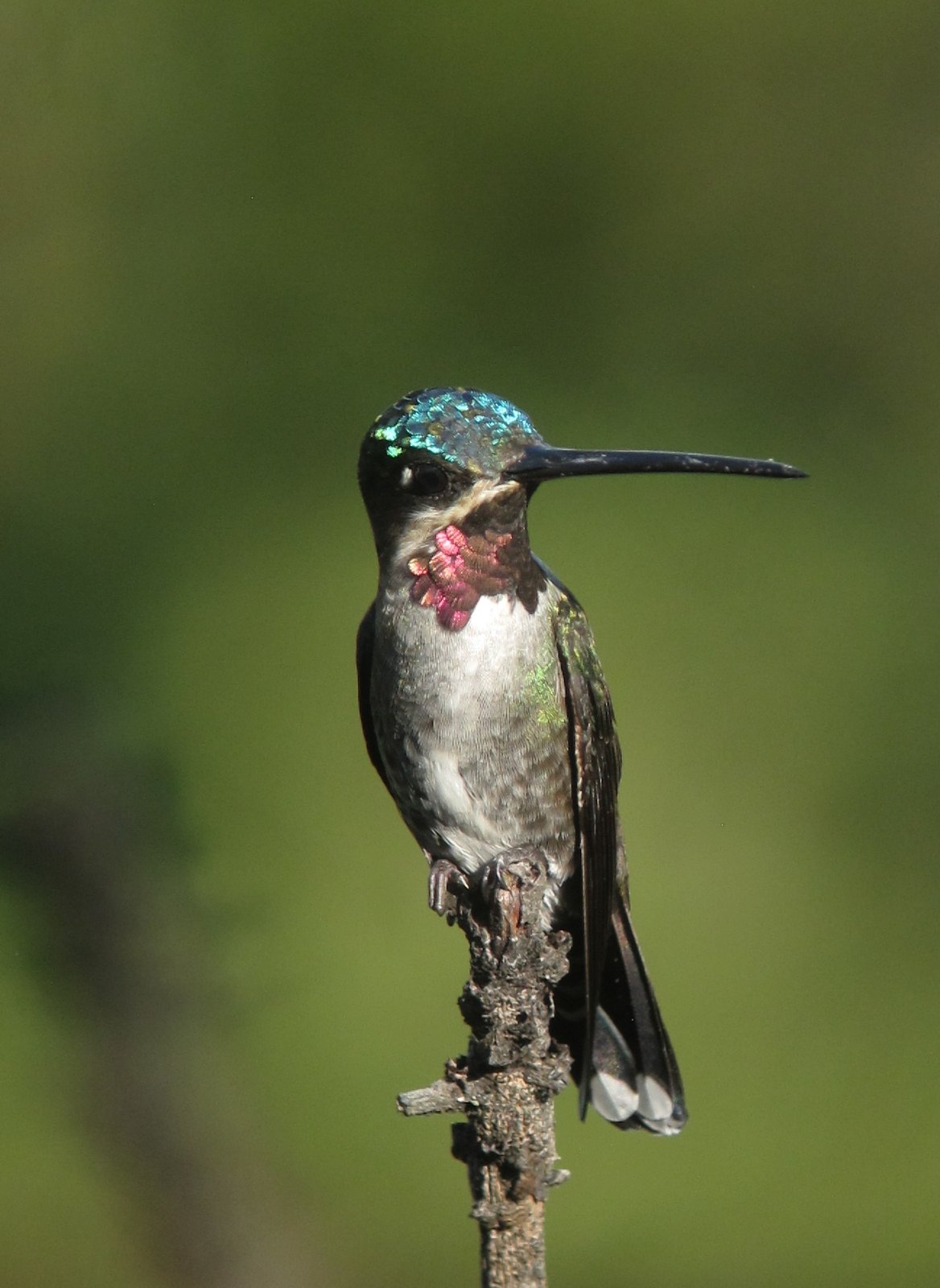
The Long-billed Starthroat is a medium-sized hummingbird of forest edges and semi-open lowlands, with a long, straight bill. The male has a rosy red gorget between white malar stripes and a glittering blue crown. It often sits for long periods on a bare branch high in a tree and catches insects in the air from there.
Voice
A sharp, high call, tseep or peek, repeated at intervals, and a soft, squeaky twittering.
Recording: JAYRSON ARAUJO DE OLIVEIRA — CC BY-NC-SA 4.0 · xeno-canto
Identification
11–12 cm, with a long (about 3.5 cm), straight, black bill and a rather short, square tail. The male is bronze-green above, with a glittering pale blue crown and a white stripe or patch on the lower back. The throat is glittering rosy red to magenta, bordered on each side by a conspicuous white malar stripe; the breast and flanks are grey, the centre of the belly whitish. The tail is dark with white tips to the outer feathers. The female has a green crown and a smaller, less glittering gorget. Young birds have a dull, slightly scaled throat. The forms of western Ecuador and northwestern Peru have whiter undertail coverts.
Confusion species
Blue-tufted Starthroat Heliomaster furcifer occurs only in the southeast of the guide area; the male has glittering blue underparts and long blue tufts on the sides of the neck, the female a forked tail. Black-throated Mango Anthracothorax nigricollis has a slightly decurved bill and a purplish red tail. Other medium-sized hummingbirds in the same habitat lack the combination of long straight bill, white malar stripe and red throat.
Habitat
Edges of humid and semi-humid forest, clearings, secondary forest, plantations, gardens and savanna with scattered trees, mostly below 1200 m, locally up to about 1800 m. It visits the flowers of trees such as Erythrina and Inga, often high in the canopy, and hawks many insects from a high, bare lookout. The nest is a small cup of plant down, covered on the outside with lichen, on a horizontal branch.
Where the bird is most at home, classified by the vegetation units of the Andes and the west coast.


Range and movements
In Colombia widespread in the lowlands west and east of the Andes and in the large valleys. In Ecuador in the western lowlands and in Amazonia in the east. In Peru in the northwest (Tumbes) and in the Amazonian lowlands east of the Andes. In Bolivia in the lowlands of the north and east. Absent from the Galápagos. Outside the guide area from Mexico through Central America to Venezuela, the Guianas and Brazil.
- Resident
- dark = core range, pale = thinly spread
How and when to look
Search along forest edges and clearings with flowering trees and check the bare tops of dead branches, where it sits still for long periods. The white malar stripe stands out even in silhouette.
Conservation status
Least Concern. The species has a very large range and also uses landscapes altered by people.
Scientific name
Heliomaster longirostris | (Audebert & Vieillot, 1801)
Audebert & Vieillot described the species in 1801 as Trochilus longirostris; because it was later moved to another genus, the author and year stand in brackets. The genus Heliomaster was introduced in 1850 by Bonaparte. The genus name combines Greek hēlios, 'sun', with mastēr, 'seeker'. The species name comes from Latin longus, 'long', and rostrum, 'bill'. The specimen the first description was based on came from Trinidad, Trinidad and Tobago.