All species › Swifts › Hummingbirds › Blue-tufted Starthroat
Blue-tufted Starthroat | Heliomaster furcifer
Roodvlaksterkeelkolibrie | Colibrí de barbijo | Bico-reto-azul
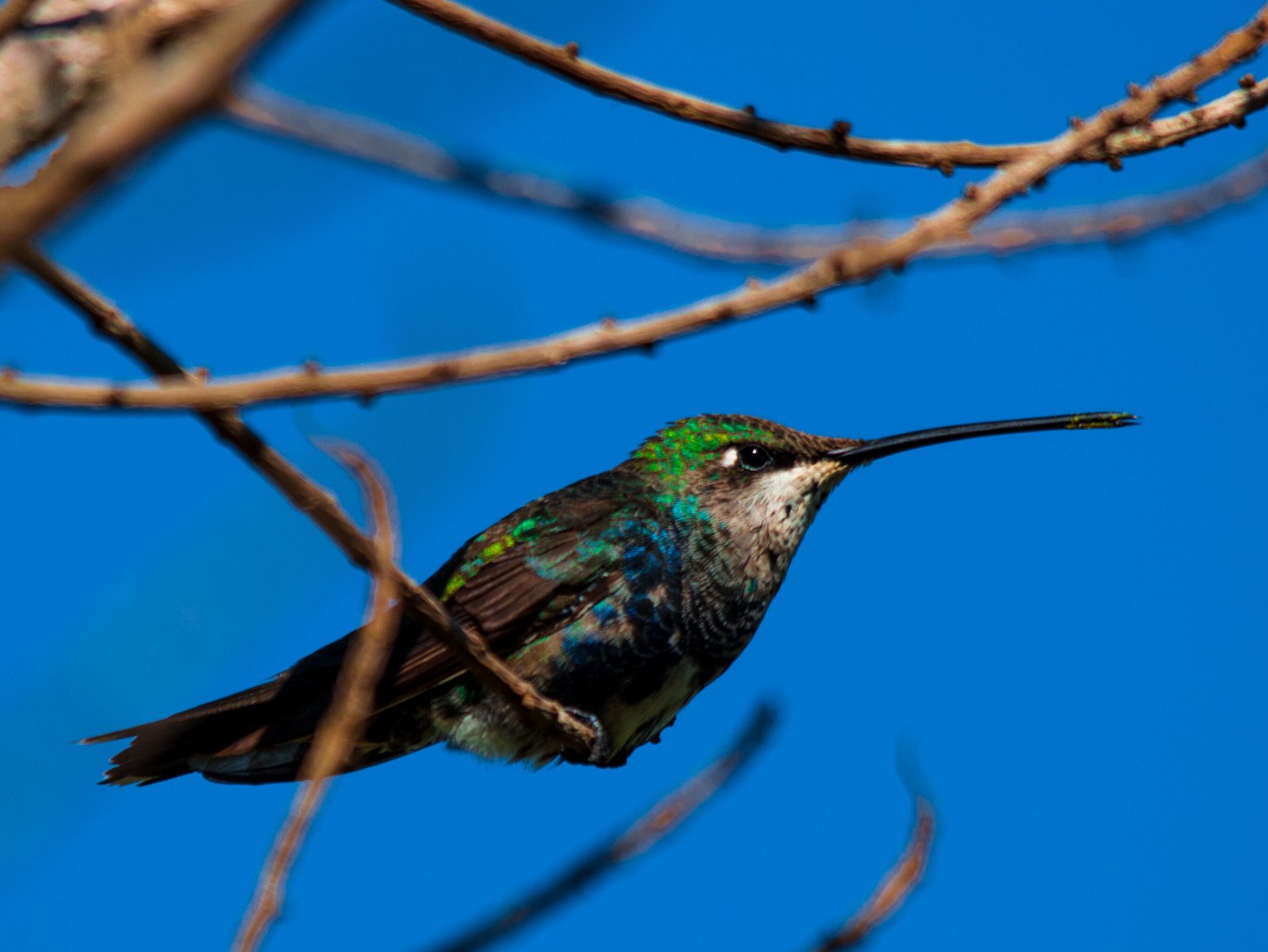
The Blue-tufted Starthroat is a starthroat of dry woodland, savanna and the Chaco in the southeast of the guide area. The male is glittering blue below, with a reddish purple throat and long blue tufts on the sides of the neck. Like Long-billed Starthroat it often sits on a high, bare branch.
Voice
A sharp, high call, tsip, often in flight, and a soft, dry twittering.
Recording: JAYRSON ARAUJO DE OLIVEIRA — CC BY-NC-SA 4.0 · xeno-canto
Identification
12–13 cm, with a long, straight, black bill and a forked tail. The male is bronze-green above, with a glittering green crown and a glittering reddish purple to magenta throat; long, glittering blue-violet tufts project from the sides of the neck. The breast and belly are glittering blue to blue-green. The tail is dark blue-green and clearly forked. The female is grey to greyish white below, with a white malar stripe, a dark cheek patch and white tips to the outer tail feathers. Outside the breeding season males partly resemble females.
Confusion species
Long-billed Starthroat Heliomaster longirostris has a square tail, a blue crown in the male and grey, not blue, underparts; females are best separated by tail shape. Gilded Sapphire Hylocharis chrysura has a red bill with a black tip and a golden copper tail. Males of Glittering-bellied Emerald Chlorostilbon lucidus are smaller, with a short, red bill.
Habitat
Dry woodland, Chaco forest, savanna and cerrado with scattered trees, gallery forest and forest edges, also parks and gardens, mainly in the lowlands, locally into the lower dry valleys of the Andes. It visits flowering trees and hawks insects from a high perch. The nest is a small cup of plant down with lichen on a horizontal branch.
Where the bird is most at home, classified by the vegetation units of the Andes and the west coast.


Range and movements
In Bolivia in the lowlands of the east and south (including Beni, Santa Cruz, Chuquisaca and Tarija); in the south it breeds mainly in the austral summer and some birds move north in winter. From Peru, Ecuador and Colombia there are at most a few isolated records from the Amazonian lowlands. Absent from the Galápagos. Outside the guide area in Paraguay, central and southern Brazil, Uruguay and northern Argentina.
- Resident
- dark = core range, pale = thinly spread
How and when to look
Search dry woodland and savanna around Santa Cruz and in the Bolivian Chaco at flowering trees, and check high bare branches. Males are most likely in the austral summer.
Conservation status
Least Concern. The species has a large range and also occurs in semi-open land altered by people.
Scientific name
Heliomaster furcifer | (Shaw, 1812)
Shaw described the species in 1812 as Trochilus Furcifer; because it was later moved to another genus, the author and year stand in brackets. The genus Heliomaster was introduced in 1850 by Bonaparte. The genus name combines Greek hēlios, 'sun', with mastēr, 'seeker'. The species name comes from Latin furca, 'fork', and -fer, 'bearing', after the forked tail. The specimen the first description was based on came from Paraguay.