All species › Swifts › Hummingbirds › Amethyst Woodstar
Amethyst Woodstar | Calliphlox amethystina
Amethistboself | Estrellita amatista | Estrelinha-ametista
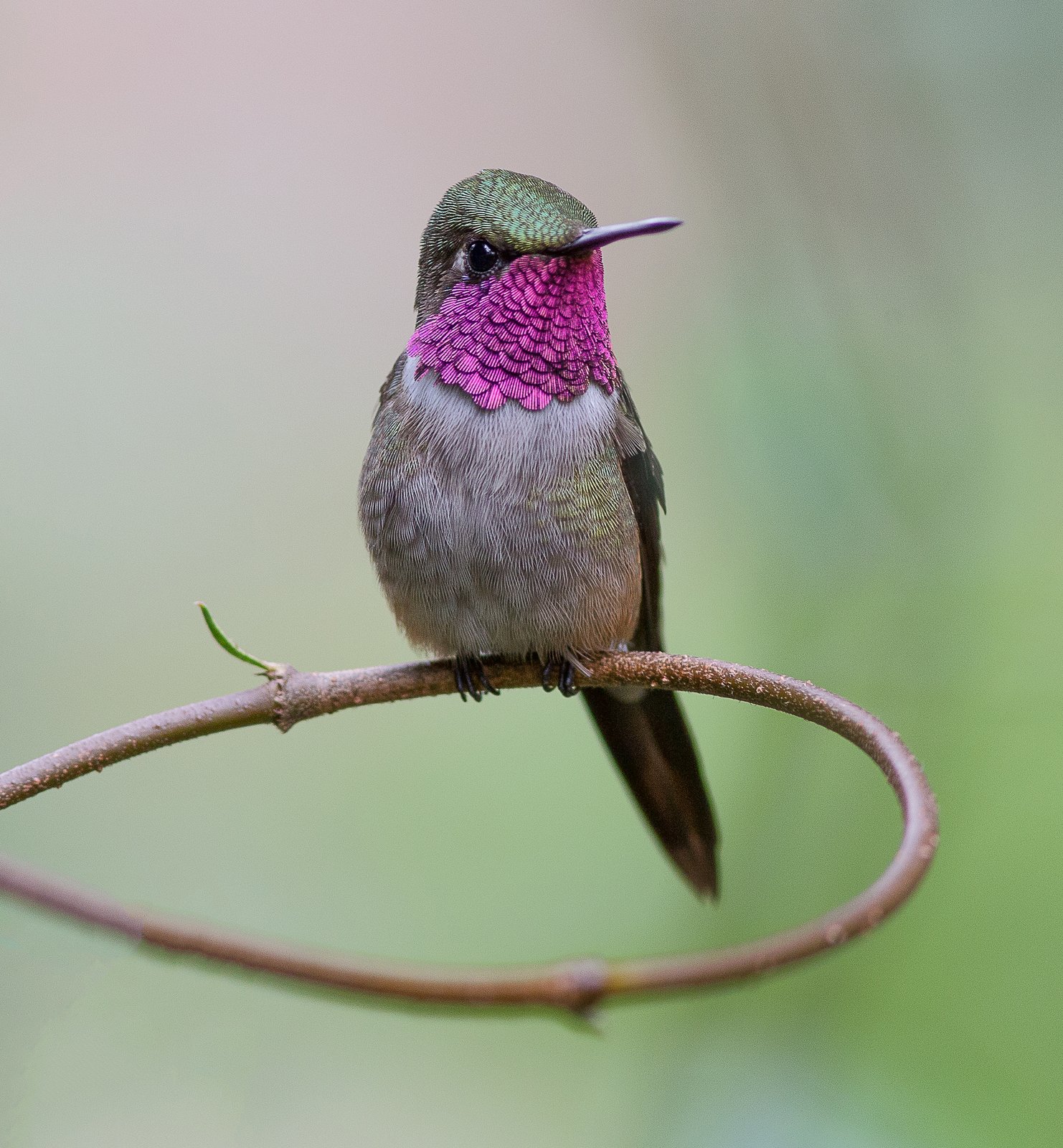
The Amethyst Woodstar is a very small hummingbird of forest edges and savannas in the lowlands east of the Andes. The male has a rosy purple throat above a white breast band and a deeply forked tail. It flies slowly and with a buzz, like a large bumblebee, from flower to flower.
Voice
High, thin tsit calls; the wings make a soft, bumblebee-like hum.
Recording: JAYRSON ARAUJO DE OLIVEIRA — CC BY-NC-SA 4.0 · xeno-canto
Identification
6–8 cm (the male is longer than the female because of its tail), with a short, straight, black bill. The male is dark bronze-green above, with a white patch on the side of the rump. The throat is glittering amethyst to rosy purple, with a broad white breast band below it; the rest of the underparts are grey-green with rufous flanks. The tail is long, deeply forked and purplish black. The female has a short, rounded tail with rufous and black bands, a white throat with dark speckles, a whitish breast band and cinnamon underparts. Young males at first resemble females.
Confusion species
Rufous-shafted Woodstar Chaetocercus jourdanii lives higher on the Andean slopes and has a shorter tail with rufous shafts. White-bellied Woodstar Chaetocercus mulsant of the Andes is largely white below and has a short tail. Female coquettes such as Festive Coquette Lophornis chalybeus have a white rump band and no white breast band.
Habitat
Forest edges, clearings, secondary forest, savanna and cerrado with shrubs, riverbanks and gardens, mainly in the lowlands and foothills up to about 1000 m, locally higher. It feeds at small flowers at low to middle height and catches small insects. Males defend a small perch near flowers. The nest is a tiny cup of plant down on a thin twig.
Where the bird is most at home, classified by the vegetation units of the Andes and the west coast.


Range and movements
In Colombia scattered in the lowlands east of the Andes. In Ecuador very scarce in the east. In Peru local in the lowlands and foothills east of the Andes. In Bolivia in the north and east, including the savannas of Beni and Santa Cruz. Absent from the Galápagos. The species appears to move locally with flowering; the details are poorly known. Outside the guide area in Venezuela, the Guianas, Brazil, Paraguay and northeastern Argentina.
- Resident
- dark = core range, pale = thinly spread
How and when to look
Check flowering shrubs along forest edges and in savannas, and watch for a very small hummingbird with a slow, insect-like flight. Males often sit on a thin bare twig close to the flowers.
Conservation status
Least Concern. The species has a very large range, but in the guide area it is local and mostly scarce.
Scientific name
Calliphlox amethystina | (Boddaert, 1783)
Boddaert described the species in 1783 as Trochilus amethystinus; because it was later moved to another genus, the author and year stand in brackets. The genus Calliphlox was introduced in 1831 by Boie. The genus name combines Greek kallos, 'beauty', with phlox, 'flame'. The species name comes from Latin amethystinus, 'amethyst-coloured', referring to the male's purple throat. The specimen the first description was based on came from Cayenne, French Guiana.