All species › Swifts › Hummingbirds › Peruvian Sheartail
Peruvian Sheartail | Thaumastura cora
Peruaanse schaarstaartkolibrie | Colibrí de Cora | Cauda-de-tesoura-peruano
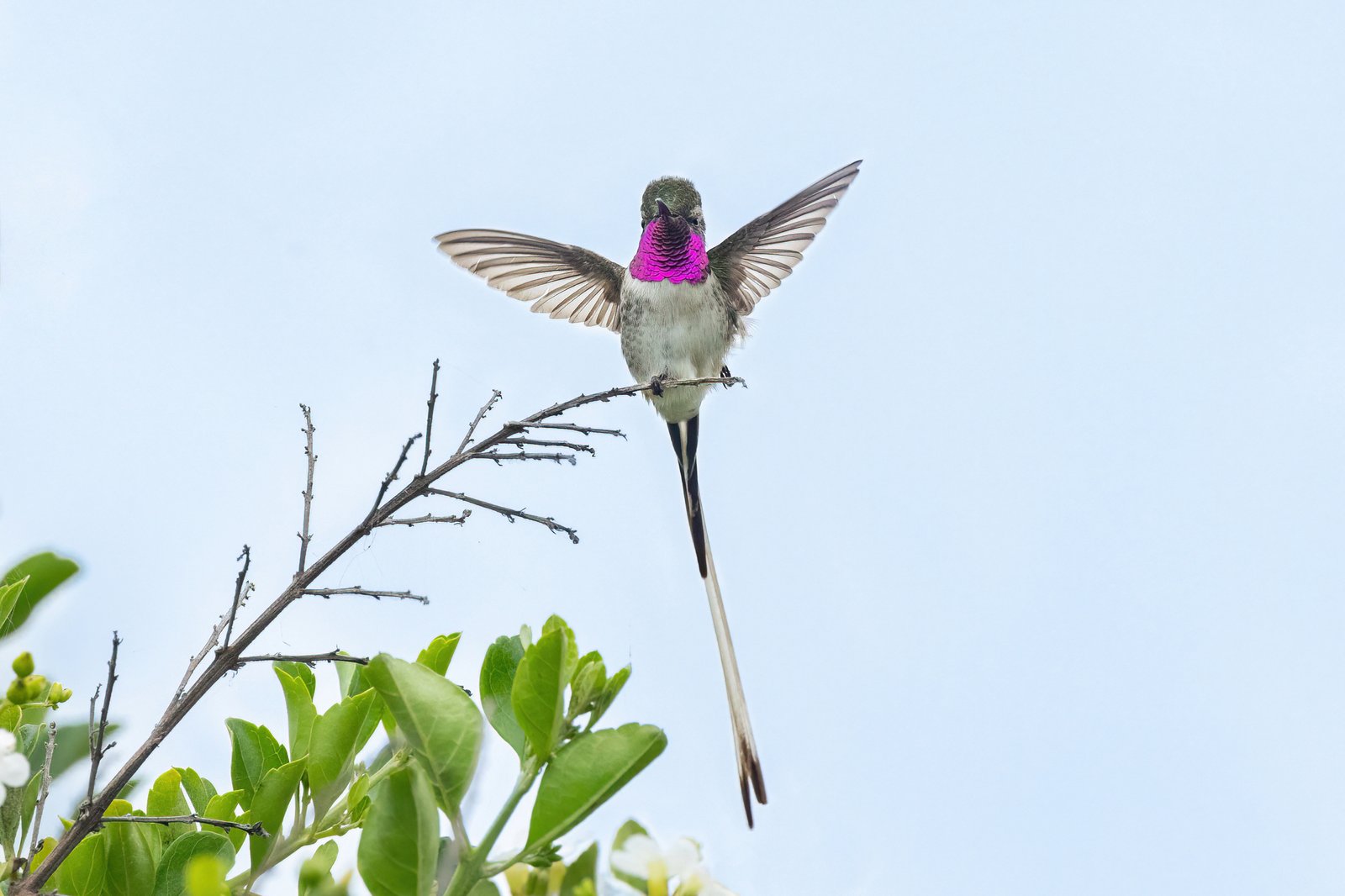
The Peruvian Sheartail is a very small hummingbird of the oases, river valleys and gardens of the Peruvian coastal desert. The male has two greatly elongated, largely white tail feathers that are almost as long as the rest of the bird. In display the male swings back and forth in front of the female, spreading its tail.
Voice
A short, dry tsik and rapid series of high, chirping notes; in display the tail feathers make a soft hum.
Recording: Ignacio Escobar — CC BY-NC-SA 4.0 · xeno-canto
Identification
Male 13–15 cm including the tail, female 7–8 cm, with a short, straight, black bill. The male is glossy green above and has a glittering magenta to rosy purple gorget with pointed side corners; the breast and belly are white, the flanks greenish. Two of the tail feathers are greatly elongated; they are white with a dark edge and tip and often diverge like scissors. The female is green above and white below with pale brown flanks, a dark ear patch and a short, rounded tail with a black band and white tips. Young males have a shorter tail and a speckled throat.
Confusion species
Oasis Hummingbird Rhodopis vesper is larger, with a long, slightly decurved bill and a cinnamon rump. The male Purple-collared Woodstar Myrtis fanny has a blue-green throat with a purple collar and no long tail feathers. Females can be confused with female Purple-collared Woodstar, which is more cinnamon below, and with Short-tailed Woodstar Myrmia micrura, which has an even shorter tail.
Habitat
Oases and irrigated farmland in the coastal desert, scrub along rivers, orchards, field edges, parks and gardens, also lomas and the dry western slope of the Andes, from sea level to about 2800 m. It feeds at the flowers of shrubs and herbs, often low down, and catches small insects. The nest is a small cup of plant down and spider silk on a twig.
Where the bird is most at home, classified by the vegetation units of the Andes and the west coast.


Range and movements
In Peru along the Pacific coast and in the river valleys of the western slope of the Andes, from the northwest to Tacna in the south. Absent from Colombia, Bolivia and the Galápagos; from Ecuador at most a few isolated records. Outside the guide area only in the far north of Chile, where the species has become established in recent decades.
- Resident
- dark = core range, pale = thinly spread
How and when to look
Search gardens, parks and flowering hedges in the coastal oases, for example around Lima and in the river valleys to the south. Watch for males flying past flowers with their long tail trailing behind.
Conservation status
Least Concern. The species benefits from irrigated farmland and gardens and has extended its range to the south.
Scientific name
Thaumastura cora | (Lesson & Garnot, 1827)
Lesson & Garnot described the species in 1827 as Orthorhynchus Cora; because it was later moved to another genus, the author and year stand in brackets. The genus Thaumastura was introduced in 1850 by Bonaparte. The genus name combines Greek thaumastos, 'wonderful', with oura, 'tail', after the male's long scissor-like tail. The species name refers to Cora, an Inca priestess of the sun in Jean Marmontel's novel Les Incas (1777). The specimen the first description was based on came from Between Callao and Lima, Peru.