All species › Swifts › Hummingbirds › Short-tailed Woodstar
Short-tailed Woodstar | Myrmia micrura
Kortstaartboself | Estrellita colicorta | Estrelinha-de-cauda-curta
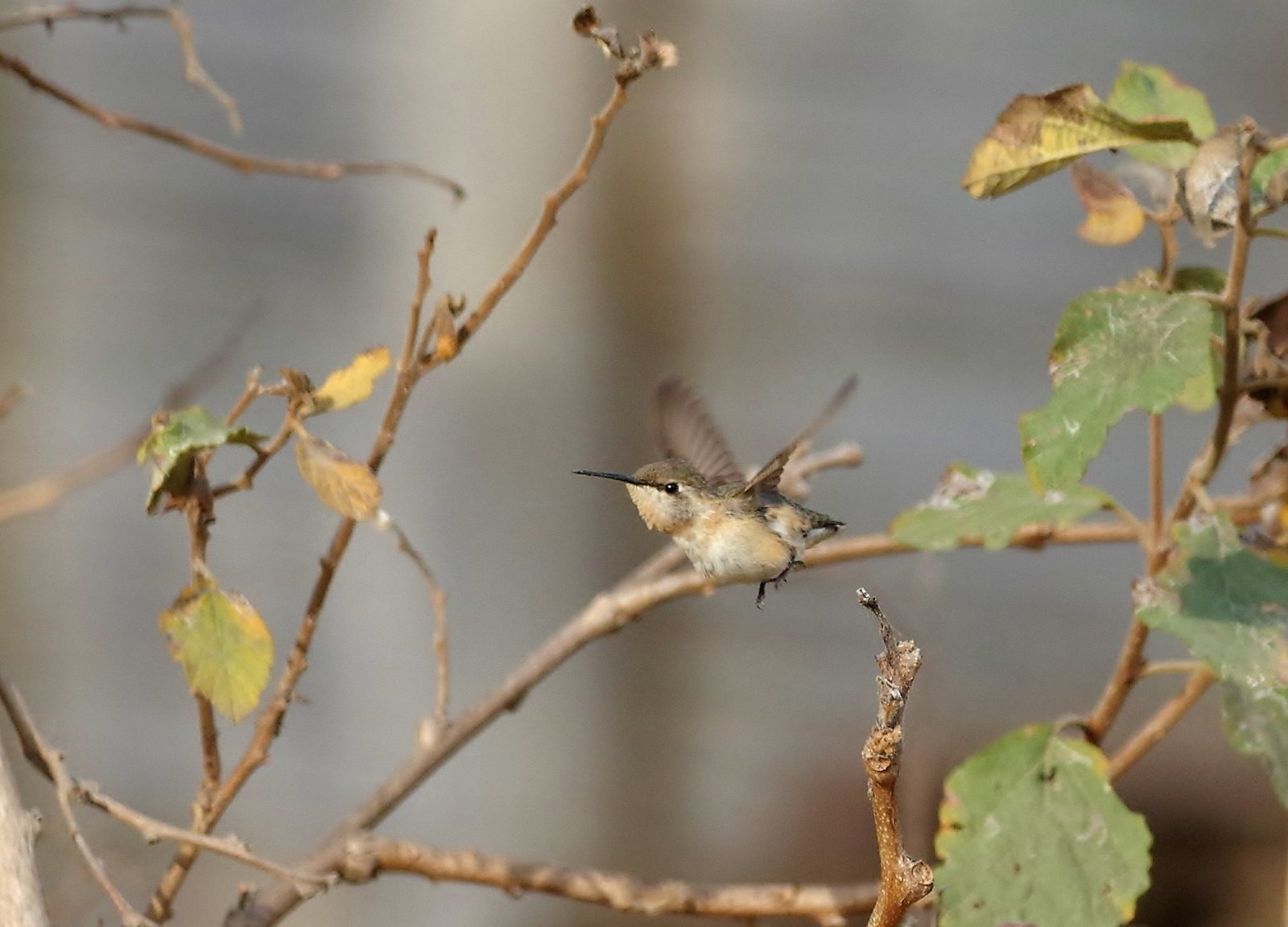
The Short-tailed Woodstar is one of the smallest hummingbirds of the guide area, with a tail that barely projects beyond the undertail coverts. It lives in the dry scrub and gardens of the Tumbesian region in southwestern Ecuador and northwestern Peru. In flight it resembles a large insect more than a bird.
Voice
High, thin tsit calls and a soft, dry twittering.
Recording: Paul Coopmans — CC BY-NC-SA 4.0 · xeno-canto
Identification
6–7 cm, with a short, straight, black bill and a very short tail. The male is grey-green above, with a glittering violet to purple gorget; the rest of the underparts are whitish with grey-green flanks. The short tail is dark, with white tips to the outer feathers. The female has no coloured gorget and is dull whitish to pale buff below, with a dark ear patch and also a short tail with white tips.
Confusion species
Purple-collared Woodstar Myrtis fanny has a longer, forked tail, a blue-green throat with a purple collar in the male, and lives mainly higher on the slopes. Little Woodstar Chaetocercus bombus and Esmeraldas Woodstar Chaetocercus berlepschi have a white breast band, rufous flanks or rump and a longer tail. Female Peruvian Sheartail Thaumastura cora has a longer tail with a clear black band.
Habitat
Dry scrub, dry forest with cacti, desert-like land with shrubs, field edges and gardens, from sea level to about 750 m, locally higher. It usually feeds low down at small flowers of shrubs and herbs and catches small insects. The nest is a very small cup of plant down on a thin twig in a shrub.
Where the bird is most at home, classified by the vegetation units of the Andes and the west coast.


Range and movements
In Ecuador in the dry western lowlands, mainly in Manabí, Santa Elena, Guayas, El Oro and lowland Loja. In Peru in the northwest, in Tumbes, Piura, Lambayeque and La Libertad. Absent from Colombia, Bolivia and the Galápagos. Not found outside the guide area.
- Resident
- dark = core range, pale = thinly spread
How and when to look
Search the dry scrub and gardens along the coast of southwestern Ecuador and northwestern Peru, and check low flowering shrubs. Watch for a tiny hummingbird with no visible tail.
Conservation status
Least Concern. The species has a small range, but also occurs in land altered by people and in gardens.
Scientific name
Myrmia micrura | (Gould, 1854)
Gould described the species in 1854 as Calothorax micrurus; because it was later moved to another genus, the author and year stand in brackets. The genus Myrmia was introduced in 1876 by Mulsant. The genus name comes from Greek muron, 'charming, sweet', and muia, 'fly', that is, a very small bird. The species name combines Greek mikros, 'small', with oura, 'tail', after the short tail. The specimen the first description was based on came from Peru.