All species › Swifts › Hummingbirds › Purple-collared Woodstar
Purple-collared Woodstar | Myrtis fanny
Purperkraagkolibrie | Estrellita gargantillada | Estrelinha-de-colar-roxo
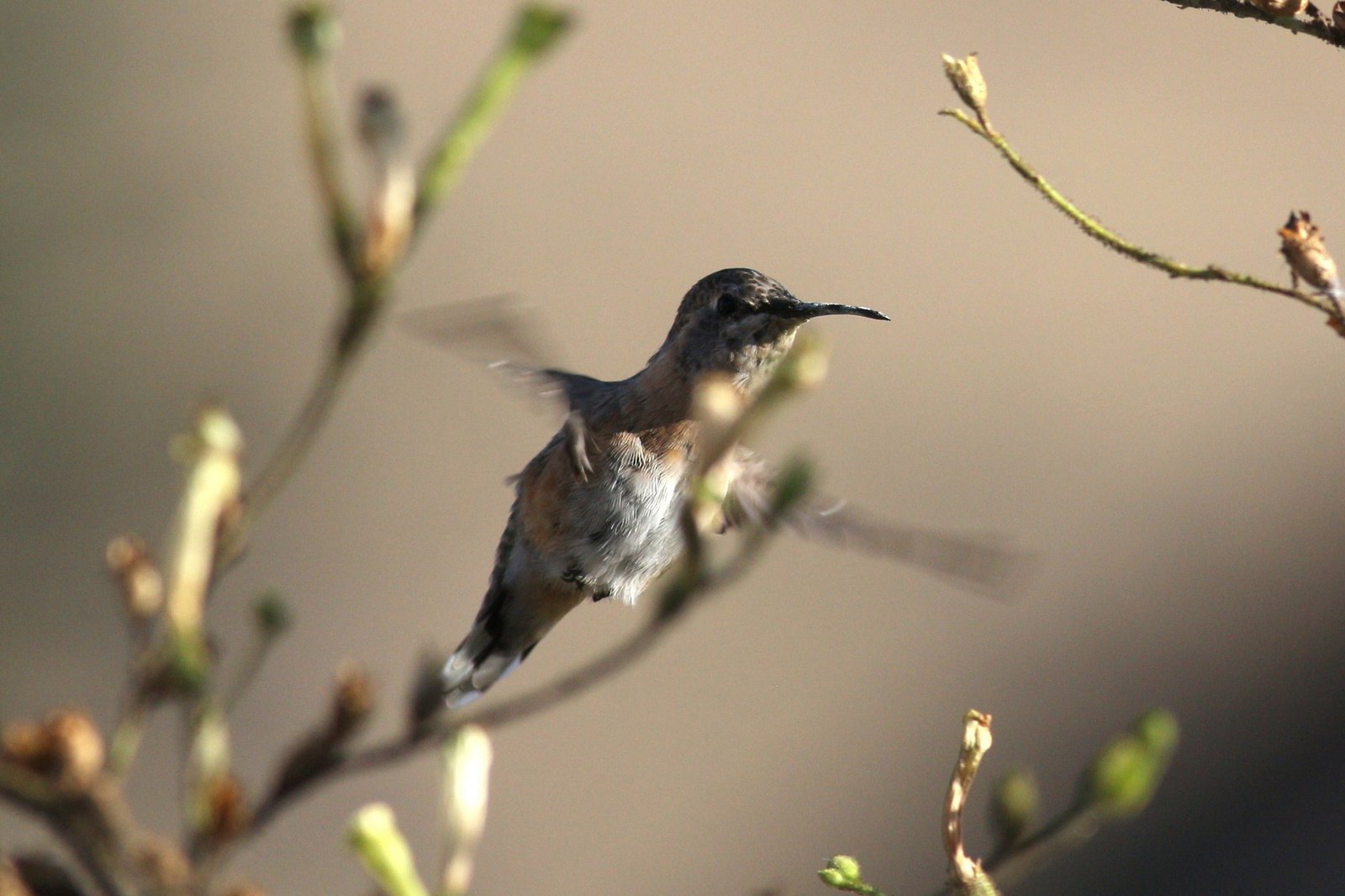
The Purple-collared Woodstar is a small hummingbird of the dry valleys and the western slope of the Andes, from southern Ecuador to southern Peru. The male has a glittering blue-green throat with a narrow purple collar below it. It is common in gardens, hedges and field edges in dry mountain areas.
Voice
High, thin tsit calls and a soft, dry rattle.
Recording: José María Loaiza B. — CC BY-NC-SA 4.0 · xeno-canto
Identification
7–9 cm, with a short, slightly decurved, black bill and a forked tail. The male is green above and has a small white spot behind the eye. The throat is glittering turquoise to blue-green, bordered below by a narrow, glittering purple band; the rest of the underparts are greyish white with greenish flanks. The tail is dark and forked. The female has cinnamon to pale buff underparts, a dark ear patch and a rounded tail with a black band and white tips.
Confusion species
Short-tailed Woodstar Myrmia micrura has a very short tail and, in the male, a violet throat without a collar; it lives mainly in the coastal lowlands. The male Peruvian Sheartail Thaumastura cora has a magenta throat and long white tail feathers; the female is whiter below. White-bellied Woodstar Chaetocercus mulsant has a white breast band and a white belly and lives in more humid montane forest.
Habitat
Dry scrub, shrubby slopes, hedges, fields and gardens in dry valleys and on the western slope of the Andes, mainly between about 500 and 3500 m, locally lower down close to the coast. It feeds at the flowers of shrubs and herbs, also of Eucalyptus and garden plants, and catches small insects. The nest is a small cup of plant down on a twig.
Where the bird is most at home, classified by the vegetation units of the Andes and the west coast.


Range and movements
In Ecuador in the south, in dry valleys of Loja, El Oro and Azuay among others. In Peru on the western slope of the Andes and in the dry valleys between the Andean ranges, including the Marañón valley, from the north to the south of the country. Absent from Colombia, Bolivia and the Galápagos. Hardly occurs outside Ecuador and Peru.
- Resident
- dark = core range, pale = thinly spread
How and when to look
Search gardens, hedges and flowering shrubs in dry mountain valleys, for example in the valleys around Cajamarca and Huánuco and on the western slope above Lima. Watch for the purple collar when the male sits in sunlight.
Conservation status
Least Concern. The species has a fairly large range and adapts to land altered by people.
Scientific name
Myrtis fanny | (Lesson, 1838)
Lesson described the species in 1838 as Ornismya Fanny; because it was later moved to another genus, the author and year stand in brackets. The genus Myrtis was introduced in 1854 by Reichenbach. The genus name refers to Myrtis, a Greek poetess from Boeotia (around 500 BC), teacher of Corinna and Pindar. The species name honours Françoise 'Fanny' Gouÿe de Longuemare, née Marsy (1796–1873), wife of the French naturalist Agathe-François Gouÿe de Longuemare. The specimen the first description was based on came from Peru.