All species › Swifts › Hummingbirds › Green-headed Hillstar
Green-headed Hillstar | Oreotrochilus stolzmanni
Peruaanse bergnimf | Estrella de cabeza verde | Estrela-de-cabeça-verde
The Green-headed Hillstar is the hillstar of the high Andes of northern and central Peru. It was long treated as a subspecies of the Andean Hillstar and is now regarded as a separate species. Like its relatives it survives cold nights in a deep torpor and often clings to flowers while feeding.
Voice
A high, sharp tseet and a dry twitter, especially in chases.
Recording: Niels Krabbe — CC BY-NC-SA 4.0 · xeno-canto
Identification
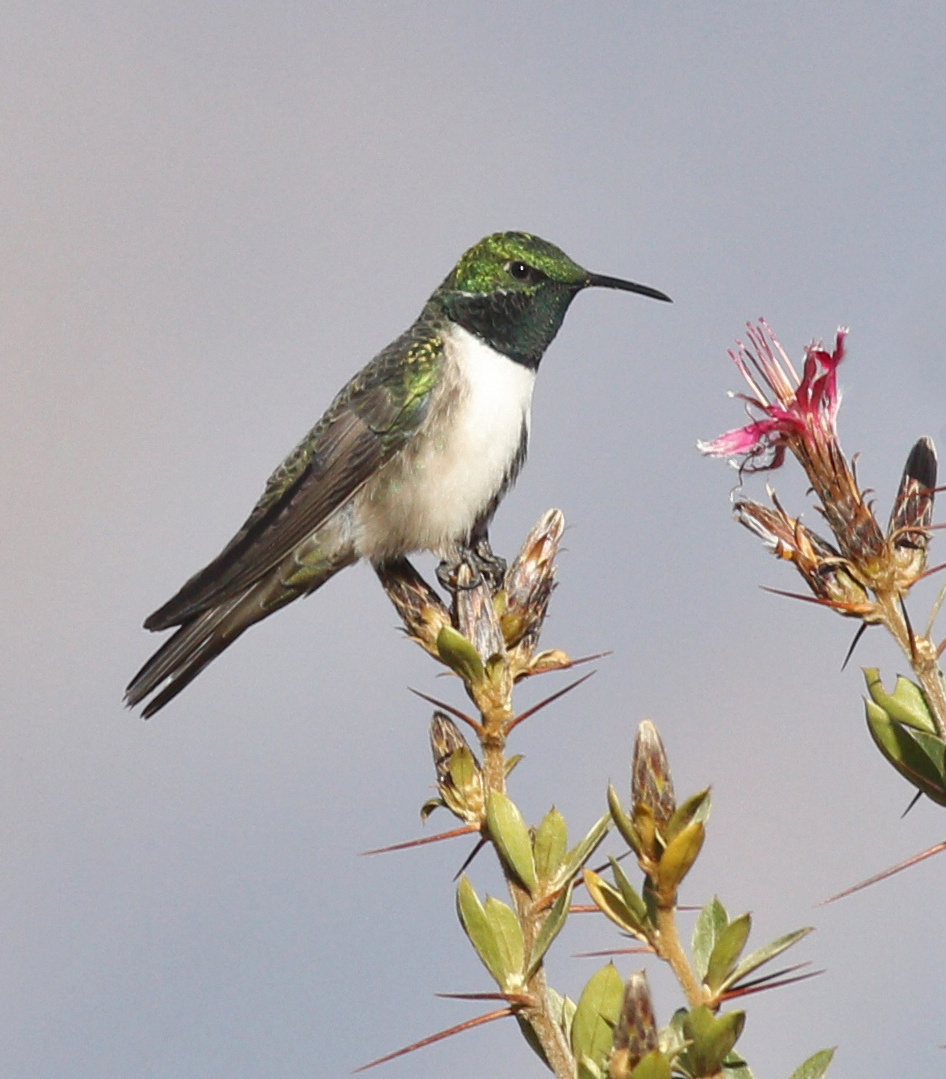
12–14 cm, with a short, slightly decurved black bill and strong feet. The male has a green head and a glittering green throat, bordered below by a narrow black band. The upperparts are olive-green to greyish green. The underparts are white, with a dark, almost black stripe down the centre of the belly. The tail is largely white, with dark outer edges and greenish central feathers. The female is greyish brown above and dingy white below, with a finely spotted throat and a dark tail with white corners.
Confusion species
Andean Hillstar Oreotrochilus estella replaces it in southern Peru; the male has a greyish brown head and a chestnut belly stripe. Black-breasted Hillstar Oreotrochilus melanogaster of central Peru has an entirely black breast and belly. Blue-throated Hillstar Oreotrochilus cyanolaemus of southern Ecuador has a blue throat. Females of these hillstars are very similar; range is decisive.
Habitat
Puna and jalca grassland, rocky slopes and ravines, Polylepis groves and shrubby slopes with flowering plants, roughly between 3000 and 4500 m. It visits mainly low flowering shrubs and herbs, such as Chuquiraga, and catches small insects. It roosts and nests in shelter under rock overhangs, in caves or in buildings; the nest is attached to a rock face or wall.
Where the bird is most at home, classified by the vegetation units of the Andes and the west coast.


Range and movements
In Peru in the Andes of the north and centre of the country, from Cajamarca southwards. In Ecuador at most in the far south; its status there is unclear. Absent from Colombia, Bolivia and the Galápagos. Does not occur outside the guide area.
- Resident
- dark = core range, pale = thinly spread
How and when to look
At flowering shrubs on rocky slopes and in ravines above the treeline in northern and central Peru, early in the morning when the birds become active after the cold night. It often perches on a boulder or low in a shrub.
Conservation status
Least Concern. Its habitat is extensive; grazing, fires and firewood collection can locally damage flowering shrubs and Polylepis groves.
Scientific name
Oreotrochilus stolzmanni | Salvin, 1895
Salvin described the species in 1895 and placed it straight away in the genus where it still stands. The genus Oreotrochilus was introduced in 1847 by Gould. The genus name combines Greek oros, 'mountain', with the hummingbird genus Trochilus. The species name honours Jan Sztolcman (Stolzmann, 1854–1928), a Polish zoologist who collected in Peru. The specimen the first description was based on came from Huamachuco and Cajamarca, Peru.