All species › Swifts › Hummingbirds › Blue-throated Hillstar
Blue-throated Hillstar | Oreotrochilus cyanolaemus
Blauwkeelbergnimf | Estrella de garganta azul | Estrela-de-garganta-azul
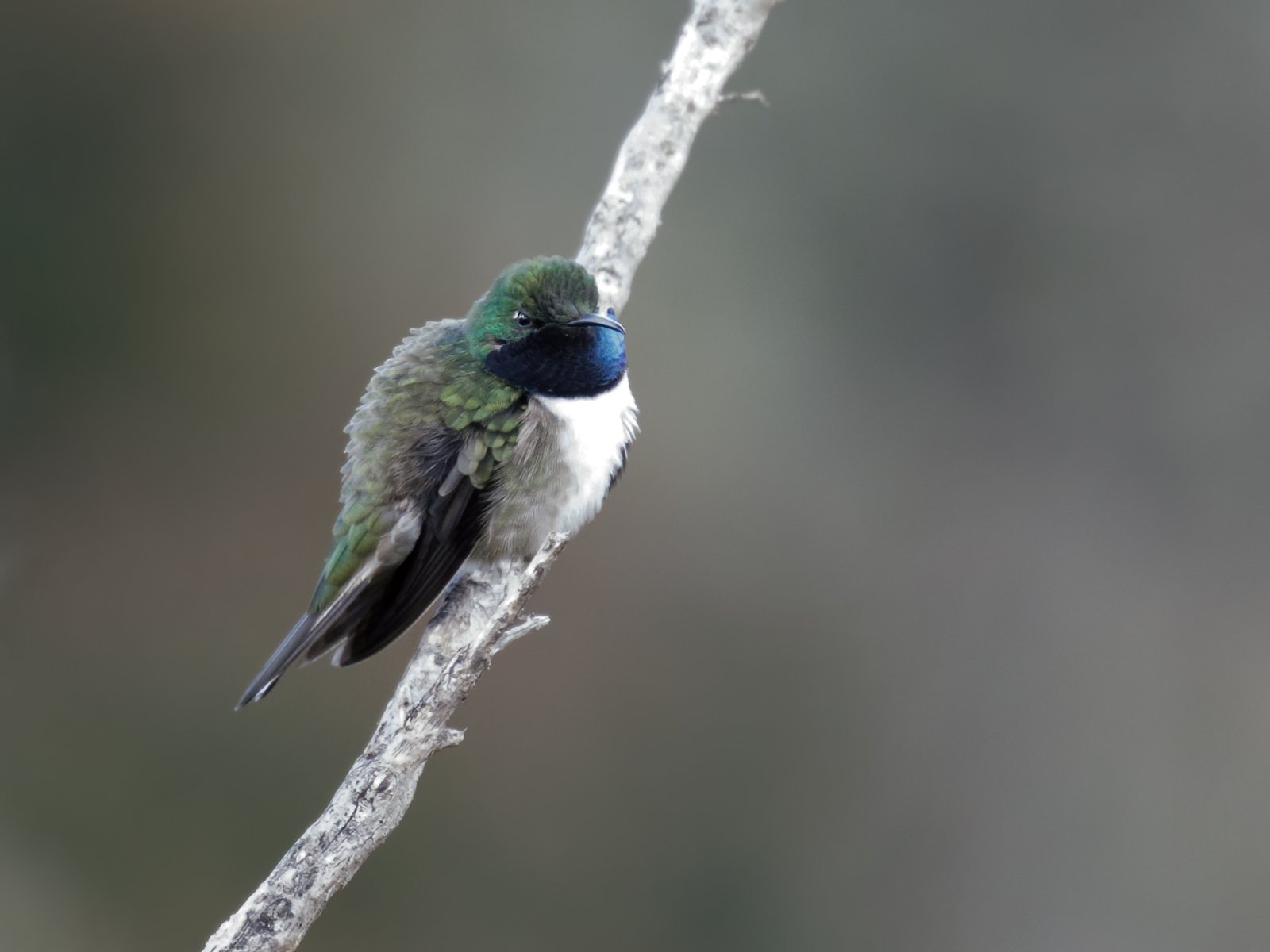
The Blue-throated Hillstar is a hillstar of the páramo of south-western Ecuador that was described as a species only in 2018. The male has a glittering ultramarine-blue throat. Its range covers only a few ridges, and the population is estimated at no more than a few hundred birds.
Voice
Varied, as in related hillstars: rapid series of high notes rising and falling in pitch, and single, short calls.
Recording: Niels Krabbe — CC BY-NC-SA 4.0 · xeno-canto
Identification
12–13 cm, with a short, slightly decurved, black bill. The male is emerald green above and on the head, with a glittering ultramarine-blue chin and throat, bordered by a narrow, velvety black collar. The breast and belly are dull white, with a black stripe down the centre of the belly; the tail is blue-black, with white on the underside. The female is green above and greyish buff below, with a spotted, greyish throat and white patches in the tail that vary between individuals.
Confusion species
Ecuadorian Hillstar Oreotrochilus chimborazo lives further north; the male has an entirely violet-blue head. Green-headed Hillstar Oreotrochilus stolzmanni occurs south of the range of this species, in northern Peru; the male has a glittering green throat. Rufous-gaped Hillstar Urochroa bougueri is larger, with a longer, straight bill and a rufous patch at the base of the bill, and lives lower along mountain streams.
Habitat
Grassy páramo with scattered shrubs, along streams on small ridges, rocky slopes and steep banks, up to about 3700 m. It feeds mainly at the flowers of Chuquiraga jussieui, also at ericads, often clinging sideways or upside down to the branches. It also catches small flies, partly in flight.
Where the bird is most at home, classified by the vegetation units of the Andes and the west coast.


Range and movements
In Ecuador only in a small area in the western Andes of the south-west, in the provinces of El Oro, Loja and Azuay, including Cerro de Arcos; the area lies between the Jubones valley in the north and the Puyango and Catamayo drainages in the south. Absent from Colombia, Peru, Bolivia and the Galápagos. Does not occur outside the guide area.
- Resident
- dark = core range, pale = thinly spread
How and when to look
On Cerro de Arcos in El Oro, at flowering Chuquiraga shrubs along streams in the páramo. Birds are most active when the sun breaks through after misty spells.
Conservation status
Critically Endangered. The population is very small and the range covers roughly 100 to 150 km². Fires, grazing and gold mining in the páramo threaten its habitat; conservation work is under way around Cerro de Arcos.
Scientific name
Oreotrochilus cyanolaemus | Sornoza-Molina, Freile, Nilsson, Krabbe & Bonaccorso, 2018
Sornoza-Molina, Freile, Nilsson, Krabbe & Bonaccorso described the species in 2018 and placed it straight away in the genus where it still stands. The genus Oreotrochilus was introduced in 1847 by Gould. The genus name combines Greek oros, 'mountain', with the hummingbird genus Trochilus. The species name combines Greek kuanos, 'dark blue', with laimos, 'throat', after the blue throat patch. The specimen the first description was based on came from Cerro de Arcos, El Oro, Ecuador.