All species › Swifts › Hummingbirds › Ecuadorian Hillstar
Ecuadorian Hillstar | Oreotrochilus chimborazo
Ecuadoraanse bergnimf | Estrella ecuatoriana | Estrela-do-equador
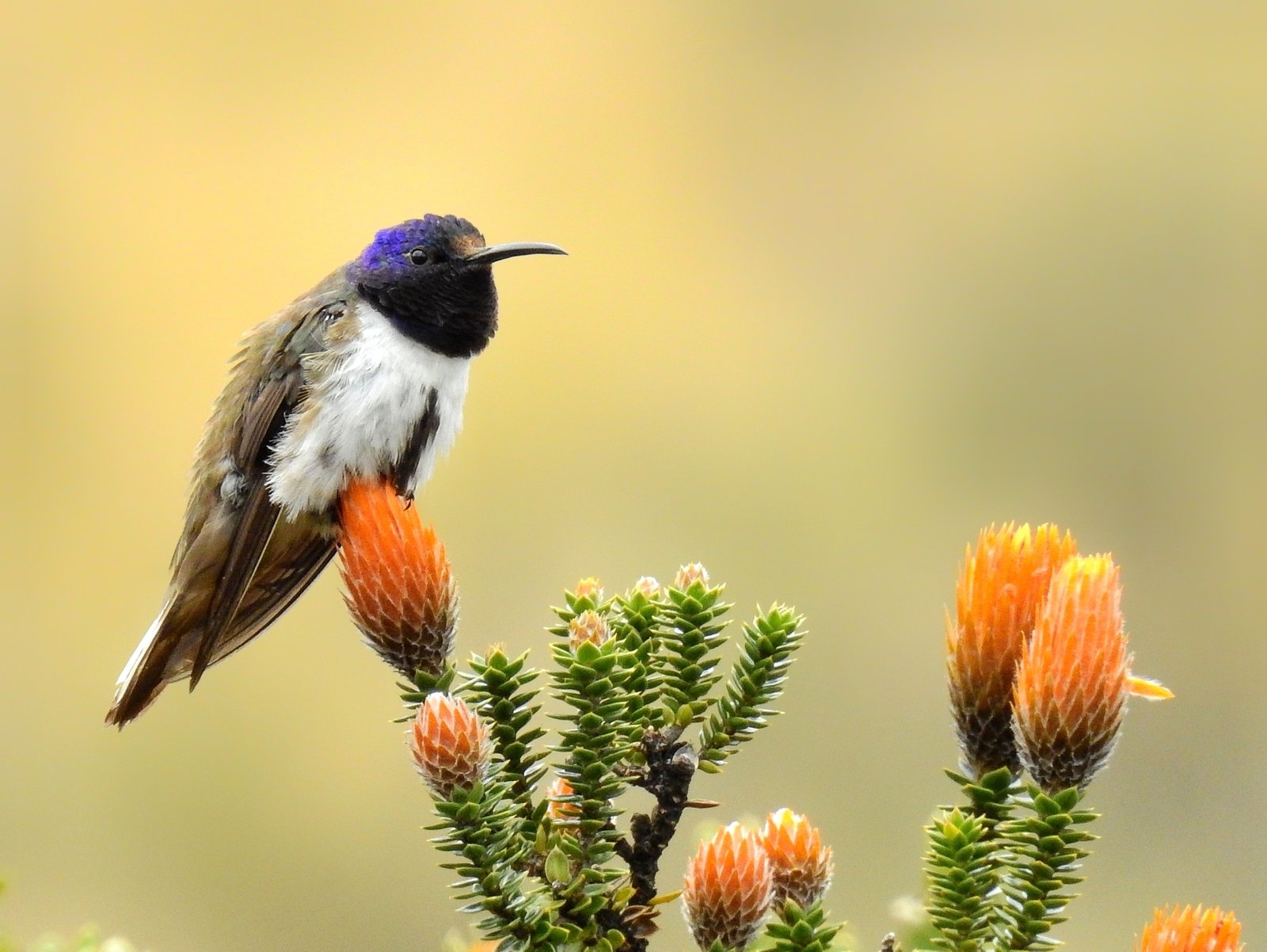
The Ecuadorian Hillstar is a hummingbird of the highest páramo of Ecuador, up to just below the snowline of volcanoes such as Chimborazo. The male stands out by its violet-blue head against the white underparts. The species is closely tied to the orange flowers of the shrub Chuquiraga jussieui.
Voice
A high, sharp tseet, also a rapid twitter in chases.
Recording: Juan Freile — CC BY-NC-SA 4.0 · xeno-canto
Identification
12–13 cm, with a short, slightly decurved black bill. The male has a glittering violet-blue head and throat; in birds on Chimborazo a green stripe runs down the centre of the throat. The upperparts are olive-green, and the underparts white with a dark stripe down the centre of the belly. The tail is largely white, with dark central feathers and outer edges. The female is greyish green above and dingy white below, with a spotted throat and white corners to the dark tail.
Confusion species
In the high páramo of Ecuador the male is unmistakable. Blue-mantled Thornbill Chalcostigma stanleyi lives in the same area, but is dark, with a very short bill and a long, dark tail. Tyrian Metaltail Metallura tyrianthina is smaller and green, with a rufous tail, and lives mainly lower, at the forest edge. Related hillstars occur only further south in Peru.
Habitat
High, open páramo with low shrubs and cushion plants, rocky slopes and scree up to the snowline, small Polylepis groves and the edges of cushion bogs, roughly between 3500 and 5000 m. It visits mainly the flowers of Chuquiraga jussieui, often clinging to them, and catches small insects. It roosts in deep torpor in sheltered places and nests under rock overhangs.
Where the bird is most at home, classified by the vegetation units of the Andes and the west coast.


Range and movements
In Ecuador in the high páramo of the Andes, from the north to the centre of the country. In Colombia only in the far south, on the border with Ecuador. Absent from Peru, Bolivia and the Galápagos. Does not occur outside the guide area.
- Resident
- dark = core range, pale = thinly spread
How and when to look
On the slopes of Chimborazo and Cotopaxi, where birds feed at flowering Chuquiraga shrubs. On cold, misty mornings they become active only when the sun breaks through.
Conservation status
Least Concern. A large part of its habitat lies within national parks, but fires and grazing in the páramo can damage the shrubs on which it depends.
Scientific name
Oreotrochilus chimborazo | (Delattre & Bourcier, 1846)
Delattre & Bourcier described the species in 1846 as Trochilus Chimborazo; because it was later moved to another genus, the author and year stand in brackets. The genus Oreotrochilus was introduced in 1847 by Gould. The genus name combines Greek oros, 'mountain', with the hummingbird genus Trochilus. The species name refers to the Chimborazo volcano in Ecuador. The specimen the first description was based on came from Chimborazo, Ecuador.