All species › Swifts › Hummingbirds › Green-tailed Trainbearer
Green-tailed Trainbearer | Lesbia nuna
Groenstaartkomeetkolibrie | Colacintillo coliverde | Cauda-de-fita-verde
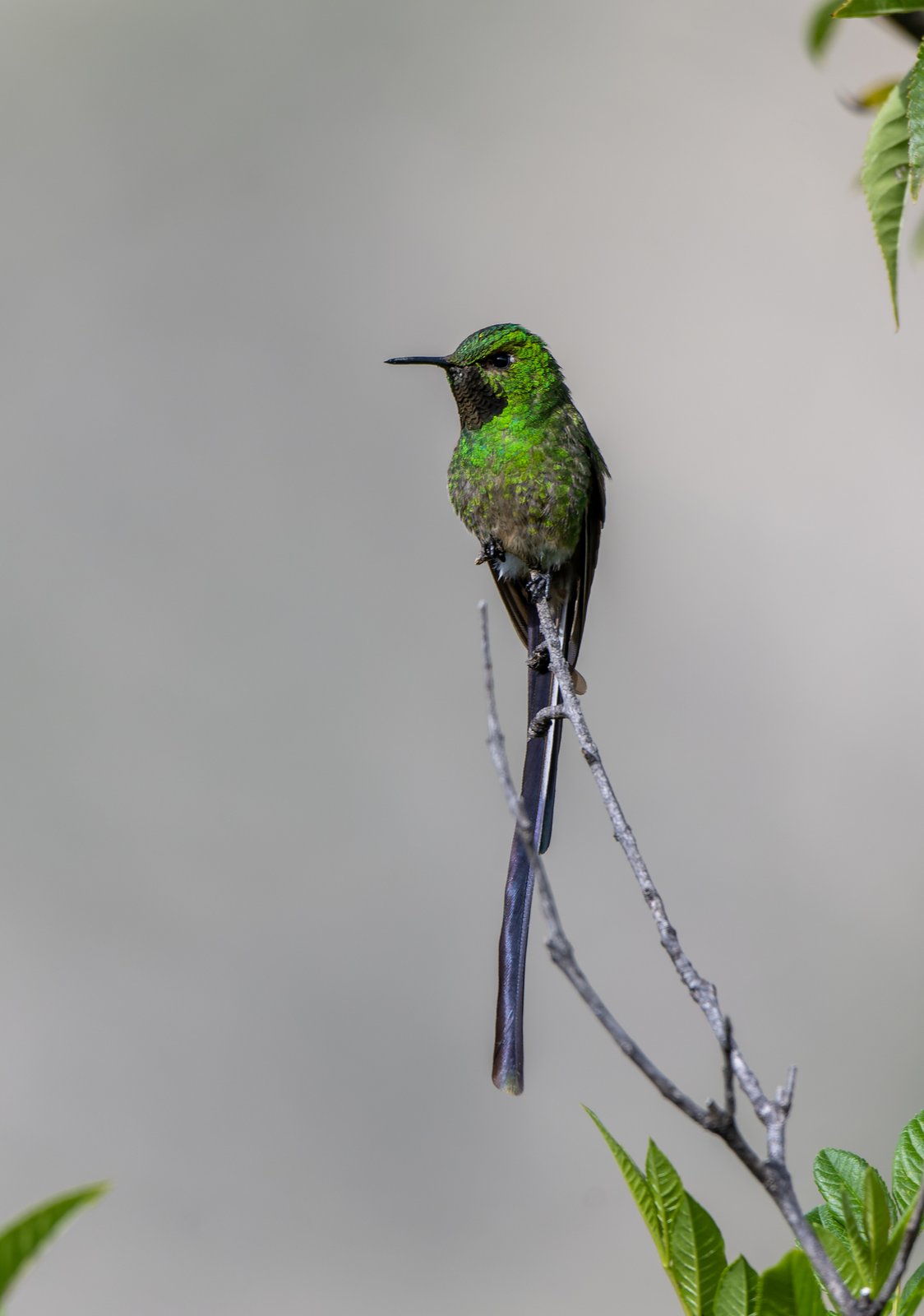
The Green-tailed Trainbearer is a small hummingbird with a very short bill, the male of which has a long, narrow, glittering green tail. It lives along forest edges and in shrubby country in the Andes, from Colombia to Bolivia. Where it occurs together with Black-tailed Trainbearer, it keeps more to the edges of forest and scrub.
Voice
A dry, high tsik and a soft, buzzy twitter. The tail feathers make a light rattling sound in flight.
Recording: Mauricio Cuellar Ramirez (@Birding.travel) — CC BY-NC-SA 4.0 · xeno-canto
Identification
Male 14–17 cm including the tail, female 10–11 cm; the bill is very short, straight and black, about 1 cm. The male is glossy green, with a glittering green throat. The long, deeply forked tail glitters emerald green, with a blackish base and small dark tips to the feathers. The female is green above and white below, with green spots, and has a shorter, forked, greenish tail. Juveniles resemble the female.
Confusion species
Black-tailed Trainbearer Lesbia victoriae is larger, with a much longer, black tail and a slightly longer bill, and more often lives in open, dry country. Long-tailed Sylph Aglaiocercus kingii is larger, with a tail glittering blue to violet, and the female has a rufous belly. The female resembles the female Purple-backed Thornbill Ramphomicron microrhynchum, but that has a forked, purplish-black tail with white tips.
Habitat
Forest edges, open woodland and scrub, secondary growth, shrubby slopes, hedgerows and gardens, roughly between 2000 and 3800 m, locally lower. It takes nectar from small flowers, often while perched, and catches small insects. The nest is a cup of moss and plant fibres, often under an overhang on a bank.
Where the bird is most at home, classified by the vegetation units of the Andes and the west coast.


Range and movements
In Colombia mainly in the Eastern Cordillera, locally elsewhere. In Ecuador locally in the Andes, mainly in the north and the south. In Peru along both slopes and in the valleys between the ranges over most of the country. In Bolivia on the eastern slope in La Paz and Cochabamba. Absent from the Galápagos. Outside the guide area in western Venezuela.
- Resident
- dark = core range, pale = thinly spread
How and when to look
Along forest edges and in shrubby gardens in the Andes of Peru, for example around Cuzco and in the Urubamba valley. Males often sit on a bare twig; note the short bill and the green tail.
Conservation status
Least Concern. The species has a large range and tolerates semi-open, disturbed country.
Scientific name
Lesbia nuna | (Lesson, 1832)
Lesson described the species in 1832 as Ornismya nuna; because it was later moved to another genus, the author and year stand in brackets. The genus Lesbia was introduced in 1833 by Lesson. The genus name comes from Greek Lesbias, 'woman of Lesbos'. The species name refers to Nouna-Koali, an Indian maiden in Jean F. Denis's novel Ismaël Ben Kaïzar ou la découverte du Nouveau Monde (1829). The specimen the first description was based on came from Peru.