All species › Swifts › Hummingbirds › Black-tailed Trainbearer
Black-tailed Trainbearer | Lesbia victoriae
Zwartstaartkomeetkolibrie | Colacintillo colinegro | Cauda-de-fita-preta
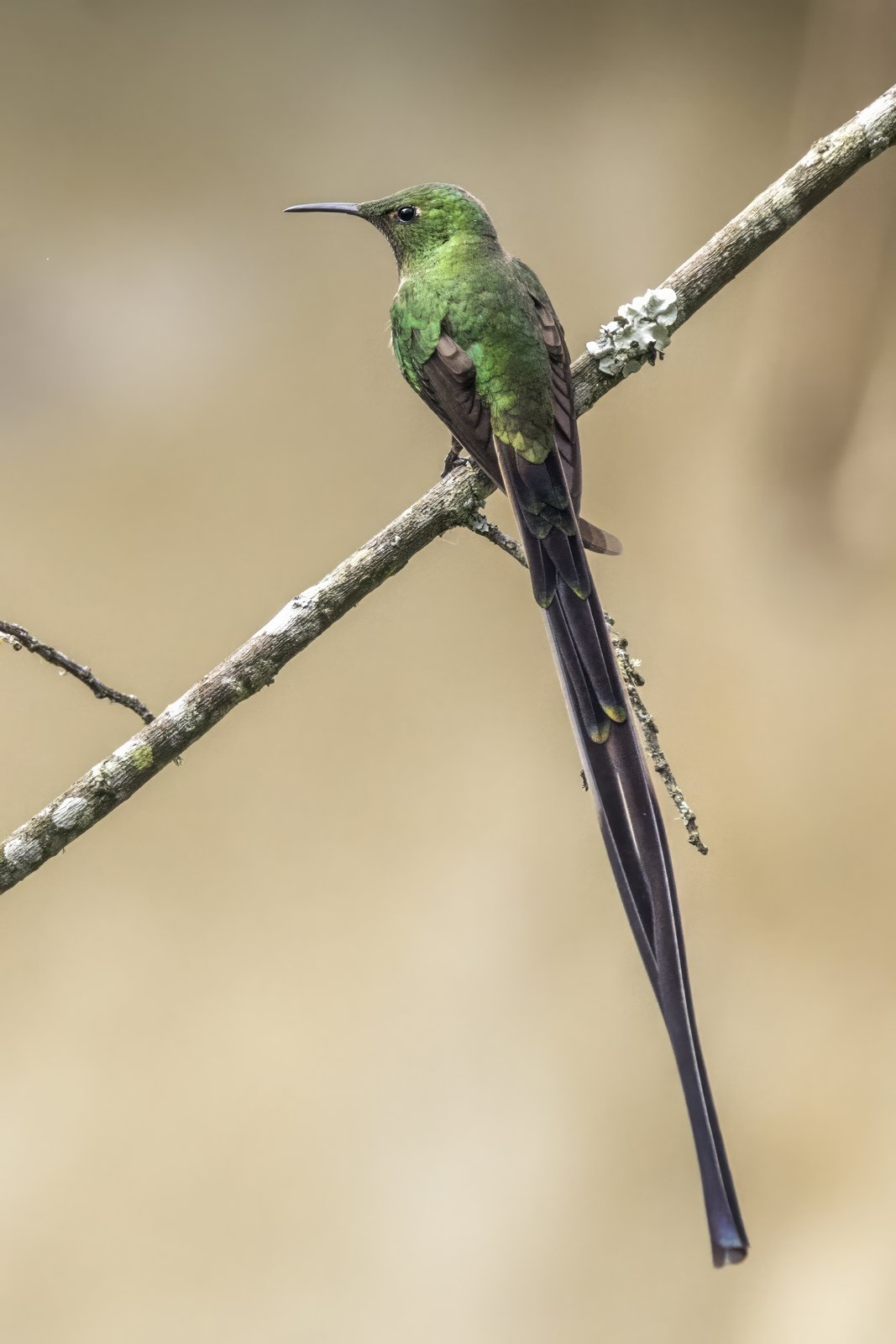
The Black-tailed Trainbearer is a hummingbird of open, shrubby country in the higher valleys of the Andes, the male of which has a tail almost three times as long as its body. In flight the long, narrow tail feathers look like a train. The species is common in gardens and parks of cities such as Quito and Bogotá.
Voice
A dry, buzzy dzzeet and a series of short, dry notes. In flight the tail feathers make an audible crackling or rattling sound, especially during the male's dive displays.
Recording: José María Loaiza B. — CC BY-NC-SA 4.0 · xeno-canto
Identification
Male 23–26 cm including the tail, female 14–15 cm; the bill is short, thin, straight and black. The male is green above, with a glittering green throat and paler, green-spotted underparts. The very long, deeply forked tail is black, with small green tips to the feathers. The female is green above and white below, densely marked with green spots, with a shorter, also forked, dark tail. Juveniles resemble the female.
Confusion species
Green-tailed Trainbearer Lesbia nuna is smaller, with a shorter, glittering green tail and an even shorter bill, and lives more at forest edges. Long-tailed Sylph Aglaiocercus kingii has a broader tail glittering blue to violet and is darker, and the female has a rufous belly. Red-tailed Comet Sappho sparganurus lives in Bolivia and has a coppery red tail.
Habitat
Shrubby slopes, dry valleys between the ranges, hedgerows, field edges, parks and gardens, locally shrubby páramo and Polylepis groves, roughly between 2500 and 4000 m. It visits a wide variety of flowers, including those of planted shrubs, and catches small insects. The nest is a cup of plant fibres and moss, often under an overhang or in a dense shrub.
Where the bird is most at home, classified by the vegetation units of the Andes and the west coast.


Range and movements
In Colombia in the Eastern Cordillera, including the Bogotá plateau, and in the south in Nariño. In Ecuador in the valleys between the ranges throughout the country. In Peru in the Andes south to Cuzco and Puno. In Bolivia only a few reports. Absent from the Galápagos. Does not occur outside the guide area.
- Resident
- dark = core range, pale = thinly spread
How and when to look
In parks and gardens of Quito and in the shrubby valleys around the city, but also along hedgerows and field edges in the Andes of Peru. Males often sit on an exposed twig or wire with the long tail hanging down.
Conservation status
Least Concern. The species tolerates agricultural and urban landscapes well and has a large range.
Scientific name
Lesbia victoriae | (Bourcier & Mulsant, 1846)
Bourcier & Mulsant described the species in 1846 as Trochilus Victoriae; because it was later moved to another genus, the author and year stand in brackets. The genus Lesbia was introduced in 1833 by Lesson. The genus name comes from Greek Lesbias, 'woman of Lesbos'. The species name honours Marie Anne Victoire Mulsant, née Jacquetton (1777–1854), mother of the French ornithologist Martial Mulsant, one of the describers. The specimen the first description was based on came from (per the description).