All species › Swifts › Hummingbirds › Purple-backed Thornbill
Purple-backed Thornbill | Ramphomicron microrhynchum
Purperrugdoornsnavel | Picoespina dorsipúrpura | Bico-de-espinho-de-dorso-roxo
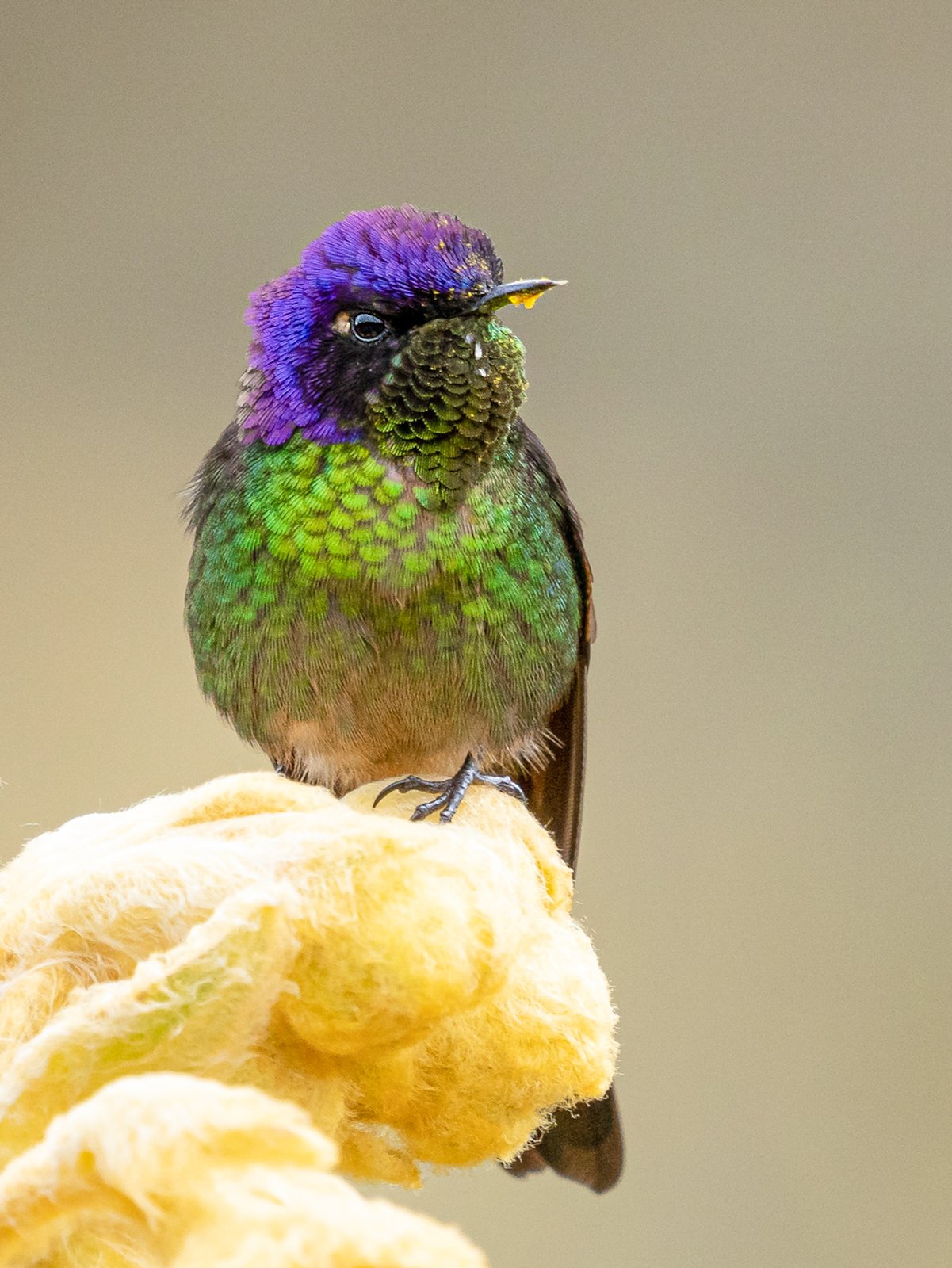
The Purple-backed Thornbill is a small hummingbird with the shortest bill of any hummingbird in the guide area. The male has a glossy purple back and a glittering green throat. With its short bill it often takes nectar through holes that flowerpiercers Diglossa have made at the base of flowers.
Voice
A soft, dry tsik; in flight a low, almost insect-like hum of the wings.
Recording: Olaf Jahn — CC BY-NC-SA 4.0 · xeno-canto
Identification
8–9 cm, with a very short, straight, black bill of about 5 mm. The male has glossy violet-purple upperparts, a glittering golden-green throat and dark green underparts. The tail is fairly long, forked and purplish black. The female is green above and white to pale buff below, densely marked with green spots, and has white tips to the outer tail feathers. Juveniles resemble the female.
Confusion species
Black-backed Thornbill Ramphomicron dorsale lives only in the Sierra Nevada de Santa Marta and has a black back. Rainbow-bearded Thornbill Chalcostigma herrani is larger, with a rufous crown, a narrow, multicoloured throat stripe and white tail tips. Tyrian Metaltail Metallura tyrianthina is green above, with a longer bill and a rufous to coppery tail. The female resembles those of the coquettes Lophornis, but these live lower and have a pale band across the rump.
Habitat
The edges and clearings of cloud forest and upper montane forest, elfin forest at the treeline, shrubby páramo and scrub, roughly between 1700 and 3600 m, mostly above 2400 m. It takes nectar from small flowers, often while perched, and uses holes in long-tubed flowers; it also catches small insects. It wanders with the flowering of plants.
Where the bird is most at home, classified by the vegetation units of the Andes and the west coast.


Range and movements
In Colombia in all three cordilleras and in the Serranía del Perijá. In Ecuador on both slopes of the Andes. In Peru along the eastern slope and locally in the north of the western slope. In Bolivia scarce, in the north-west. Absent from the Galápagos. Outside the guide area in the Andes of Venezuela.
- Resident
- dark = core range, pale = thinly spread
How and when to look
At flowering shrubs along forest edges in upper montane forest, such as around Papallacta and Yanacocha in Ecuador. Birds often appear unexpectedly at flowers and are gone again after a short time.
Conservation status
Least Concern. The species has a large range and tolerates forest edges and scrub, but occurs locally and in fluctuating numbers.
Scientific name
Ramphomicron microrhynchum | (Boissonneau, 1840)
Boissonneau described the species in 1840 as Ornismya microrhyncha; because it was later moved to another genus, the author and year stand in brackets. The genus Ramphomicron was introduced in 1850 by Bonaparte. The genus name comes from Greek rhamphos, 'bill', and mikros, 'small'. The specific name comes from Greek mikros, 'small', and rhunkhos, 'bill': small-billed. The specimen the first description was based on came from Bogotá, Colombia.