All species › Swifts › Hummingbirds › Black-backed Thornbill
Black-backed Thornbill | Ramphomicron dorsale
Zwartrugdoornsnavel | Picoespina dorsinegro | Bico-de-espinho-de-dorso-preto
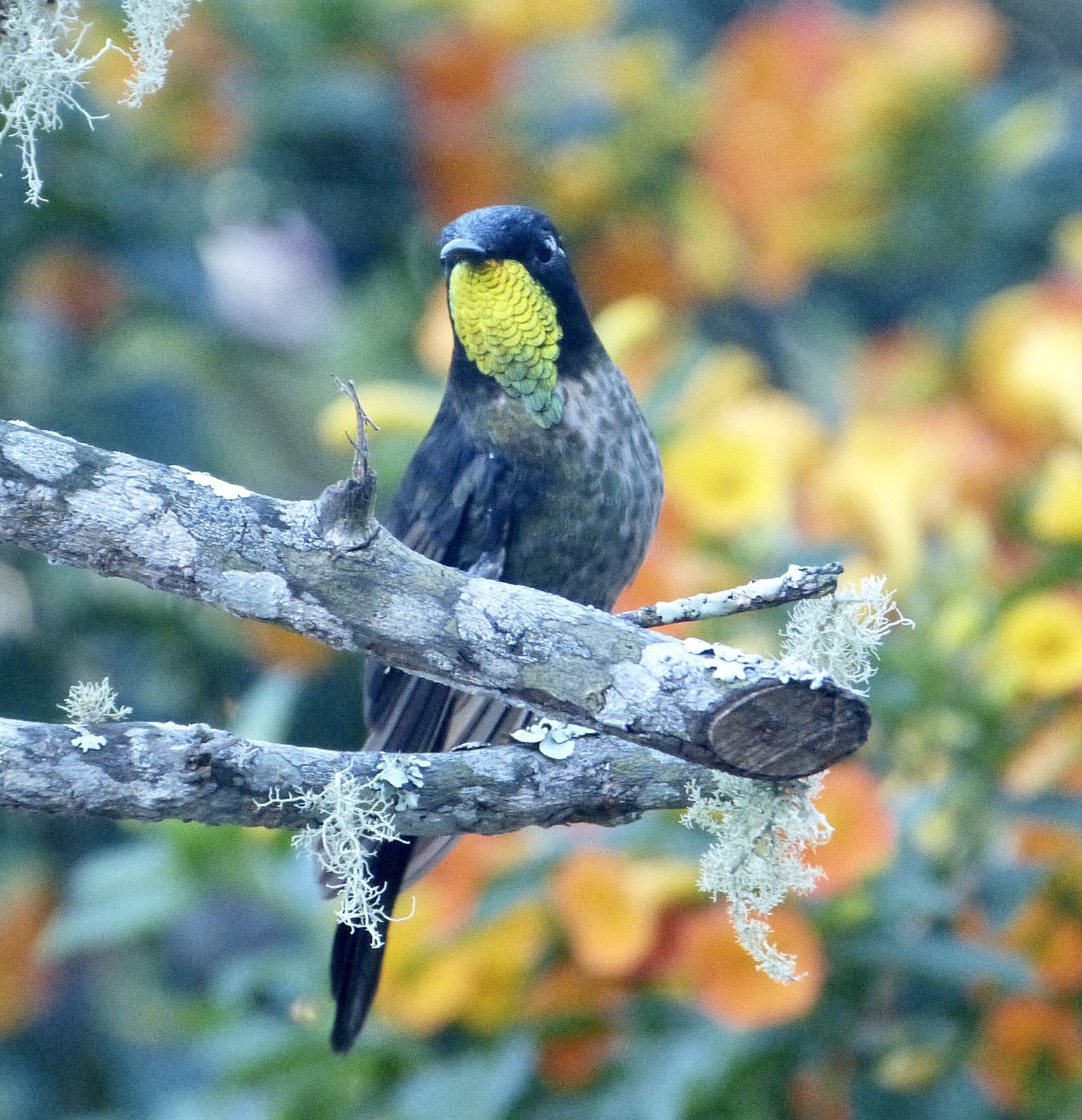
The Black-backed Thornbill is a small hummingbird with a very short bill, found only in the Sierra Nevada de Santa Marta in northern Colombia. The male is largely black above. The species lives in the highest part of the range, in páramo and at the upper edge of the forest.
Voice
A soft, dry tsik and short, high chirps; in flight a low, humming wing sound.
Recording: Andrew Spencer — CC BY-NC-SA 3.0 · xeno-canto
Identification
8–9 cm, with a very short, straight, black bill of less than a centimetre. The male has blackish upperparts, a glittering olive-green to golden-green throat and dark, brownish underparts. The tail is long for a bird of this size, forked and purplish black. The female is bronzy green above and white below, with green spots, and has white tips to the outer tail feathers. Juveniles resemble the female.
Confusion species
Purple-backed Thornbill Ramphomicron microrhynchum does not occur in the Sierra Nevada de Santa Marta; the male has a purple back. Tyrian Metaltail Metallura tyrianthina lives in the same mountains, but is green, with a longer bill and a rufous to coppery tail. Blue-bearded Helmetcrest Oxypogon cyanolaemus lives in the high páramo of the same range, but is larger, with a crest and a white beard with blue in the centre.
Habitat
Shrubby páramo, the edges of elfin forest and cloud forest and scrub on open slopes, roughly between 2000 and 4600 m, most records above 3000 m. It takes nectar from low shrubs and flowering trees, often perching at the flower, and catches small insects. It may move up and down the slopes with the flowering of plants.
Where the bird is most at home, classified by the vegetation units of the Andes and the west coast.


Range and movements
In Colombia only in the Sierra Nevada de Santa Marta. Absent from Ecuador, Peru, Bolivia and the Galápagos. Does not occur outside the guide area.
- Resident
- dark = core range, pale = thinly spread
How and when to look
In the upper part of the Sierra Nevada de Santa Marta, for example along the road to the San Lorenzo ridge above Minca. Watch for small hummingbirds at flowering shrubs along the forest edge and in the páramo.
Conservation status
Near Threatened. The range is small and confined to a single mountain massif. Fires, grazing and deforestation in the highlands affect its habitat, although a large part lies within the national park.
Scientific name
Ramphomicron dorsale | Salvin & Godman, 1880
Salvin & Godman described the species in 1880 and placed it straight away in the genus where it still stands. The genus Ramphomicron was introduced in 1850 by Bonaparte. The genus name comes from Greek rhamphos, 'bill', and mikros, 'small'. The specific name comes from Latin dorsalis, 'of the back', after the black back. The specimen the first description was based on came from Sierra Nevada de Santa Marta, Colombia.