All species › Swifts › Hummingbirds › Red-tailed Comet
Red-tailed Comet | Sappho sparganurus
Sapphokomeetkolibrie | Colibrí cometa | Cometa-de-cauda-vermelha
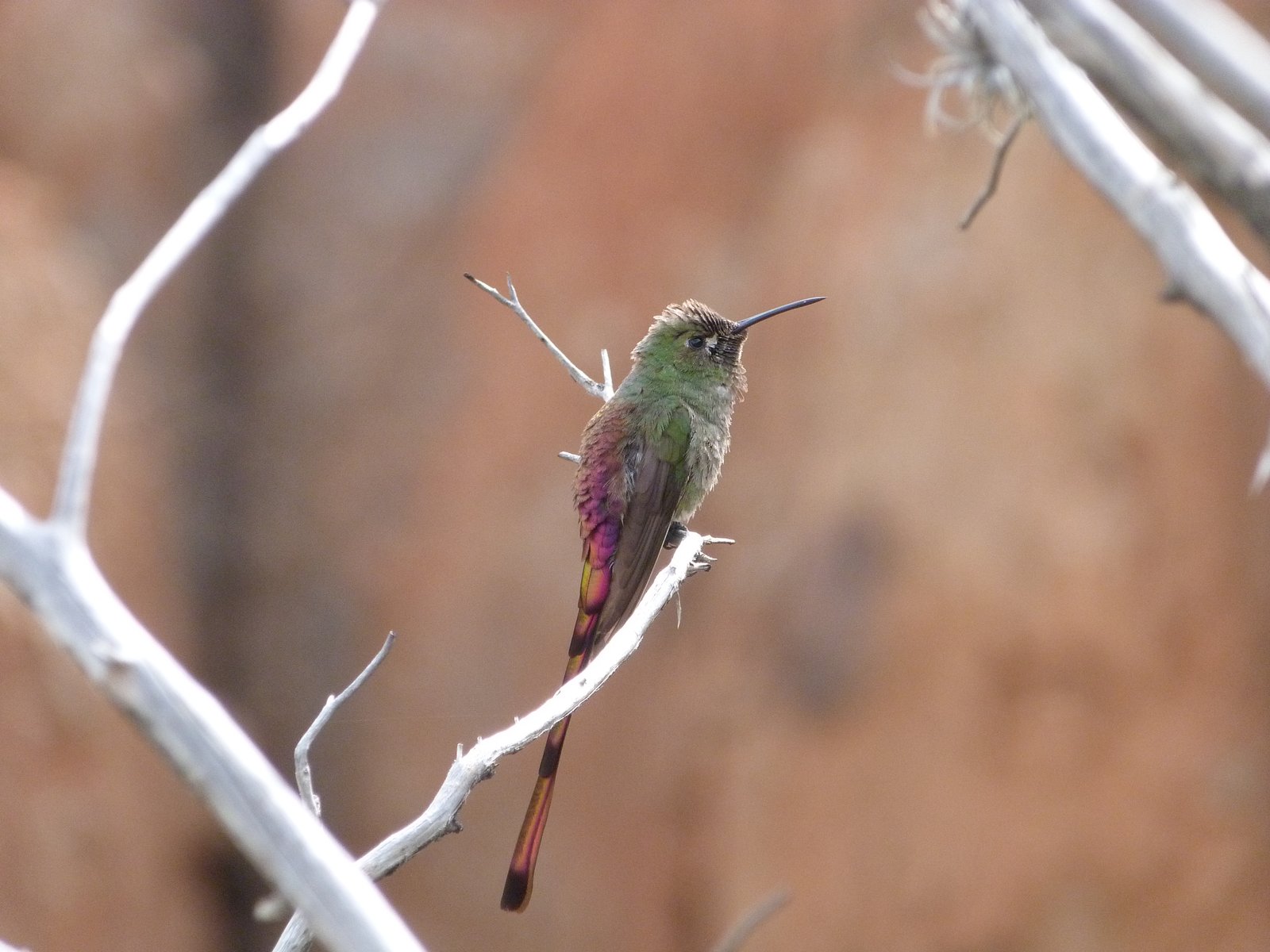
The Red-tailed Comet is a hummingbird of the dry valleys and slopes of the Andes in Bolivia, the male of which has a long, deeply forked tail that glitters coppery red. In the guide area it is almost restricted to Bolivia. The species is common in gardens, field edges and scrub around villages and towns.
Voice
High, sharp tseet notes, also a rapid, squeaky twitter in chases. In flight the tail sometimes makes a soft rattling sound.
Recording: Franco Vushurovich — CC BY-NC-SA 4.0 · xeno-canto
Identification
Male 18–20 cm including the tail, female 12–14 cm; the bill is short, straight and black. The male is green, with a glittering green throat and a purplish, glossy back. The long, deeply forked tail glitters fiery red to coppery, with black bars and tips to the feathers. The female is green above, with a whitish, green-spotted throat, pale buff underparts and a shorter, also reddish, forked tail. Juveniles resemble the female.
Confusion species
Green-tailed Trainbearer Lesbia nuna occurs in the Bolivian Andes, but is smaller, with a narrow, glittering green tail and a much shorter bill. Bronze-tailed Comet Polyonymus caroli lives in Peru, outside the range of Red-tailed Comet, and has a shorter, bronze tail and a pink throat. Wedge-tailed Hillstar Oreotrochilus adela lives in the same regions, but has a short, wedge-shaped tail and a decurved bill.
Habitat
Dry scrub and open woodland in the valleys between the ranges, slopes with cacti and shrubs, field edges, hedgerows, Polylepis groves, riparian woodland and gardens in villages and towns, roughly between 1500 and 4000 m, mostly between 2500 and 3500 m. It visits a wide variety of flowers, including those of planted shrubs, and catches small insects. The nest is a cup of plant fibres, often under an overhang or in a building.
Where the bird is most at home, classified by the vegetation units of the Andes and the west coast.


Range and movements
In Bolivia in the Andes and the dry valleys from La Paz and Cochabamba south to Chuquisaca, Potosí and Tarija. In Peru only a few reports from the far south-east, on the Bolivian border. Absent from Colombia, Ecuador and the Galápagos. Outside the guide area in north-western Argentina and northern Chile.
- Resident
- dark = core range, pale = thinly spread
How and when to look
In gardens, parks and dry valleys around Cochabamba, Sucre and Tarija. Males often sit on a prominent twig or wire near flowering shrubs; against the light the red colour of the tail shows clearly.
Conservation status
Least Concern. The species tolerates agricultural and urban landscapes and has a large range.
Scientific name
Sappho sparganurus | (Shaw, 1812)
Shaw described the species in 1812 as Trochilus sparganurus; because it was later moved to another genus, the author and year stand in brackets. The genus Sappho was introduced in 1849 by Reichenbach. The genus name refers to Sappho, an ancient Greek poet from the island of Lesbos. The specific name comes from Greek sparganoō, 'to wrap' (cf. sparganon, 'swaddling band'), and oura, 'tail', probably after the banded tail. The specimen the first description was based on came from Bolivia.