All species › Swifts › Hummingbirds › Violet-tailed Sylph
Violet-tailed Sylph | Aglaiocercus coelestis
Violetstaartnimf | Silfo colivioleta | Silfo-de-cauda-violeta
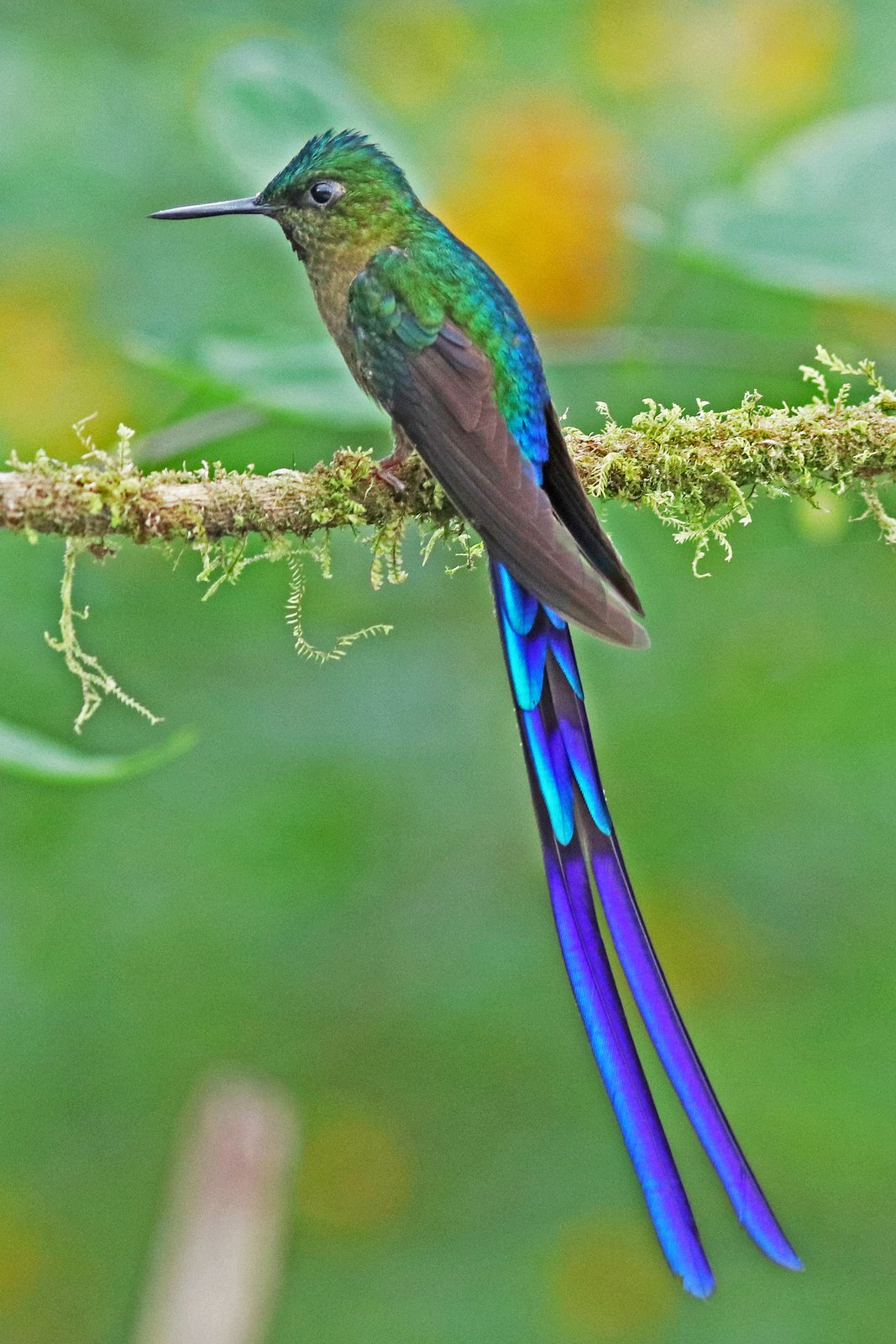
The Violet-tailed Sylph is the western counterpart of the Long-tailed Sylph, a hummingbird of humid forest on the Pacific slope of the Andes in Colombia and Ecuador. The male has a very long, forked tail that glitters violet, with blue-green tips. The species lives lower than the Long-tailed Sylph and is a regular visitor to feeders in north-western Ecuador.
Voice
A dry, buzzy dzzt, often repeated, and a rasping twitter in chases.
Recording: Carlos Delgado JUMABITA — CC BY-NC-SA 4.0 · xeno-canto
Identification
Male 18–21 cm including the tail, female 10–11 cm; the bill is short, straight and black. The male is green, with a glittering green crown and a violet-blue throat patch. The very long, deeply forked tail glitters violet to purple, and the outer feathers have blue-green tips. The female has a blue-green crown, a white throat spotted green, a white breast band and a rufous belly; her tail is short, forked and bluish, with pale tips. Juveniles resemble the female.
Confusion species
Long-tailed Sylph Aglaiocercus kingii lives mainly on the eastern slope and higher; the male has a bluer tail without green tips, and the female lacks the white breast band. Where both occur together, as in northern Ecuador, intermediate birds have occasionally been reported. White-booted Racket-tail Ocreatus underwoodii is much smaller, with white leg puffs and tail feathers ending in rackets. The male Western Emerald Chlorostilbon melanorhynchus is smaller and entirely green, with a short, forked tail.
Habitat
The interior and edges of humid foothill and montane forest and cloud forest, also older secondary growth, wooded gardens and shade coffee, roughly between 900 and 2100 m, locally lower or higher. It takes nectar in the lower and middle levels of the forest and catches small insects. It comes to feeders. The nest is a domed ball of moss with a side entrance, often on a branch above a trail or stream.
Where the bird is most at home, classified by the vegetation units of the Andes and the west coast.


Range and movements
In Colombia on the western slope of the Western Cordillera and locally in the Central Cordillera. In Ecuador on the western slope of the Andes, from the Colombian border to El Oro and Loja. In Peru only a few reports from the far north-west. Absent from Bolivia and the Galápagos. Does not occur outside the guide area.
- Resident
- dark = core range, pale = thinly spread
How and when to look
At feeders in lodges and reserves around Mindo and Milpe in north-western Ecuador, and along forest trails in the Chocó region of Colombia. Males often sit on a shaded twig with the tail hanging down.
Conservation status
Least Concern. The species tolerates some disturbance and occurs in wooded gardens, but deforestation on the western slope of the Andes affects its habitat locally.
Scientific name
Aglaiocercus coelestis | (Gould, 1861)
Gould described the species in 1861 as Cynanthus coelestis; because it was later moved to another genus, the author and year stand in brackets. The genus Aglaiocercus was introduced in 1930 by Zimmer. The genus name comes from Greek aglaia, 'splendour', and kerkos, 'tail', after the long glossy tail. The species name comes from Latin caelestis, 'heavenly, sky-blue', after the violet-blue tail. The specimen the first description was based on came from Ecuador.