All species › Swifts › Hummingbirds › Long-tailed Sylph
Long-tailed Sylph | Aglaiocercus kingii
Langstaartnimf | Silfo colilargo | Silfo-de-cauda-longa
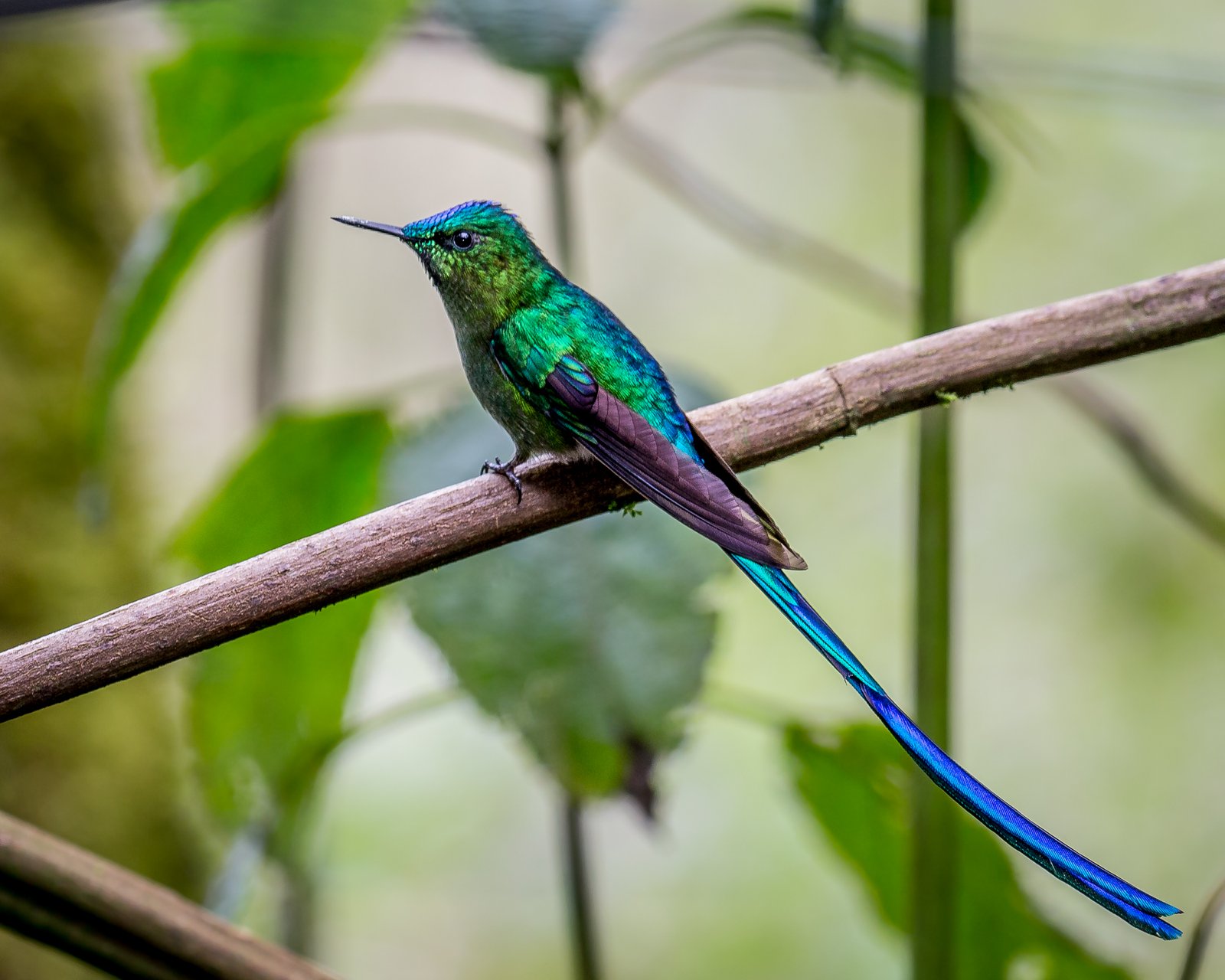
The Long-tailed Sylph is a hummingbird of montane forest edges in the Andes, the male of which has a tail longer than its body. The tail is deeply forked and glitters blue to violet. It is one of the most widespread hummingbirds of middle elevations in the guide area and also occurs in gardens and scrub.
Voice
A dry, buzzy dzzt and a series of short, rasping notes, often in chases. In flight a soft hum of the wings can be heard.
Recording: Bernabé López-Lanus (Colección de Sonidos Ambientales - Instituto Humboldt) — CC BY-NC-SA 4.0 · xeno-canto
Identification
Male 16–19 cm including the tail, female 9–10 cm; the bill is short, straight and black. The male is dark green, with a glittering green crown and, in most forms, a small blue throat patch. The very long, deeply forked tail glitters blue to purple-violet, sometimes greenish at the tip. The female also has a glittering green crown, a white throat spotted green and rufous underparts; her tail is much shorter, forked and bluish. Juveniles resemble the female.
Confusion species
Violet-tailed Sylph Aglaiocercus coelestis lives on the western slope, mostly lower; the male has a violet-purple tail with blue-green tips, and the female has a white breast band between the throat and rufous belly. Black-tailed Trainbearer Lesbia victoriae and Green-tailed Trainbearer Lesbia nuna also have long tails, but are more slender, with whitish, green-spotted underparts and a narrower tail, and live in more open, drier country. White-booted Racket-tail Ocreatus underwoodii is much smaller, with white leg puffs and tail feathers ending in rackets.
Habitat
Edges and clearings of humid montane and cloud forest, secondary growth, scrub, hedgerows and gardens, roughly between 1200 and 3000 m. It takes nectar from flowers in the lower and middle levels and catches many small insects, often in flight or from leaves. The nest is a domed ball of moss with a side entrance, usually against a bank or on a hanging branch.
Where the bird is most at home, classified by the vegetation units of the Andes and the west coast.


Range and movements
In Colombia in all three cordilleras, especially on the eastern slopes and in the valleys between the ranges. In Ecuador on the eastern slope of the Andes and locally in the north-west. In Peru along the eastern slope throughout the country. In Bolivia on the eastern slope in La Paz, Cochabamba and Santa Cruz. Absent from the Galápagos. Outside the guide area in the mountains of Venezuela.
- Resident
- dark = core range, pale = thinly spread
How and when to look
Along forest edges, roadsides and gardens on the eastern slope, for example around Papallacta and Baeza in Ecuador or Manu in Peru. Males often sit on an exposed twig; the long tail is also visible in flight.
Conservation status
Least Concern. The species tolerates disturbed and semi-open country and occurs in gardens, but depends in part on the edge of montane forest.
Scientific name
Aglaiocercus kingii | (Lesson, 1832)
Lesson described the species in 1832 as Trochilus kingi; because it was later moved to another genus, the author and year stand in brackets. The genus Aglaiocercus was introduced in 1930 by Zimmer. The genus name comes from Greek aglaia, 'splendour', and kerkos, 'tail', after the long glossy tail. The species name honours Phillip Parker King (1791–1856), a British naval officer and hydrographer who surveyed the coasts of South America. The specimen the first description was based on came from Bogotá, Colombia.