All species › Passerines › Manakins › Green Manakin
Green Manakin | Cryptopipo holochlora
Groene manakin | Saltarín verde | Dançarino-verde
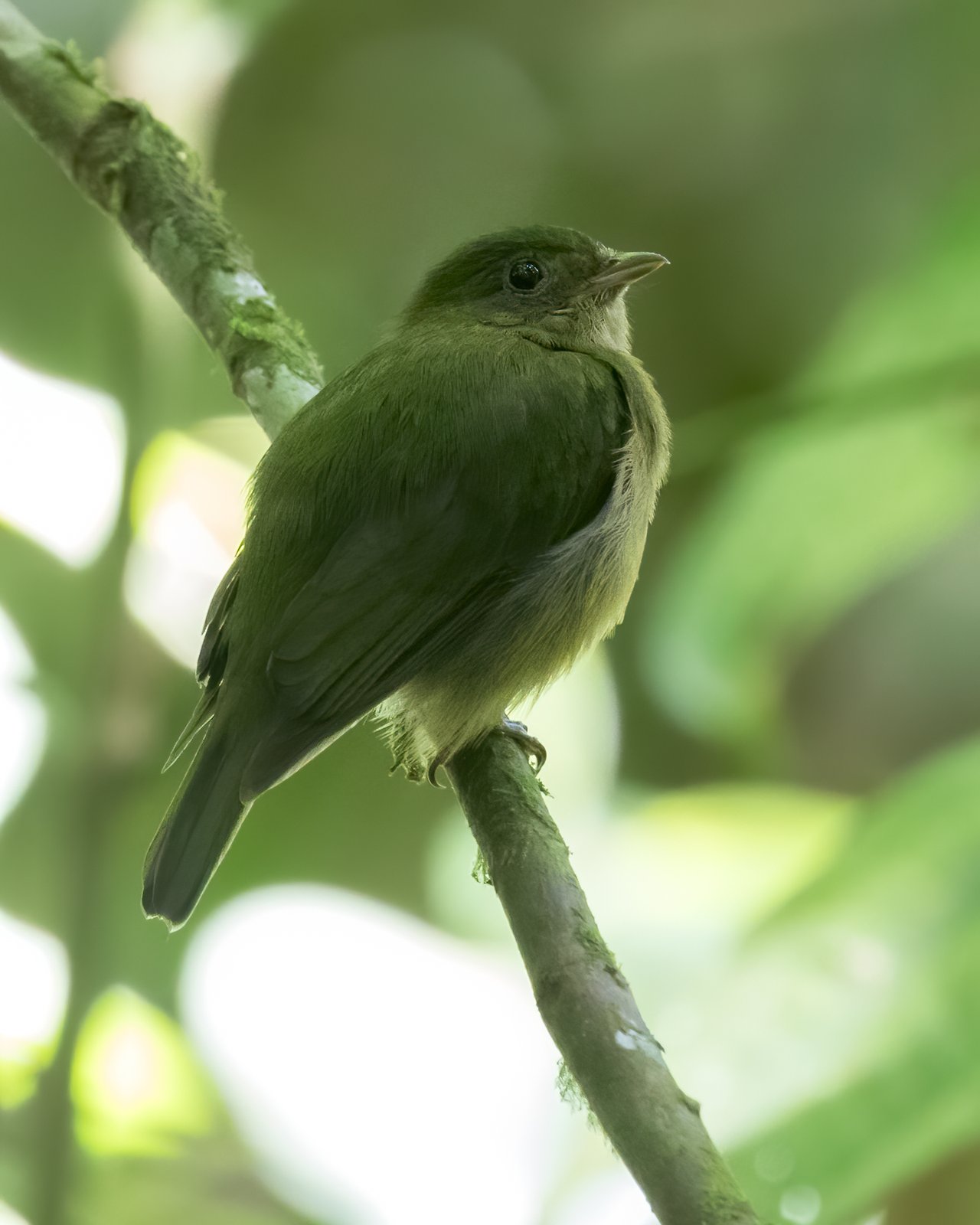
The Green Manakin is a uniformly green manakin with few features, living mainly in foothill forest on the east slope of the Andes. Male and female look alike, which is unusual among manakins. Birds west of the Andes are now treated as a separate species, Cryptopipo litae.
Voice
Seldom heard. The presumed song is a very high, thin, rising whistle, roughly tueee?. The call is a two-part rattle: first a short, rough, low buzz, then a higher, longer and thinner rattle.
Recording: Juan Freile — CC BY-NC-SA 4.0 · xeno-canto
Identification
12 cm. The head, upperparts and central tail feathers are bright grass-green; the wings and outer tail feathers are dusky with green edges. The throat, breast, flanks and undertail coverts are olive-green, the chin and centre of the belly pale yellowish. The iris is brown, with a pale eye-ring; the upper mandible is black, the lower mandible dark grey. Birds in Cusco and Puno (viridior) are larger, brighter green and yellower on the belly. The sexes are alike.
Confusion species
Females of Blue-capped Manakin Lepidothrix coronata are smaller, with a shorter tail. The female Golden-winged Manakin Masius chrysopterus has a yellow throat and usually lives higher. The female Jet Manakin Chloropipo unicolor is darker and greyer, and lives higher. Tyrant-manakins (Neopelma) are larger, with a longer tail and a yellow crown stripe.
Habitat
The understorey and middle storey of humid to wet terra firme forest, mainly in the foothills, roughly between 300 and 1200 m. It feeds on small fruits and insects. Little is known about the nest.
Where the bird is most at home, classified by the vegetation units of the Andes and the west coast.


Range and movements
In Colombia on the east slope of the Andes from Meta southwards, below about 1200 m. In Ecuador on the east slope and in the adjacent foothills. In Peru on the east slope, from the north to Junín, and in Cusco and Puno (viridior). Not known with certainty from Bolivia. Absent from the Galápagos. Birds in the Chocó of Colombia and in western Ecuador belong to Cryptopipo litae.
- Resident
- dark = core range, pale = thinly spread
How and when to look
Search the understorey of foothill forest on the east slope, such as in the foothills of Ecuador or in the lower parts of the Manu region in Peru. The bird often sits still for long periods; the thin whistle and the rattle help to find it.
Conservation status
Least Concern. Foothill forest is being lost locally to clearing and road building.
Scientific name
Cryptopipo holochlora | (Sclater, 1888) (GBIF: Xenopipo holochlora)
Sclater described the species in 1888 as Chloropipo holochlora; because it was later moved to another genus, the author and year stand in brackets. The genus Cryptopipo was introduced in 2013 by Ohlson, Fjeldså & Ericson. The genus name combines Greek kruptos, 'hidden', with New Latin pipo, 'manakin'. It alludes to the inconspicuous appearance and behaviour of the Green Manakin and to its relationships, which remained obscured until the DNA studies of 2013. The specific name comes from Greek holos, 'entire', and khlōros, 'green', after the entirely green plumage. The specimen the first description was based on came from Bogotá, Colombia.