All species › Passerines › Manakins › Blue-capped Manakin
Blue-capped Manakin | Lepidothrix coronata
Blauwkruinmanakin | Saltarín coroniazul | Uirapuru-de-chapéu-azul
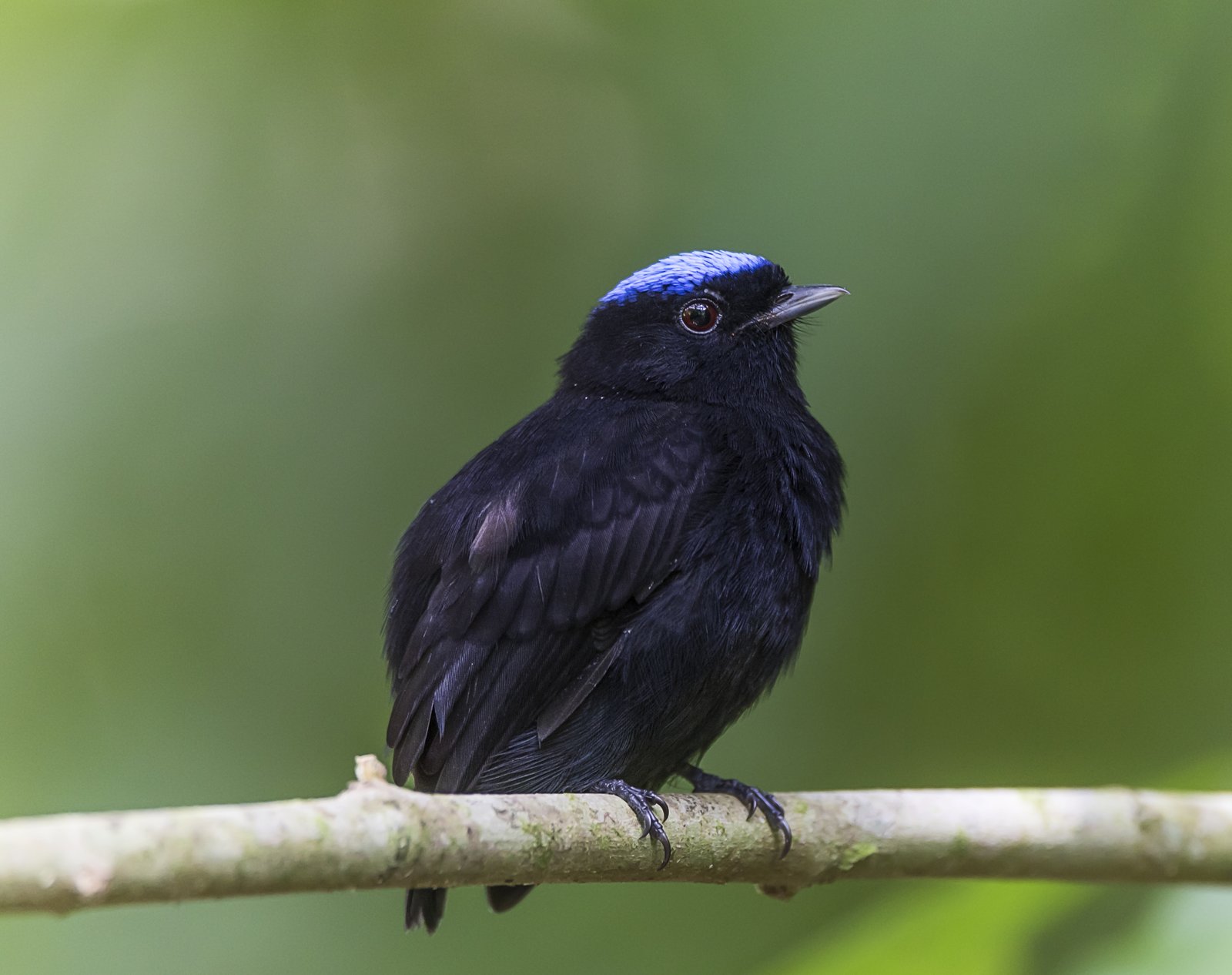
The Blue-capped Manakin is a very small manakin of the Amazonian forest understorey. In the north of the range the males are black with a sky-blue crown, in the south green with a blue crown. Birds west of the Andes are treated as a separate species, Lepidothrix velutina.
Voice
The song is a short, buzzy, rising note, roughly chee-vreee, often repeated for long periods. Also a short, rolling trill.
Recording: Juan Freile — CC BY-NC-SA 4.0 · xeno-canto
Identification
8–9 cm, with a short tail. The male has a sky-blue crown. In the north (Colombia, Ecuador, northern Peru) the rest of the plumage is velvety black; in south-eastern Peru and Bolivia the males are green with a yellowish belly, with intermediate forms in between. The female is bright green, paler and yellowish below. The legs are dark.
Confusion species
The male Blue-rumped Manakin Lepidothrix isidorei has a white crown and a pale blue rump, and lives higher, in foothill forest. White-crowned Manakin Pseudopipra pipra is larger; the male has a white crown. The female Green Manakin Cryptopipo holochlora is larger, with a longer tail. The female White-bearded Manakin Manacus manacus is larger and has orange legs.
Habitat
The understorey of humid lowland terra firme forest and mature second growth, locally also flooded forest, from the lowlands to roughly 1000 m in the foothills. It feeds mainly on small fruits, plucked in flight, and on insects. Males display dispersed through the forest on a few fixed branches. The nest is a small cup in a fork, low in the understorey.
Where the bird is most at home, classified by the vegetation units of the Andes and the west coast.


Range and movements
In Colombia in the lowlands east of the Andes, mainly in the south and south-east. In Ecuador throughout the eastern lowlands and foothills. In Peru in the eastern lowlands from north to south. In Bolivia in the north, in Pando, Beni and La Paz. Absent from the Galápagos. West of the Andes, in the Chocó and western Ecuador, Lepidothrix velutina occurs. Outside the guide area in southern Venezuela and western Amazonian Brazil.
- Resident
- dark = core range, pale = thinly spread
How and when to look
Listen in the understorey of lowland forest for the buzzy song; males often sit on a fixed, low branch. On the forest trails of the lodges in the Amazonian lowlands of Ecuador and Peru the species is regularly heard.
Conservation status
Not Evaluated. In its current circumscription, without the birds west of the Andes, the species has not yet been assessed separately; the older, broader species was rated Least Concern. The range is large and largely forested.
Scientific name
Lepidothrix coronata | (Spix, 1825)
Spix described the species in 1825 as Pipra coronata; because it was later moved to another genus, the author and year stand in brackets. The genus Lepidothrix was introduced in 1854 by Bonaparte. The genus name combines Greek lepis (lepidos), 'scale', with thrix (trikhos), 'hair', after the scale-like crown feathers. The specific name is Latin coronatus, 'crowned', after the blue crown. The specimen the first description was based on came from São Paulo de Olivença, Amazonas, Brazil.