All species › Passerines › Manakins › Snow-capped Manakin
Snow-capped Manakin | Lepidothrix nattereri
Sneeuwkapmanakin | Saltarín coronialbo | Uirapuru-de-chapéu-branco
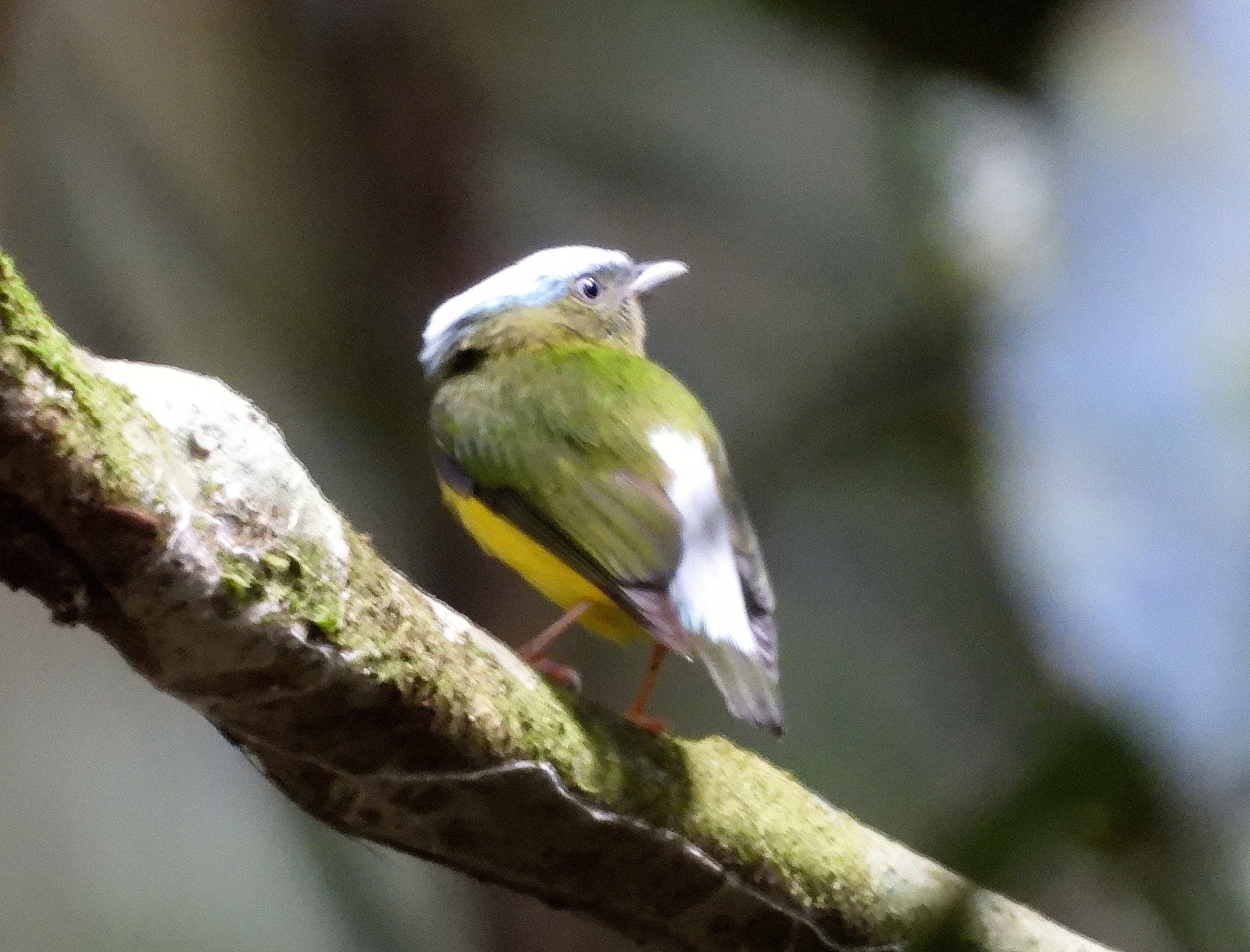
The Snow-capped Manakin is a small manakin of the southern Amazon basin, living mainly in Brazil south of the Amazon and reaching the guide area only in north-eastern Bolivia. The male is green, with a white crown and a white rump. As in related manakins, males display each at their own spot in the forest understorey, within earshot of one another.
Voice
From a fixed perch the male gives a short, soft, slightly rising whistle, repeated at intervals. Also dry ticking notes.
Recording: Nathália Victória — CC BY-NC-SA 4.0 · xeno-canto
Identification
8–9 cm, small and compact, with a short tail and a short, dark bill. The male is green above, with a white crown and a white, sometimes bluish-white rump; the underparts are paler yellowish green, yellower on the belly. The female is plain olive-green, with a yellower belly, and lacks the white on the head and rump. Young males at first resemble the female and acquire the white gradually.
Confusion species
Blue-capped Manakin Lepidothrix coronata has a blue crown and no white rump in the male; the females of the two species are very similar. White-crowned Manakin Pseudopipra pipra is larger; the male is black with a white crown, and the female has a greyish head and red eyes.
Habitat
The lower and middle storeys of humid terra firme lowland forest and of transitional forest towards drier woodland, mainly below 600 m. It eats small fruits, plucked in flight, and insects. The nest, as in other manakins, is a small open cup slung in a horizontal twig fork.
Where the bird is most at home, classified by the vegetation units of the Andes and the west coast.


Range and movements
In Bolivia in the north-east, mainly in northern and eastern Santa Cruz, for example in Noel Kempff Mercado National Park, and locally in adjacent Beni. Absent from Colombia, Ecuador, Peru and the Galápagos. Outside the guide area in the Amazon basin of Brazil south of the Amazon, roughly between the Madeira and the Xingu, south into Mato Grosso.
- Resident
- dark = core range, pale = thinly spread
How and when to look
In the forest of Noel Kempff Mercado National Park. Listen in the understorey for the short whistle of a displaying male, then look for the white crown in the dim forest interior.
Conservation status
Least Concern. The species depends on closed forest and disappears where it is cleared, which is happening on a large scale in the southern Amazon basin.
Scientific name
Lepidothrix nattereri | (Sclater, 1865)
Sclater described the species in 1865 as Pipra nattereri; because it was later moved to another genus, the author and year stand in brackets. The genus Lepidothrix was introduced in 1854 by Bonaparte. The genus name combines Greek lepis (lepidos), 'scale', with thrix (trikhos), 'hair', after the scale-like crown feathers. The specific name honours the Austrian naturalist Johann Natterer (1787–1843), who collected birds in Brazil from 1817 to 1835. The specimen the first description was based on came from Borba, Rio Madeira, Amazonas, Brazil.