All species › Passerines › Manakins › Blue-rumped Manakin
Blue-rumped Manakin | Lepidothrix isidorei
Blauwstuitmanakin | Saltarín lomiazul | Uirapuru-de-uropígio-azul
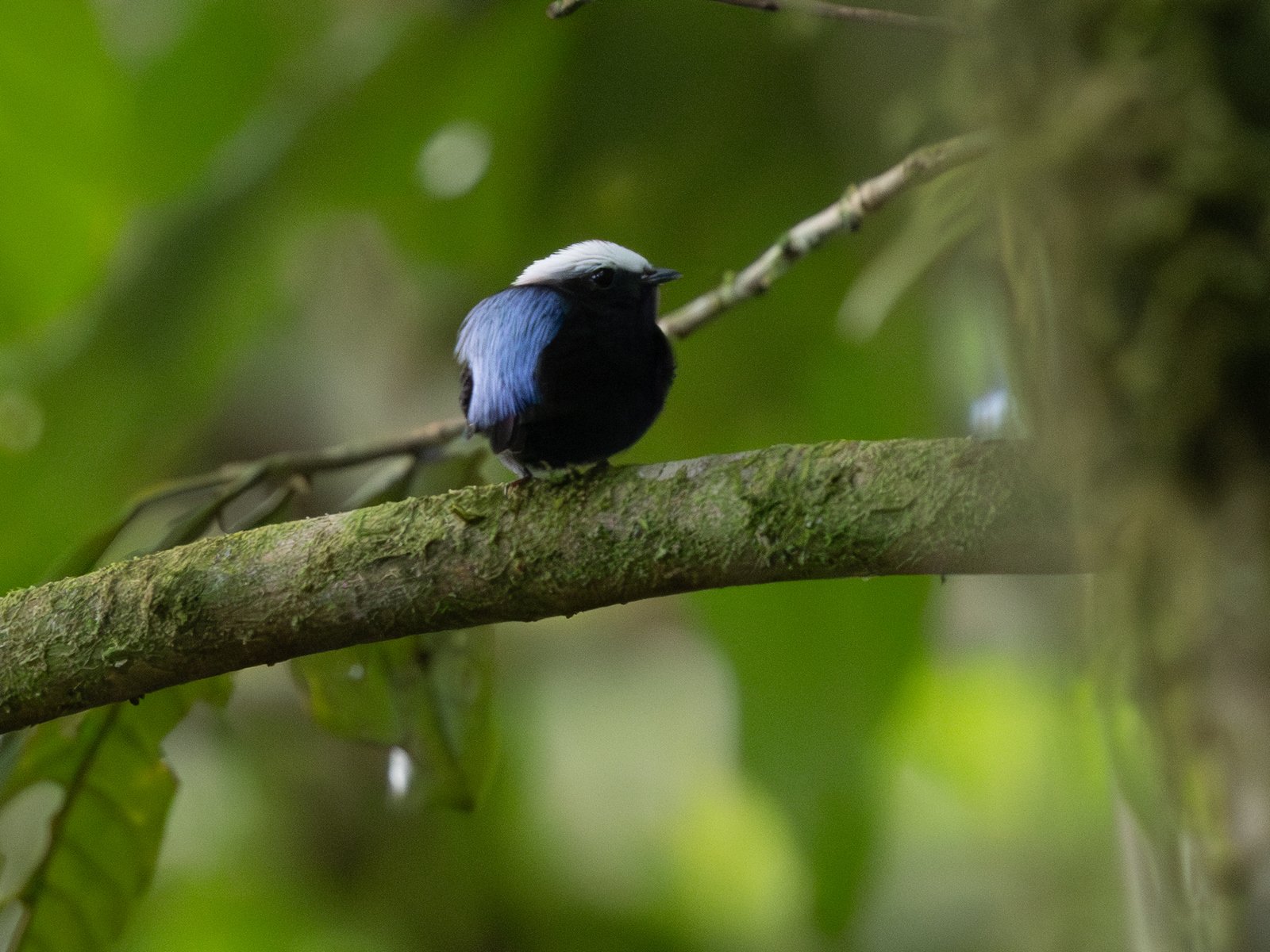
The Blue-rumped Manakin is a small black manakin of the foothills on the east slope of the Andes, from Colombia to Peru. The male has a white crown and a pale blue to whitish rump. The species lives higher on the slopes than most other manakins of the eastern lowlands.
Voice
A short, soft, slightly rising whistle and a fast, dry trill, repeated at intervals from the display site.
Recording: Juan Freile — CC BY-NC-SA 4.0 · xeno-canto
Identification
8 cm, small and compact, with a short tail. The male is velvety black, with a white crown and a pale blue rump; in Peru the rump is whiter. The female is olive-green, with a slightly more yellowish-green crown and a paler, yellowish-green belly. Young males resemble the female.
Confusion species
Blue-capped Manakin Lepidothrix coronata has a blue crown and a black rump in the male and usually lives lower. White-crowned Manakin Pseudopipra pipra is larger, with red eyes and a black rump. The male Cerulean-capped Manakin Lepidothrix coeruleocapilla of central and southern Peru has a blue instead of a white crown.
Habitat
Humid foothill and lower montane forest on the east slope of the Andes, roughly between 1000 and 1700 m, locally lower. It lives in the understorey and eats small fruits, plucked in flight, and insects. The nest is a small cup in a horizontal twig fork.
Where the bird is most at home, classified by the vegetation units of the Andes and the west coast.


Range and movements
In Colombia locally on the east slope of the Eastern Andes and in the Serranía de la Macarena. In Ecuador along the east slope of the Andes. In Peru on the east slope south to the centre of the country. Absent from Bolivia and the Galápagos. Does not occur outside the guide area.
- Resident
- dark = core range, pale = thinly spread
How and when to look
In foothill forest on the east slope in Ecuador, for example around Wildsumaco in Napo province, and in the foothills of San Martín in Peru. Find a spot where a male is calling and wait in the understorey.
Conservation status
Least Concern. Its range is a narrow elevational band that is being cleared in places for farming and cattle ranching.
Scientific name
Lepidothrix isidorei | (Sclater, 1852)
Sclater described the species in 1852 as Pipra isidorei; because it was later moved to another genus, the author and year stand in brackets. The genus Lepidothrix was introduced in 1854 by Bonaparte. The genus name combines Greek lepis (lepidos), 'scale', with thrix (trikhos), 'hair', after the scale-like crown feathers. The specific name honours the French zoologist Isidore Geoffroy Saint-Hilaire (1805–1861). The specimen the first description was based on came from Buenavista, Meta, Colombia.