All species › Passerines › Manakins › Cerulean-capped Manakin
Cerulean-capped Manakin | Lepidothrix coeruleocapilla
Blauwkapmanakin | Saltarín coroniceleste | Uirapuru-de-boné-celeste
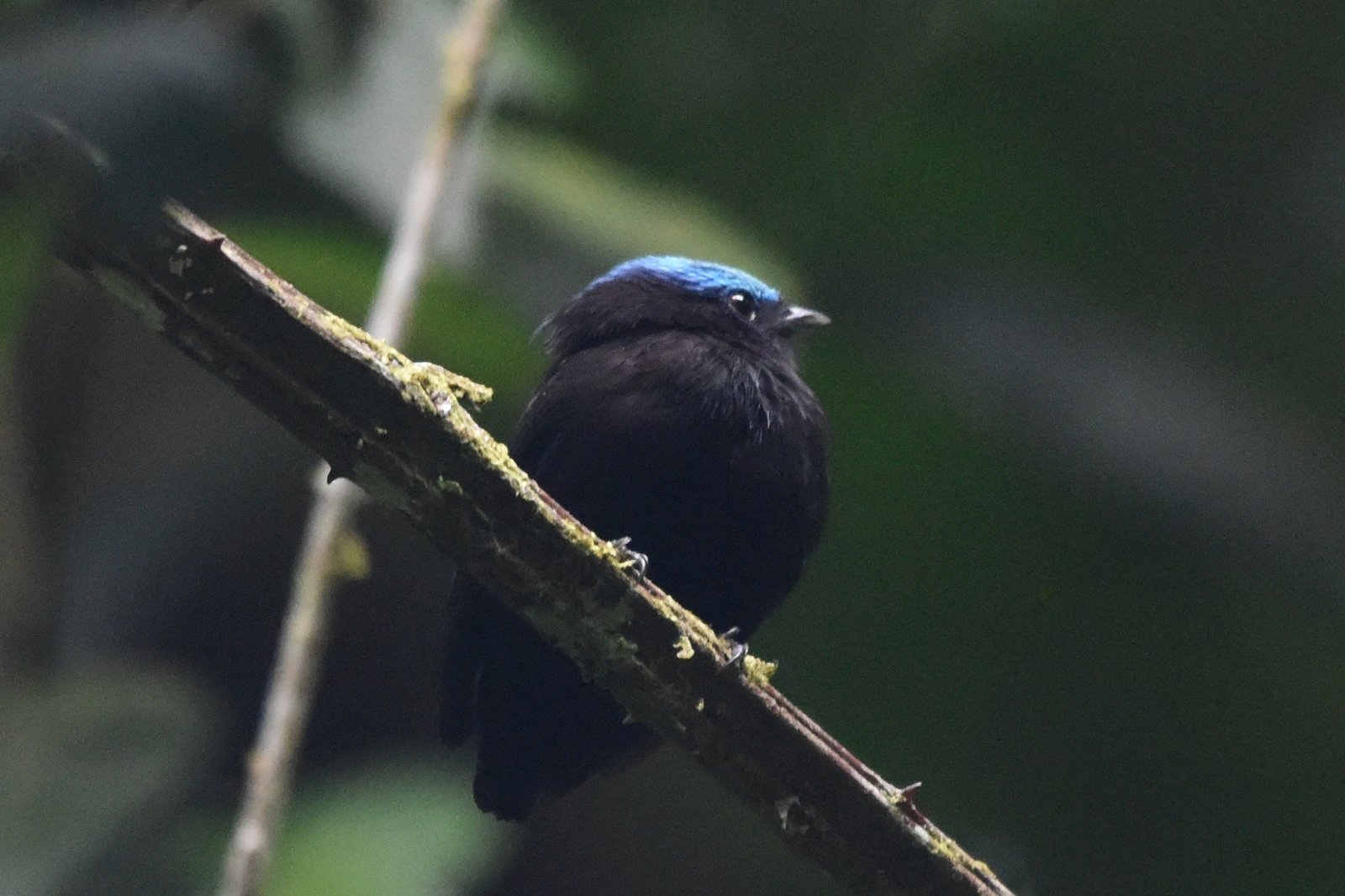
The Cerulean-capped Manakin is a small manakin found only in Peru, in the foothills and lower montane forest on the east slope of the Andes in the centre and south of the country. The male is black, with a pale, sky-blue crown and a blue rump. Males display at fixed spots in the forest understorey.
Voice
A short, soft, slightly rising whistle and a dry, fast trill, repeated at intervals from the display site.
Recording: GABRIEL LEITE — CC BY-NC-SA 4.0 · xeno-canto
Identification
9 cm, small and compact, with a short tail. The male is velvety black, with a pale, sky-blue crown and a blue rump. The female is olive-green, with paler, greyish-green to yellowish-green underparts. Young males at first resemble the female.
Confusion species
Blue-capped Manakin Lepidothrix coronata has a darker blue crown and a black rump in the male, and usually lives lower, in lowland forest. Blue-rumped Manakin Lepidothrix isidorei has a white crown in the male and lives farther north. The females of these three species are very similar.
Habitat
Humid foothill and lower montane forest, roughly between 600 and 1700 m. It lives in the lower and middle storeys and eats small fruits, plucked in flight, and insects. The nest is a small cup in a horizontal twig fork.
Where the bird is most at home, classified by the vegetation units of the Andes and the west coast.


Range and movements
Only in Peru, on the east slope of the Andes from Huánuco and Pasco south through Junín and Cusco to Puno. Absent from Colombia, Ecuador, Bolivia and the Galápagos. Does not occur outside the guide area.
- Resident
- dark = core range, pale = thinly spread
How and when to look
In foothill forest along the Manu road in Cusco and in the Chanchamayo area in Junín. Listen in the understorey for the short whistles of displaying males.
Conservation status
Least Concern, despite its limited range. Deforestation in the foothills is a local threat.
Scientific name
Lepidothrix coeruleocapilla | (Tschudi, 1844)
Tschudi described the species in 1844 as P[ipra] coeruleo-capilla; because it was later moved to another genus, the author and year stand in brackets. The genus Lepidothrix was introduced in 1854 by Bonaparte. The genus name combines Greek lepis (lepidos), 'scale', with thrix (trikhos), 'hair', after the scale-like crown feathers. The specific name comes from Latin caeruleus, 'sky blue', and capillus, 'hair of the head', after the blue crown. The specimen the first description was based on came from Vitoc, Junín, Peru.