All species › Passerines › Manakins › Orange-crested Manakin
Orange-crested Manakin | Heterocercus aurantiivertex
Oranjekruinmanakin | Saltarín crestinaranja | Dançarino-de-crista-laranja
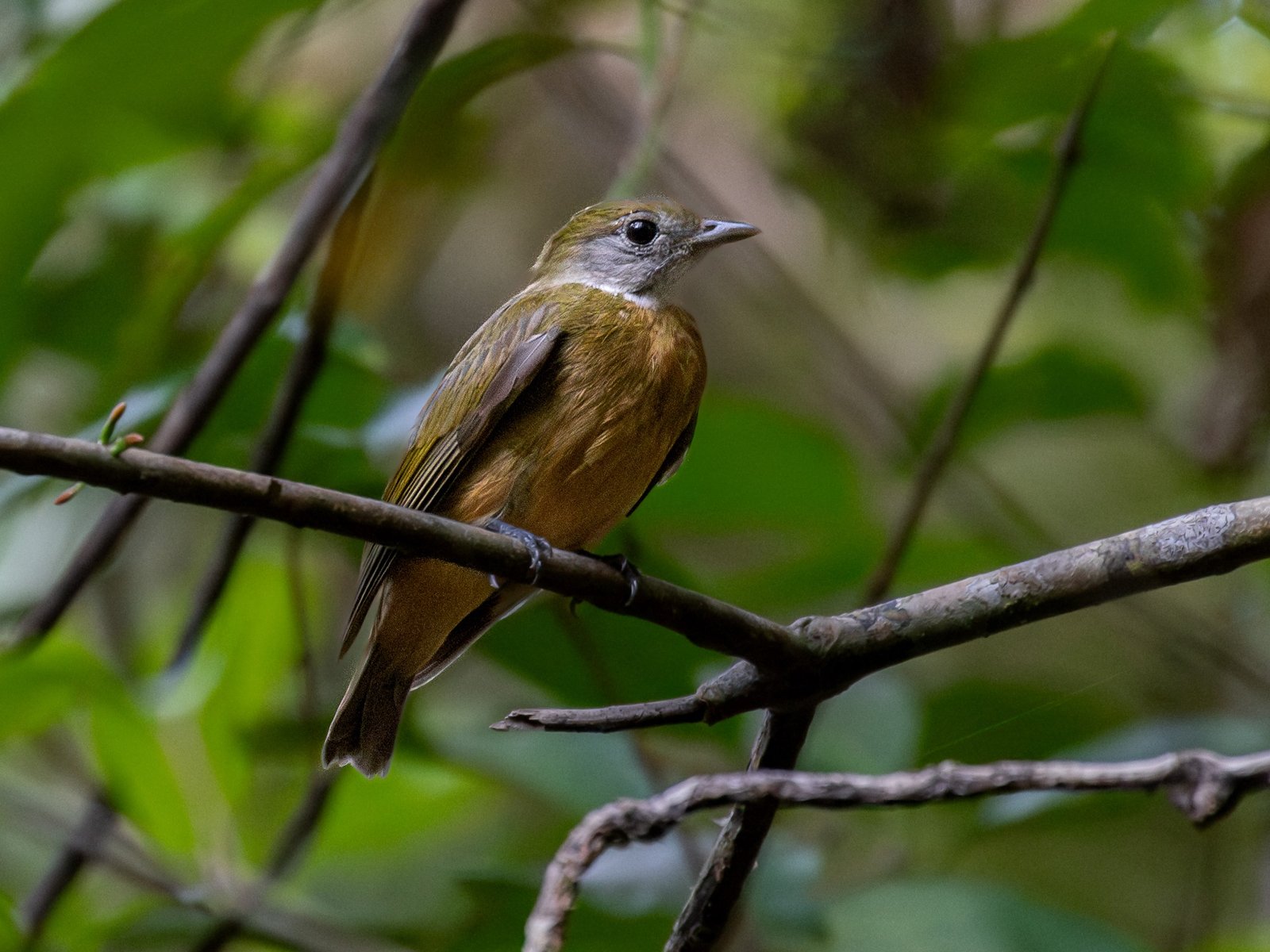
The Orange-crested Manakin is a large, plainly coloured manakin of flooded forest along rivers and lakes in the western Amazon basin. The male's orange crown stripe is usually concealed. With two related species it forms the genus Heterocercus, manakins tied to watersides.
Voice
A high, thin, slightly descending whistle and sharp chip notes, from a perch in the middle storey.
Recording: Fabrice Schmitt — CC BY-NC-SA 4.0 · xeno-canto
Identification
14 cm, large for a manakin, with a fairly long tail. The male is olive-green above, with a grey head, a whitish throat with silky, slightly elongated feathers at the sides and a cinnamon-brown breast that becomes paler towards the belly. On the crown a narrow orange stripe, usually concealed. The female lacks the crown stripe and is duller on the breast.
Confusion species
Flame-crested Manakin Heterocercus linteatus has a darker, almost black head, a red crown stripe and a contrasting white throat; it lives farther south. Yellow-crested Manakin Heterocercus flavivertex has a yellow crown stripe and lives farther east. Varzea Schiffornis Schiffornis major of the same habitat is plain rusty brown, without the pale throat.
Habitat
Seasonally flooded forest, mainly várzea and igapó, riverside scrub and the edges of oxbow lakes, below about 300 m. It lives in the lower and middle storeys and eats fruit and insects.
Where the bird is most at home, classified by the vegetation units of the Andes and the west coast.


Range and movements
In Ecuador in the eastern lowlands, along the Napo, the Aguarico and their tributaries. In Peru in the north-east, in Loreto, along the Napo, the Amazon and the lower Marañón. Absent from Bolivia and the Galápagos; in Colombia at most in the extreme south. Outside the guide area at most in adjacent western Brazil.
- Resident
- dark = core range, pale = thinly spread
How and when to look
In flooded forest along the blackwater tributaries of the Napo in Ecuador, such as in Yasuní National Park, and around Iquitos in Peru. Search from a canoe along the bank; the bird often sits still for long periods in the middle storey.
Conservation status
Least Concern. Flooded forest along rivers is under local pressure from logging and clearance.
Scientific name
Heterocercus aurantiivertex | Sclater & Salvin, 1880
Sclater & Salvin described the species in 1880 and placed it straight away in the genus where it still stands. The genus Heterocercus was introduced in 1862 by Sclater. The genus name comes from Greek heteros, 'different', and kerkos, 'tail'. The specific name comes from Latin aurantius, 'orange', and vertex, 'crown', after the orange crown patch. The specimen the first description was based on came from Sarayacu, Pastaza, Ecuador.