All species › Swifts › Hummingbirds › Green Thorntail
Green Thorntail | Discosura conversii
Groene draadkolibrie | Colibrí colicerda verde | Rabo-de-espinho-verde
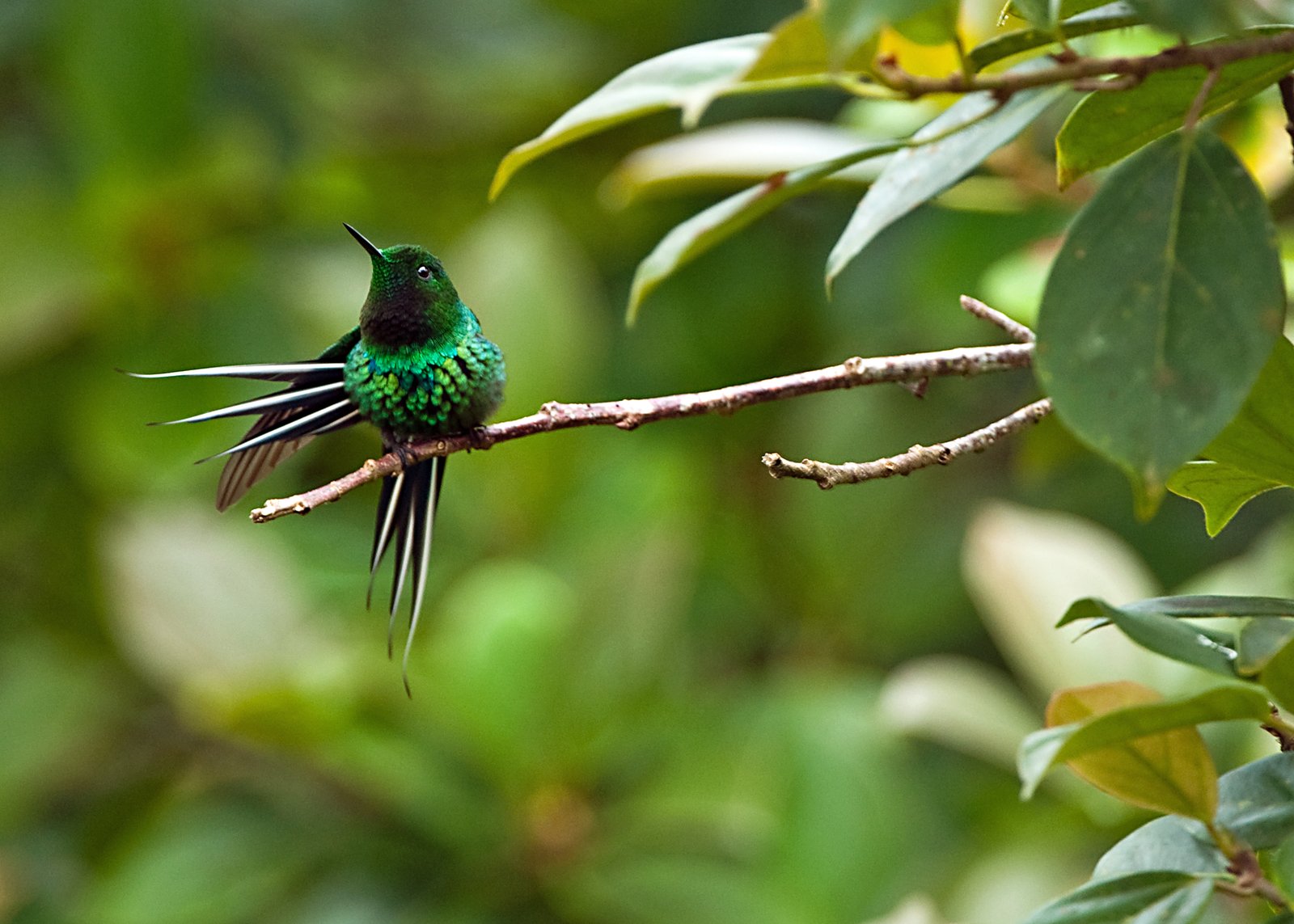
The Green Thorntail is the only thorntail west of the Andes, from Costa Rica to western Ecuador. The male is largely green, with a white rump band and a long, deeply forked blue-black tail with very narrow outer feathers. The species feeds mainly in the crowns of flowering trees.
Voice
Mostly silent; soft, squeaky chip notes during encounters with other hummingbirds.
Recording: Jerome Fischer — CC BY-NC-SA 4.0 · xeno-canto
Identification
7–10 cm; the male is clearly longer than the female because of its long tail. Short, straight black bill. The male has a dark green crown, a paler metallic green back, a bronzy rump with a white band and a glittering green throat; the centre of the breast has a blue-green sheen. The deeply forked blue-black tail has very narrow outer feathers. The female resembles the male above, but has a short, notched tail, dark underparts with a broad white cheek patch and a white flank patch; the outer tail feathers have white bases and white tips.
Confusion species
Wire-crested Thorntail Discosura popelairii and Black-bellied Thorntail Discosura langsdorffi occur only east of the Andes and have a black belly in the male. Female woodstars, such as Little Woodstar Chaetocercus bombus, are also very small and hover with an insect-like flight, but have rufous or buff underparts. Purple-bibbed Whitetip Urosticte benjamini has white tail tips and a white spot behind the eye, but a longer bill and no white rump band.
Habitat
The canopy and edges of humid lowland and foothill forest, also flowering trees in clearings and plantations, in Colombia from sea level to about 1000 m and in Ecuador between about 300 and 1000 m. It feeds mainly at flowers in the crowns of trees, including legumes, and at epiphytes; it also catches small insects and spiders. When hovering it holds the tail almost at right angles to the body. In the breeding season males perch on high bare twigs and sometimes perform diving displays.
Where the bird is most at home, classified by the vegetation units of the Andes and the west coast.


Range and movements
In Colombia on the Pacific slope, along the whole length of the country. In Ecuador on the western slope, south to near the border with Peru. Absent from Peru, Bolivia and the Galápagos. Outside the guide area in Costa Rica and Panama.
- Resident
- dark = core range, pale = thinly spread
How and when to look
At flowering verbena hedges (Stachytarpheta) and flowering trees at lodges in the foothills of north-western Ecuador, for example around Milpe and Mashpi. Watch for the white rump band of the hovering bird.
Conservation status
Least Concern. The species is locally fairly common, but deforestation of the western lowlands and foothills affects its habitat.
Scientific name
Discosura conversii | (Bourcier & Mulsant, 1846)
Bourcier & Mulsant described the species in 1846 as Trochilus Conversii; because it was later moved to another genus, the author and year stand in brackets. The genus Discosura was introduced in 1850 by Bonaparte. The genus name combines Greek diskos, 'disc' or 'plate', with oura, 'tail'. The species name honours M. Convers (fl. 1845), a French naturalist and collector who lived in Bogotá, Colombia. The specimen the first description was based on came from Bogotá, Colombia.