All species › Swifts › Hummingbirds › Rufous-crested Coquette
Rufous-crested Coquette | Lophornis delattrei
Vuurkuifkoketkolibrie | Coqueta crestirrufa | Topetinho-de-crista-ruiva
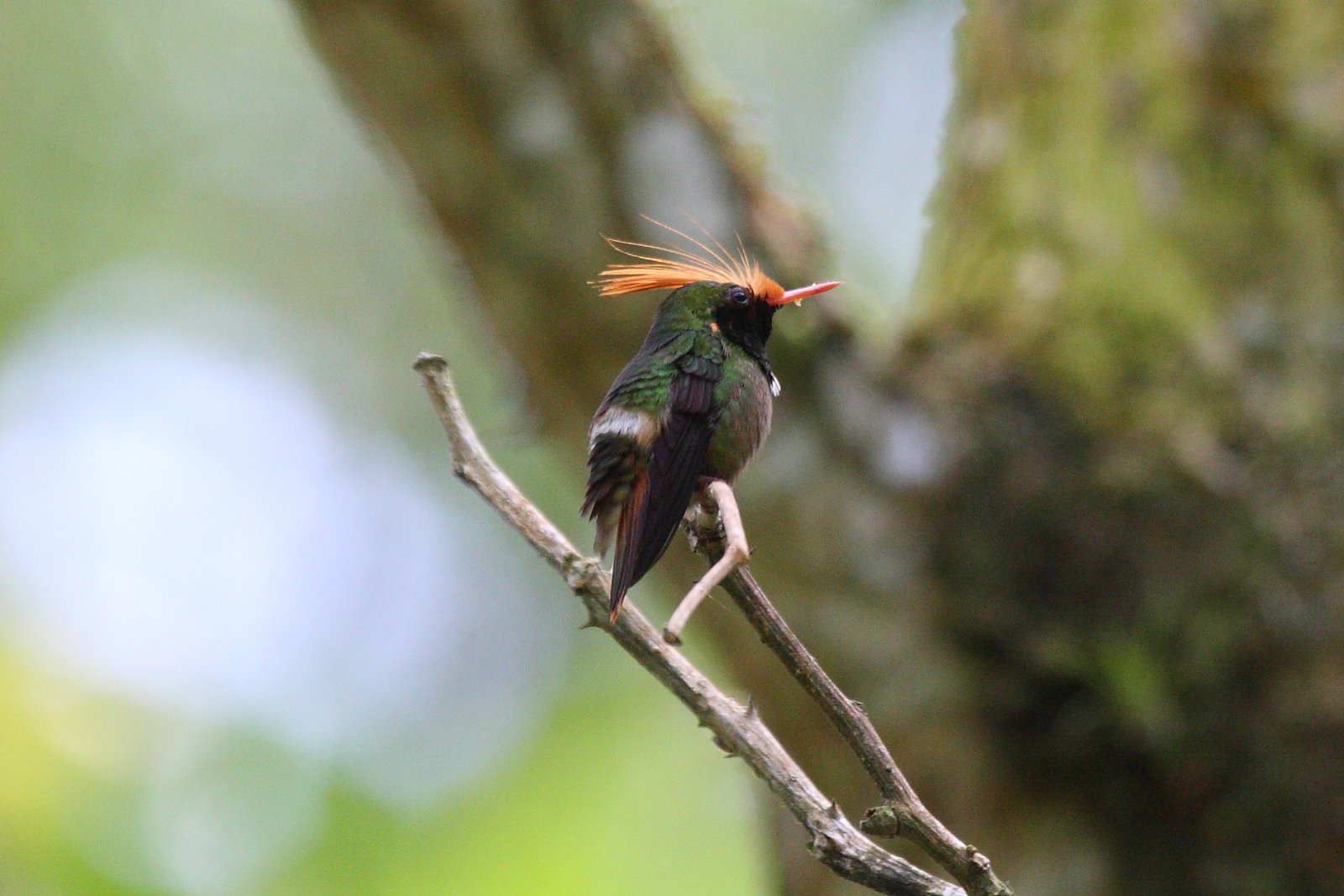
The Rufous-crested Coquette is a tiny hummingbird of the Andean foothills. The male has a long rufous crest that it raises when excited. Because of its small size and slow, bee-like flight it is often overlooked or taken for an insect.
Voice
Usually silent. The call is a soft, thin tsip.
Recording: Dries Van de Loock — CC BY-NC-SA 4.0 · xeno-canto
Identification
7 cm, with a short, straight bill. The male is bronzy green above, with a long rufous crest of narrow feathers, the longest with dark tips, and a glittering green throat. A conspicuous white band crosses the rump. The tail is rufous with a dark terminal band. The female lacks the crest, but has a rufous forehead and forecrown, a cinnamon throat and the same white rump band. In flight the bird often holds its tail raised and moves it up and down.
Confusion species
Spangled Coquette Lophornis stictolophus is very similar; the male has a shorter, fuller crest in which every feather has a black spot at the tip. Females are very similar. The male Festive Coquette Lophornis chalybeus has no rufous crest but green and white plumes at the sides of the head. Wire-crested Thorntail Discosura popelairii also has a white rump band, but the male has a thin, wire-like crest and a long, pointed tail.
Habitat
Edges of humid foothill and lower montane forest, clearings, roadside forest edges and semi-open country with scattered flowering trees and shrubs, at roughly 500 to 1800 m. It visits small flowers, often high in flowering trees such as Inga, and also flowering hedges and shrubs at forest edges.
Where the bird is most at home, classified by the vegetation units of the Andes and the west coast.


Range and movements
In Colombia local, mainly on the eastern side of the Andes; in Ecuador scarce on the eastern slope; in Peru and Bolivia on the eastern slope of the Andes. Scarce and local throughout. Absent from the Galápagos. Outside the guide area locally in Panama and Costa Rica.
- Resident
- dark = core range, pale = thinly spread
How and when to look
At flowering trees and shrubs at forest edges and along roads in the foothills of the eastern slope, and at flowering hedges in lodge gardens. Look for an insect-like bird flying with its tail raised and a white band across the rump.
Conservation status
Least Concern. The species is scarce and local throughout, but tolerates semi-open, human-altered country with flowering plants.
Scientific name
Lophornis delattrei | (Lesson, 1839)
Lesson described the species in 1839 as Ornismya (Lophorinus) DeLattrei; because it was later moved to another genus, the author and year stand in brackets. The genus Lophornis was introduced in 1829 by Lesson. The genus name combines Greek lophos, 'crest', with ornis, 'bird'. The species name honours Adolphe Delattre (1805–1854), a French naturalist and collector of birds in the Americas. The specimen the first description was based on came from probably Peru.