All species › Passerines › New World warblers › Grey-and-gold Warbler
Grey-and-gold Warbler | Myiothlypis fraseri
Feeënzanger | Reinita grisidorada | Pula-pula-cinza-e-dourado
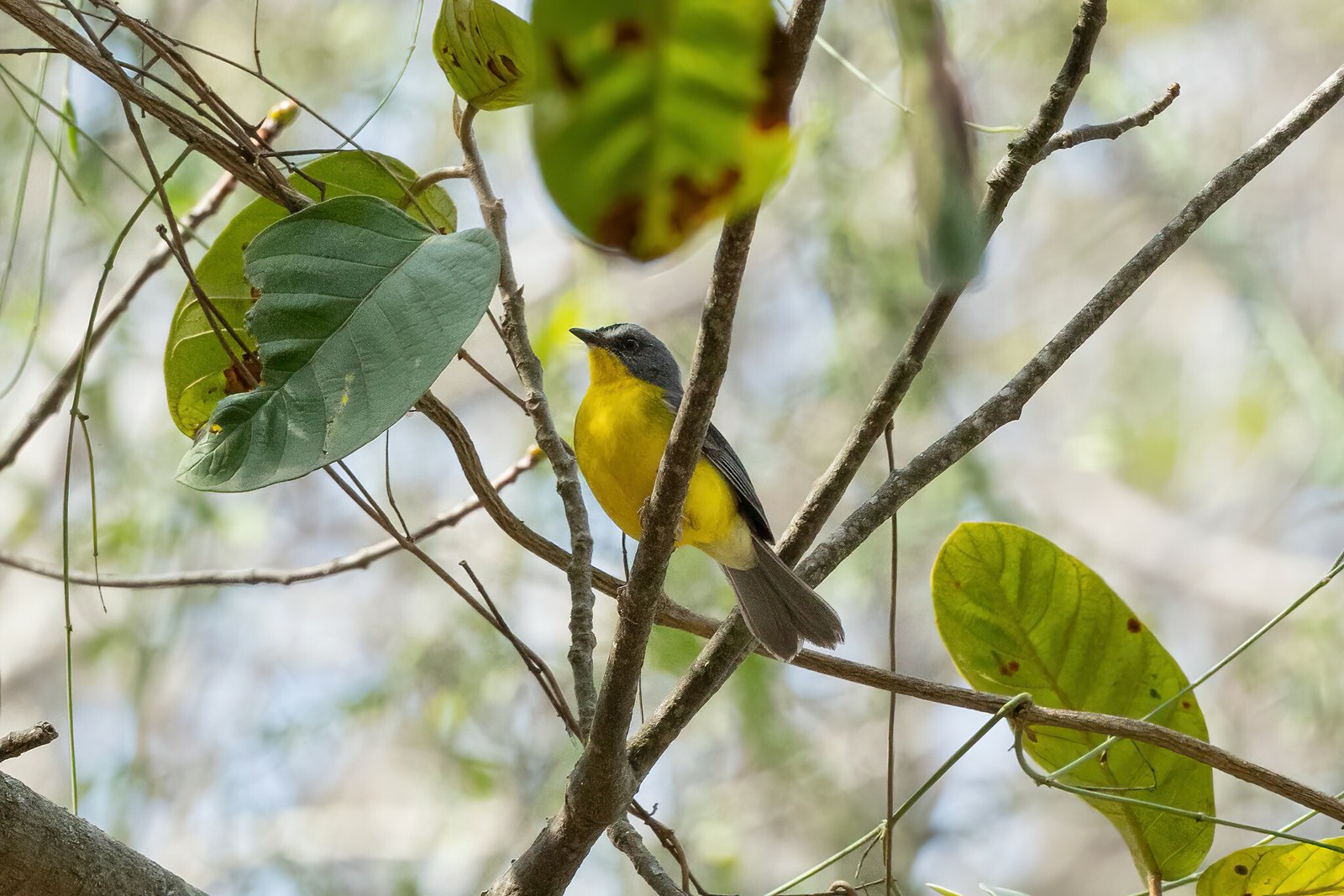
The Grey-and-gold Warbler is a blue-grey and yellow warbler of the dry and semi-humid forests of the Tumbesian region in western Ecuador and north-western Peru. It forages close to the ground and is a regular member of mixed understorey flocks.
Voice
The song is a fast, rising series of bright notes that grows louder towards the end. The call is a dry tchek.
Recording: Juan Freile — CC BY-NC-SA 4.0 · xeno-canto
Identification
14 cm, with a fairly long tail. The upperparts are blue-grey, the back sometimes with an olive wash. The crown has a yellow to ochre-brown central stripe between black bands; the colour of the crown stripe varies by subspecies. The side of the head is grey, with dark lores. The underparts are bright yellow, with greyish flanks. The sexes are alike. Young birds are duller, with fainter head markings.
Confusion species
Three-banded Warbler Basileuterus trifasciatus has an olive-green back, a grey head with three black stripes and paler yellow underparts, and usually lives higher in humid montane forest. Russet-crowned Warbler Myiothlypis coronata has an olive-green back and a rufous crown stripe, and lives much higher.
Habitat
Understorey of dry and semi-humid deciduous forest, more humid forest in ravines, secondary forest and scrub, from the lowlands to about 1800 m. It forages in pairs, often with mixed flocks, for insects on and just above the ground. The nest, as in related species, is a domed nest on the ground.
Where the bird is most at home, classified by the vegetation units of the Andes and the west coast.


Range and movements
Ecuador: the west and south-west, from Manabí south to El Oro and Loja. Peru: the north-west, in Tumbes, Piura and Lambayeque, locally into Cajamarca. Absent from Colombia, Bolivia and the Galápagos. It does not occur outside the guide area.
- Resident
- dark = core range, pale = thinly spread
How and when to look
In Tumbesian forest such as the Bosque Protector Cerro Blanco near Guayaquil and the reserves of Loja, look for pairs in the understorey, often in mixed flocks with other small insectivores.
Conservation status
Least Concern. The species has a limited range in the Tumbesian region, where much dry forest has been lost to agriculture, grazing and logging; it tolerates secondary forest and is fairly common in remaining forest.
Scientific name
Myiothlypis fraseri | (Sclater, 1884)
Sclater described the species in 1884 as Basileuterus fraseri; because it was later moved to another genus, the author and year stand in brackets. The genus Myiothlypis was introduced in 1851 by Cabanis. The genus name combines Greek muia, 'fly', with thlupis, an unidentified small bird. The species name honours Louis Fraser (1810–1866), English zoologist and collector, who collected the first specimen in Ecuador. The specimen the first description was based on came from Pallatanga, Chimborazo, Ecuador.