All species › Passerines › Antbirds › Guianan Warbling Antbird
Guianan Warbling Antbird | Hypocnemis cantator
Guyanaorpheusmierkruiper | Hormiguero guayanés | Papa-formiga-cantador
The Guianan Warbling Antbird is a small, streaked antbird of the Guianas and the northern Amazon basin. In the guide area itself it occurs barely if at all; its range reaches close to the eastern border of Colombia in Venezuela. It belongs to a group of closely related warbling antbirds that were treated as a single species until 2007 and are best told apart by song.
Voice
The song is a series of about six to ten clear whistles that gradually descend and become harsher: pee-pee-pee-pyee-pyee-pyeer. The female often answers with a shorter series of her own. Calls are a harsh cherr and short, sharp notes.
Recording: João Capurucho — CC BY-NC-SA 4.0 · xeno-canto
Identification
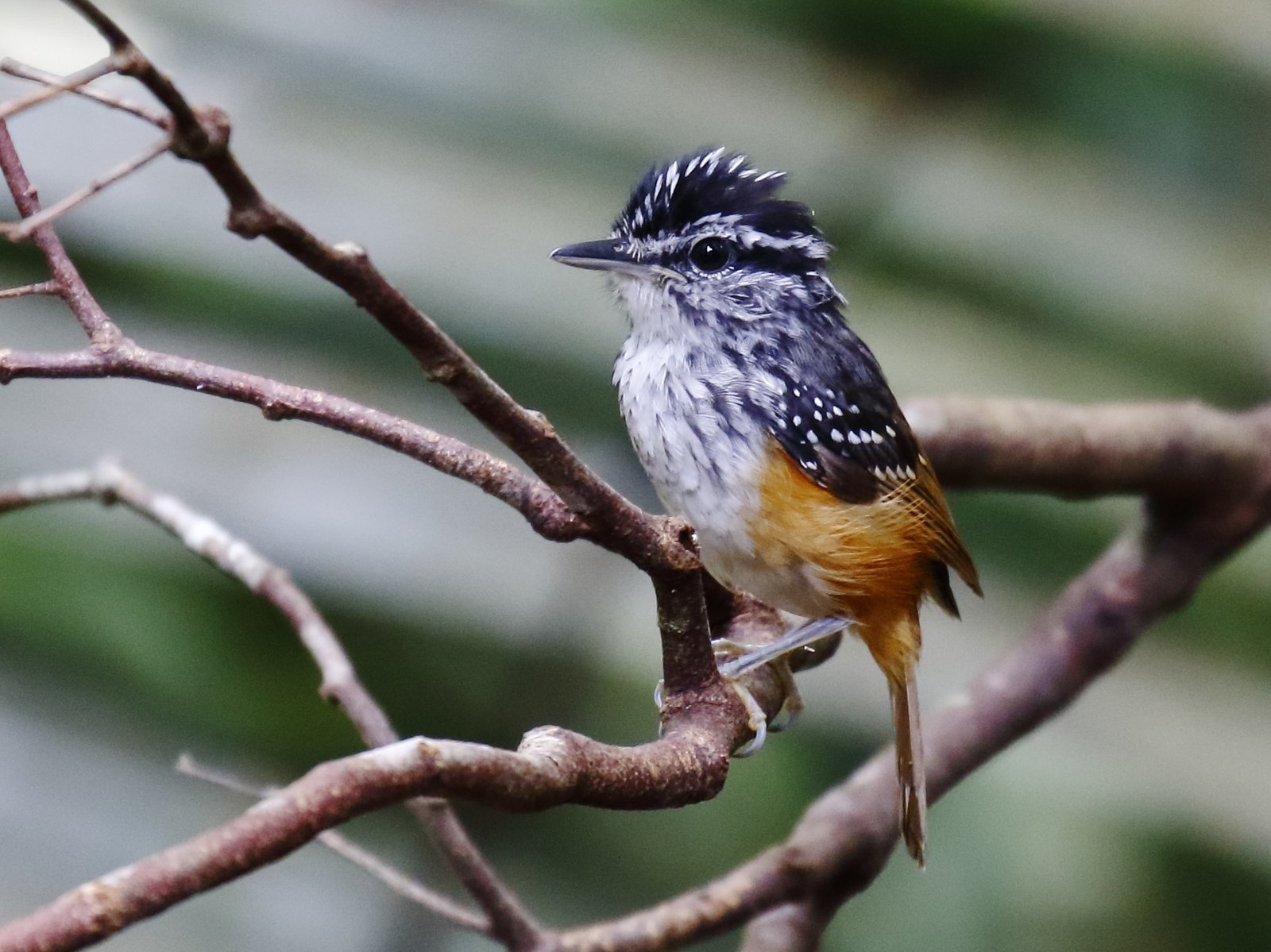
11–12 cm, with a fairly short tail. The male has a black crown with white streaks, a white supercilium, an olive-brown back with a black-and-white patch between the scapulars and black wings with rows of white spots. The throat and breast are white with black streaks on the sides, and the flanks are rufous. The female resembles the male but has ochre rather than white streaks on the crown.
Confusion species
Peruvian Warbling Antbird Hypocnemis peruviana lives in the western Amazon basin, from southern Colombia to Bolivia; it is more heavily streaked black on the breast and has deeper rufous flanks. Imeri Warbling Antbird Hypocnemis flavescens lives in eastern Colombia and has yellowish underparts. Yellow-breasted Warbling Antbird Hypocnemis subflava occurs in Peru and Bolivia and is yellow below. In all these cases the song is the most reliable feature.
Habitat
The understorey and mid-storey at edges of humid terra firme forest, at treefalls, in dense shrubbery and in secondary forest, from the lowlands to about 1000 m. It forages in pairs in dense vegetation for insects, sometimes in mixed flocks. The nest is a cup low in the vegetation.
Where the bird is most at home, classified by the vegetation units of the Andes and the west coast.


Range and movements
Occurs barely if at all in the guide area. Reports from the far east of Colombia need extra checking, because Imeri Warbling Antbird lives there. Absent from Ecuador, Peru, Bolivia and the Galápagos. Outside the guide area in eastern and southern Venezuela, the Guianas and northern Brazil.
- Resident
- dark = core range, pale = thinly spread
How and when to look
In the guide area the species is not to be expected regularly. Warbling antbirds in Colombia, Ecuador, Peru and Bolivia almost always belong to other species of this group; pay particular attention to the song.
Conservation status
Least Concern. Common in most of its range in the Guianas and northern Brazil.
Scientific name
Hypocnemis cantator | (Boddaert, 1783)
Boddaert described the species in 1783 as Formicarius Cantatar; because it was later moved to another genus, the author and year stand in brackets. The genus Hypocnemis was introduced in 1847 by Cabanis. The genus name combines Greek hupo, 'somewhat like', and knēmis, 'leggings'. The species name comes from Latin cantator, 'singer'. The specimen the first description was based on came from Cayenne, French Guiana.