All species › Passerines › Antbirds › Amazonian Antshrike
Amazonian Antshrike | Thamnophilus amazonicus
Amazonemierklauwier | Batará amazónico | Choca-canela
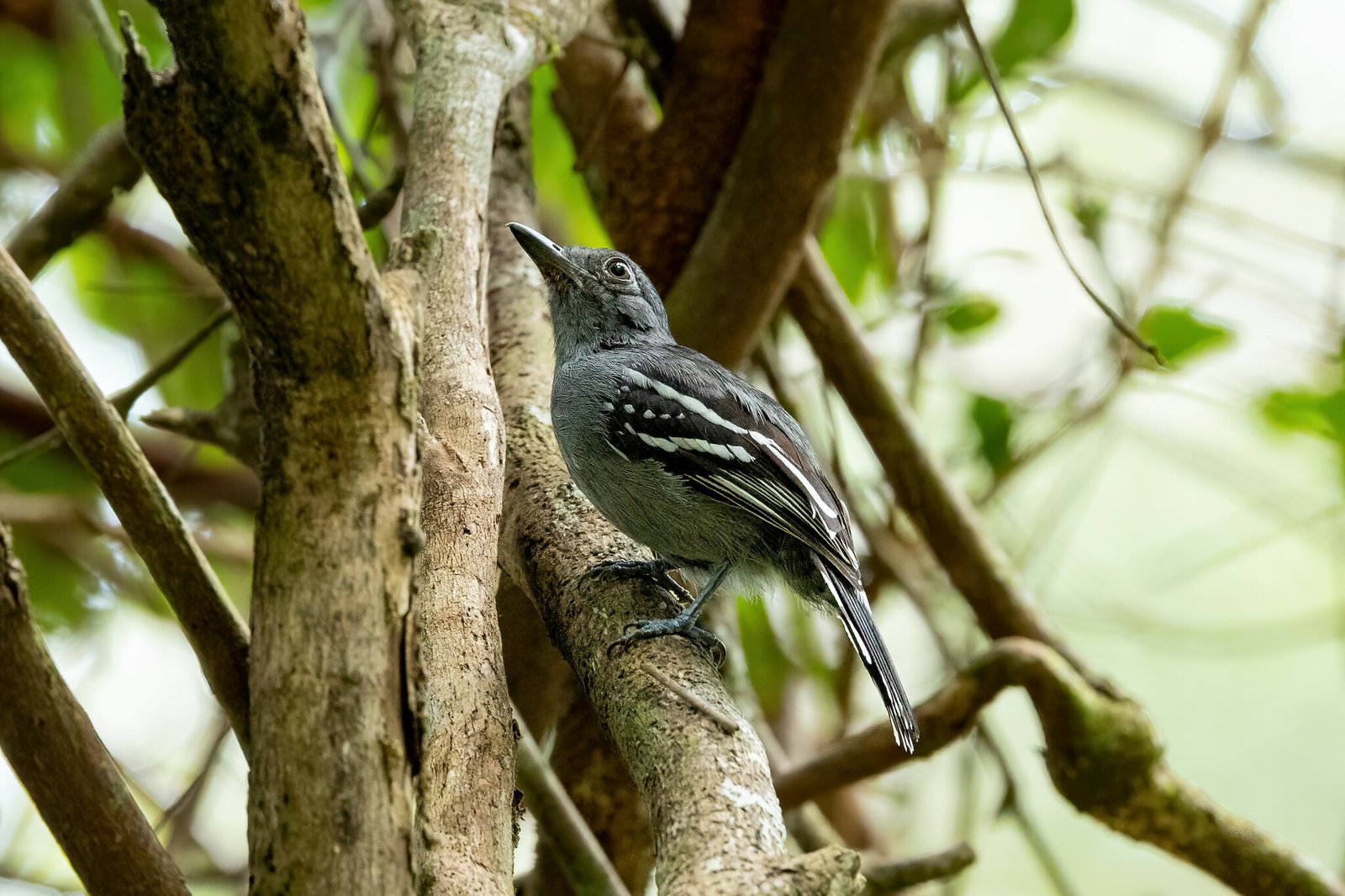
The Amazonian Antshrike is a small, grey antshrike of river-edge forest, várzea and forest edges in the Amazon basin and the Guianas. The female departs from the usual pattern of the genus with her orange-rufous head and breast. In the guide area it occurs mainly in eastern Colombia and north-eastern Peru.
Voice
The song is an accelerating series of nasal notes that drops slightly in pitch and ends in a short, emphatic note, as in related Thamnophilus species. Calls are short nasal notes and a soft rattle.
Recording: JAYRSON ARAUJO DE OLIVEIRA — CC BY-NC-SA 4.0 · xeno-canto
Identification
14–15 cm, with a heavy, hooked bill. The male is grey with a black crown, a concealed white patch between the shoulders, black wings with obvious white wing bars and edges, and a black tail with white tips; the underparts are pale grey, whiter on the belly. The female has an orange-rufous to rusty head, throat and breast, olive-brown upperparts, black wings with white wing bars and a buff belly.
Confusion species
Plain-winged Antshrike Thamnophilus schistaceus has wings without white markings; the female has a rufous crown but an olive breast. Mouse-colored Antshrike Thamnophilus murinus is browner grey with hardly any wing markings. Male Castelnau's Antshrike Thamnophilus cryptoleucus is larger and entirely black, with white shoulders. Spot-winged Antshrike Pygiptila stellaris has a short tail and small white dots on the wing coverts, and lives in the canopy.
Habitat
Mid-storey and lower canopy of várzea, igapó and other river-edge forest, forest edges, scrub on river islands, gallery forest in the llanos and locally white-sand forest, up to about 500 m. It searches leaves and twigs for insects and other arthropods, often in pairs and regularly with mixed flocks. The nest is an open cup suspended in a branch fork.
Where the bird is most at home, classified by the vegetation units of the Andes and the west coast.


Range and movements
Colombia: in the east, from Meta, Vichada and Guaviare to Guainía, Vaupés and Amazonas. Ecuador: rare and local in the north-east (Sucumbíos). Peru: in the Amazonian lowlands, mainly in Loreto, locally further south. Bolivia: in the north and north-east. Absent from the Galápagos. Outside the guide area in Venezuela, the Guianas and Amazonian Brazil.
- Resident
- dark = core range, pale = thinly spread
How and when to look
In eastern Colombia search gallery forest around Puerto Carreño and Inírida, or in Peru the edges of várzea and river islands around Iquitos. The pair is often heard first.
Conservation status
Least Concern. Widespread and locally fairly common; river-edge forest often recovers quickly after disturbance.
Scientific name
Thamnophilus amazonicus | Sclater, 1858
Sclater described the species in 1858 and placed it straight away in the genus where it still stands. The genus Thamnophilus was introduced in 1816 by Vieillot. The genus name comes from Greek thamnos, 'bush', and philos, 'loving': bush-lover. The species name refers to Amazonia. The specimen the first description was based on came from Rio Javari, Brazil/Peru.