All species › Passerines › Antbirds › Black-backed Antshrike
Black-backed Antshrike | Thamnophilus melanonotus
Zwartrugmierklauwier | Batará dorsinegro | Choca-de-dorso-preto
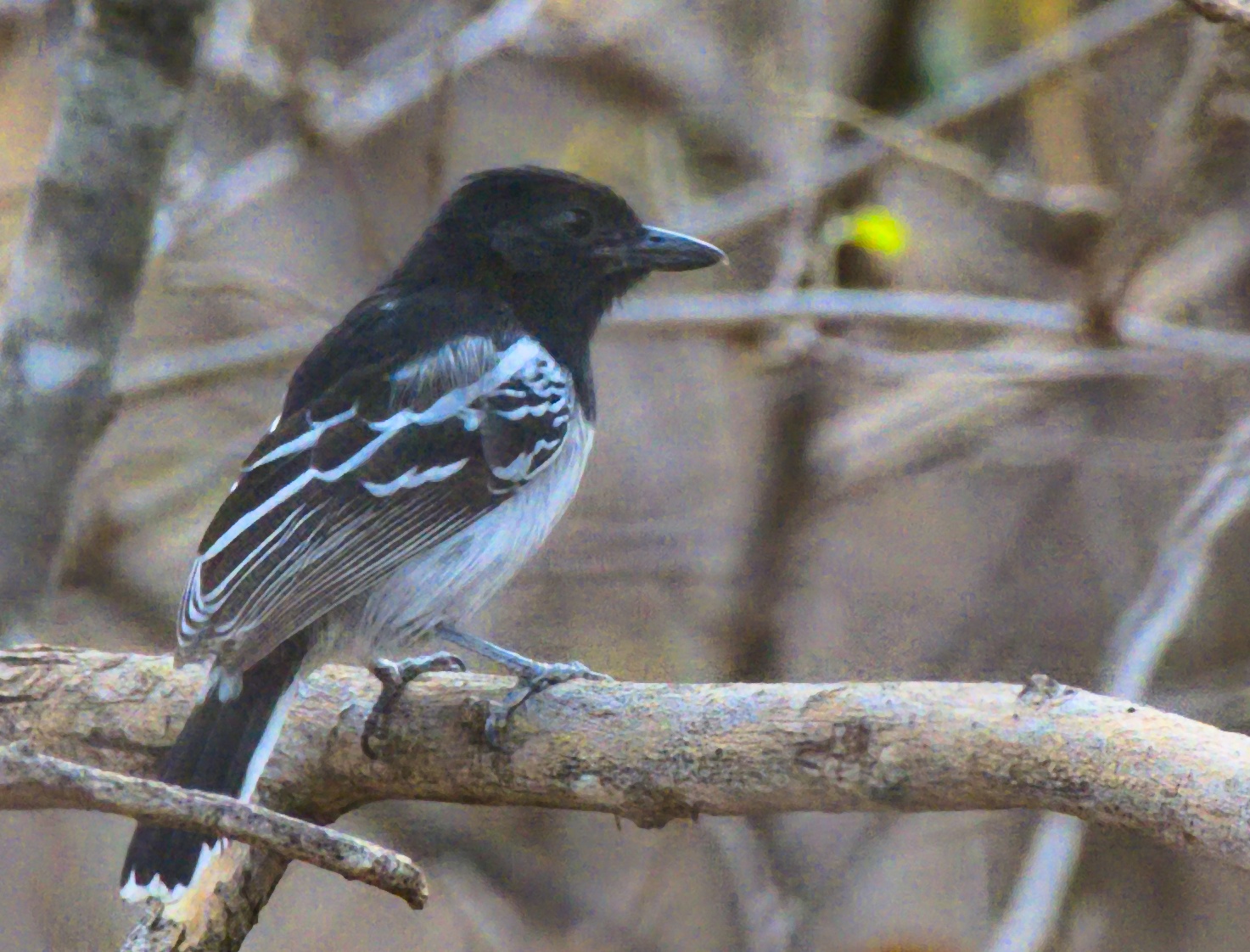
The Black-backed Antshrike is an antshrike of dry deciduous forest and thorn scrub in the Caribbean lowlands of northern Colombia and north-western Venezuela. The male is black with a white belly and white-marked wings, the female mainly brown and buff. It forages rather sluggishly, usually alone or in pairs, low in dense vine tangles.
Voice
Two song types have been described: a single soft cuua and a short nasal roll, qurrrrrr. Other calls include a nasal caaa-aa, nasal grunts and a soft ca-hunk.
Recording: Bernabe Lopez-Lanus — CC BY-NC-SA 3.0 · xeno-canto
Identification
15–16 cm, with a heavy, hook-tipped bill. The male has a black head, back, throat and breast; the scapulars are edged white and a concealed white patch lies between them. The lower back and rump are pale grey. The black wings have broad white tips to the coverts, and the black tail has white tips; the flanks, belly and undertail coverts are white. The female has a dark brown crown with cinnamon fringes, a buff face, brown upperparts with dark feather centres, brownish-black wings with pale buff edges, a rufous-brown tail with whitish tips, and buff underparts becoming whiter on the belly. Young males resemble the female with some black feathers.
Confusion species
Black-crested Antshrike Sakesphorus canadensis has an obvious crest; the male has a greyish-white back and grey flanks, the female a rufous crest and head. Male Barred Antshrike Thamnophilus doliatus is barred black and white throughout, the female plain rufous with streaked cheeks. Black-crowned Antshrike Thamnophilus atrinucha is grey with a black crown and lacks the black breast.
Habitat
Understorey and mid-storey of dry deciduous and semi-deciduous forest, especially where vine tangles are dense, also thorn scrub and gallery forest, from sea level to about 1000 m. It takes insects and other small arthropods on or just above the ground up to about 6 m, by gleaning and dropping to the ground; it rarely joins mixed flocks and occasionally attends army ants. In northern Colombia it breeds from March to July; the only nest described was an open cup in a branch fork holding two eggs.
Where the bird is most at home, classified by the vegetation units of the Andes and the west coast.


Range and movements
Colombia: in the Caribbean lowlands and foothills, from La Guajira and the Sierra Nevada de Santa Marta through Magdalena, Atlántico and Cesar south to northern Bolívar; a second population in the Zulia valley in Norte de Santander. Absent from Ecuador, Peru, Bolivia and the Galápagos. Outside the guide area in north-western Venezuela, around Lake Maracaibo and at the foot of the Cordillera de Mérida.
- Resident
- dark = core range, pale = thinly spread
How and when to look
Search dry forest around the Sierra Nevada de Santa Marta and in La Guajira, for example along forest edges with many vines. Listen in the early morning for the nasal roll and wait for the bird to show itself low in the vegetation.
Conservation status
Least Concern. The population size is unknown and thought to be declining. Fairly scarce in Colombia; conversion of dry forest to farmland and goat pasture may become a threat.
Scientific name
Thamnophilus melanonotus | Sclater, 1855
Sclater described the species in 1855 and placed it straight away in the genus where it still stands. The genus Thamnophilus was introduced in 1816 by Vieillot. The genus name comes from Greek thamnos, 'bush', and philos, 'loving': bush-lover. The species name comes from Greek melas, 'black', and nōtos, 'back'. The specimen the first description was based on came from Santa Marta, Colombia.