All species › Passerines › Antbirds › Upland Antshrike
Upland Antshrike | Thamnophilus aroyae
Aroyomierklauwier | Batará montano | Choca-montana
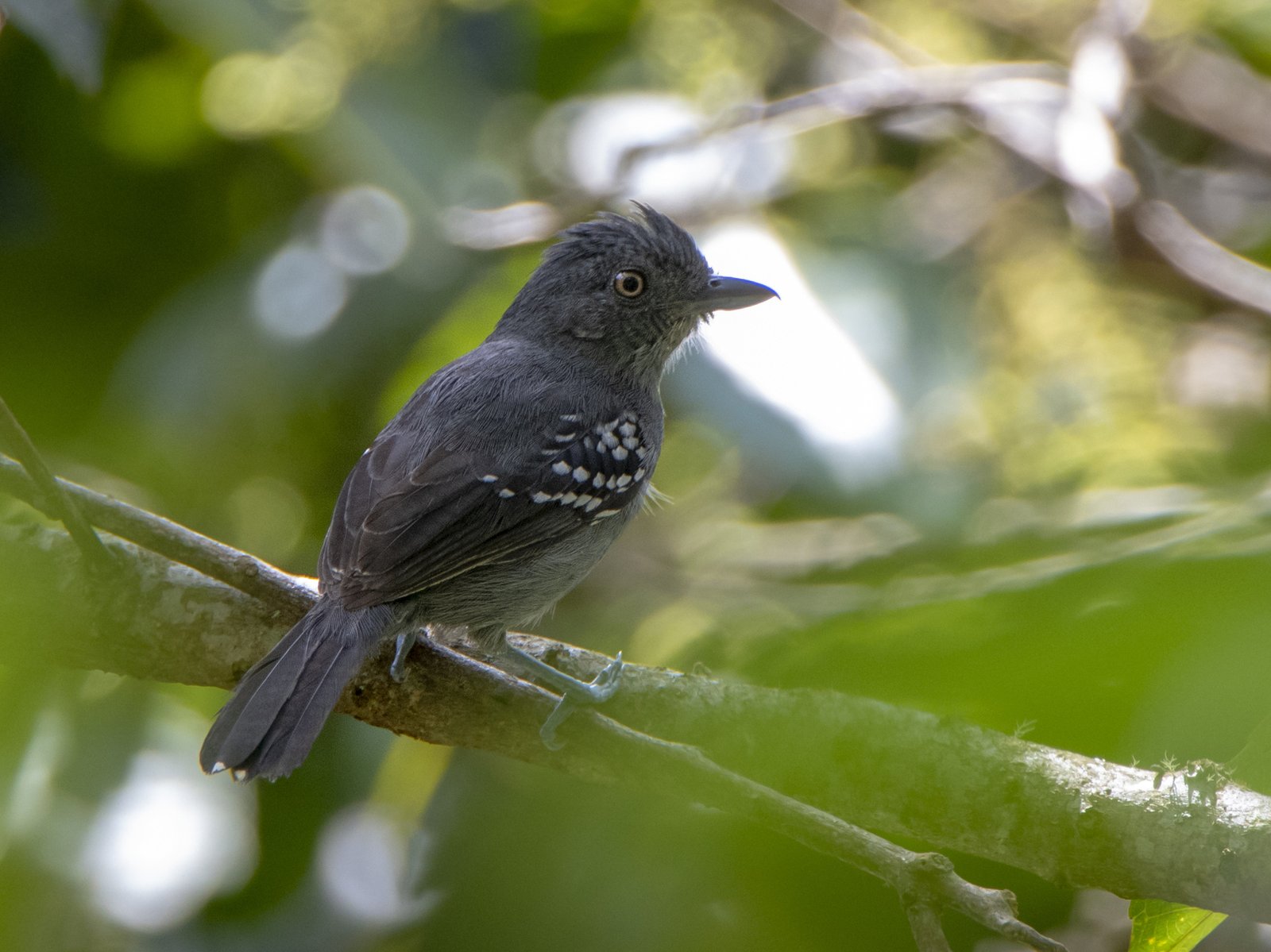
Upland Antshrike is a small grey antshrike with white wing spots of montane forest edges on the eastern side of the Andes in extreme south-eastern Peru and Bolivia. It lives in dense shrubs and vine tangles at forest edges, also in young growth on landslides and along roads. The whole range lies within the guide area.
Voice
The song is a fast, accelerating series of nasal notes ending in a descending, drawn-out note. Calls are high whines, a throaty, descending kaw and a mewing sound.
Recording: Jacob Wijpkema — CC BY-NC-SA 4.0 · xeno-canto
Identification
15 cm (14.5–15 cm). The male is mid-grey with a darker crown and a concealed white patch between the shoulders; wings and tail are black to brownish black, the wing coverts and most tail feathers have white tips. The underparts are slightly paler grey. The female has a dark rufous crown and nape, a grey face with white streaks or spots, dark olive-brown upperparts and tawny to olive-brown underparts. The eyes vary from pale buff to brown.
Confusion species
Variable Antshrike Thamnophilus caerulescens often lives higher and nearby; in Bolivia the male often has a buff lower belly and the female lacks the rufous crown. Uniform Antshrike Thamnophilus unicolor lacks the white wing spots and lives farther north. Bolivian Slaty Antshrike Thamnophilus sticturus and Natterer's Slaty Antshrike Thamnophilus stictocephalus live lower in the lowlands. Plain-winged Antshrike Thamnophilus schistaceus has no white spots in the wing and a red eye.
Habitat
Edges of humid montane forest, especially dense shrubs and vine tangles; it rarely enters the forest interior, but does use young growth on landslides and along roads. In Peru at about 800–1000 m, in Bolivia up to 1700–1900 m. It lives in pairs and searches dense foliage for insects.
Where the bird is most at home, classified by the vegetation units of the Andes and the west coast.


Range and movements
Peru: only in the extreme south-east, in Puno. Bolivia: on the east slope of the Andes in La Paz, Cochabamba and western Santa Cruz. Absent from Colombia, Ecuador and the Galápagos. Does not occur outside the guide area.
- Resident
- dark = core range, pale = thinly spread
How and when to look
Search along mountain roads in the Yungas of La Paz and Cochabamba, where forest edges and young growth on slopes can be scanned. Listen for the accelerating series that ends in a long, descending note.
Conservation status
Least Concern; formerly (1988) assessed as Near Threatened. The species has a small range but tolerates forest edges and young growth.
Scientific name
Thamnophilus aroyae | (Hellmayr, 1904)
Hellmayr described the species in 1904 as Dysithamnus aroyae; because it was later moved to another genus, the author and year stand in brackets. The genus Thamnophilus was introduced in 1816 by Vieillot. The genus name comes from Greek thamnos, 'bush', and philos, 'loving': bush-lover. The species name refers to La Aroya (La Oroya) in the Inambari valley, Peru, where the type was collected. The specimen the first description was based on came from La Oroya, Inambari valley, Peru.