All species › Passerines › Antbirds › White-shouldered Antshrike
White-shouldered Antshrike | Thamnophilus aethiops
Witschoudermierklauwier | Batará hombriblanco | Choca-lisa
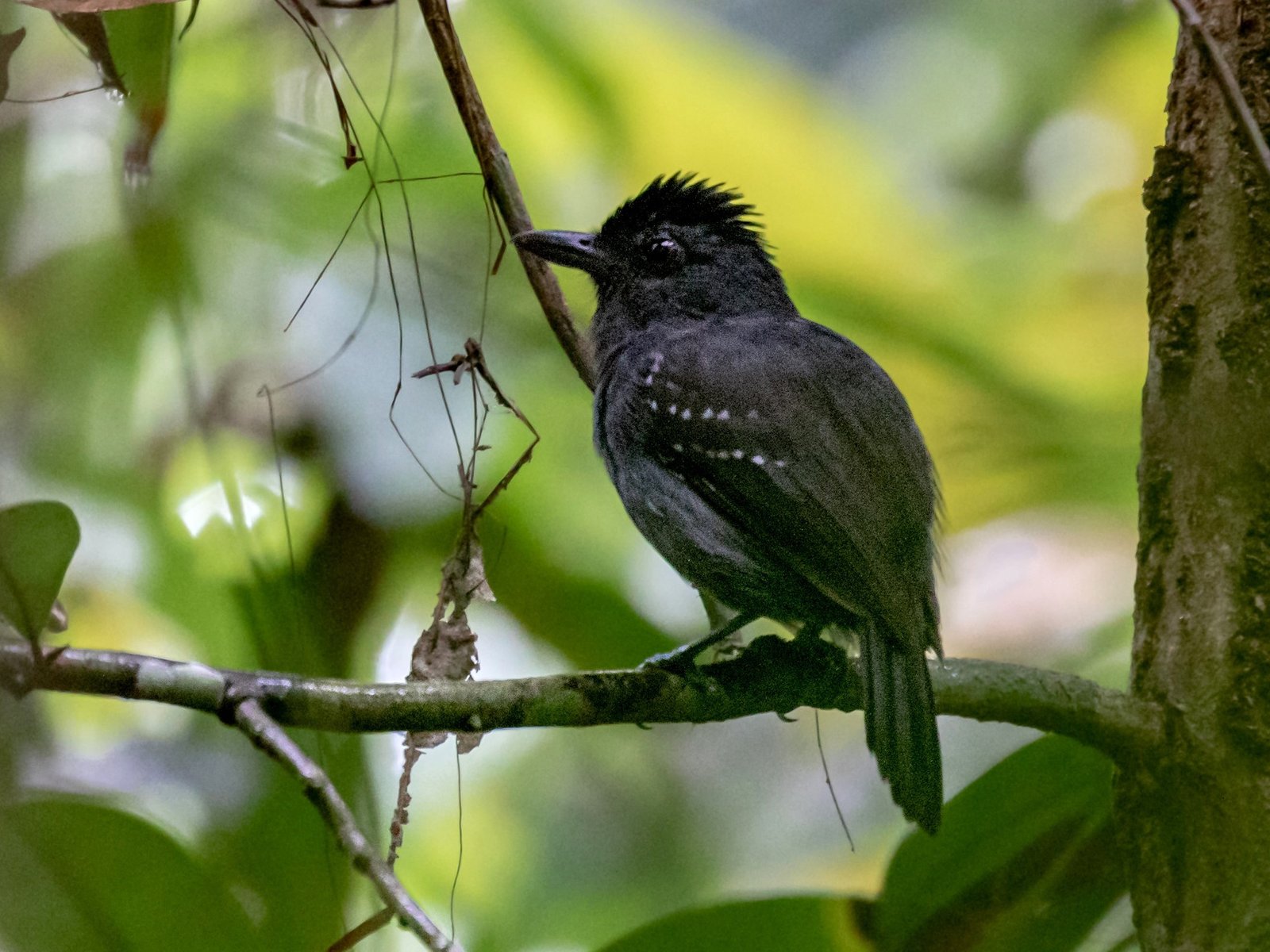
White-shouldered Antshrike is a dark antshrike of the dense understorey of Amazonian forest and the Andean foothills. The male is almost black with a few white dots on the shoulder, the female entirely deep rufous-brown. The song is a slow series of even, low notes, unlike the accelerating song of most relatives.
Voice
The male's song is a short series of low, slow notes at an even pace and even intensity, likened to the call of a forest-falcon or a trogon; the female's is higher. The most frequent call is an abrupt, throaty cuck, often repeated for long periods; also kaw calls, nasal notes and growls.
Recording: Juan Freile — CC BY-NC-SA 4.0 · xeno-canto
Identification
16 cm (15–17 cm), with a heavy, hooked bill. The male is mostly black, with a few white spots on the lesser wing coverts and the bend of the wing, white underwing coverts and a blackish-grey lower belly and undertail; some forms are greyer. The female is entirely deep rufous-brown, slightly darker above.
Confusion species
Castelnau's Antshrike Thamnophilus cryptoleucus is larger and lives on river islands; the female is black as well. The female Cocha Antshrike Thamnophilus praecox has a black head; that species lives in flooded forest. Plain-winged Antshrike Thamnophilus schistaceus is grey with a black crown and a red eye; the female has olive underparts. The female Great Antshrike Taraba major is white below.
Habitat
Dense understorey of evergreen forest, especially terra firme forest in the lowlands and in the Andean foothills, with a preference for dense, overgrown gaps. In Colombia up to 800 m, in Ecuador up to 1000 m, in Peru up to 1500 m. It lives in pairs and searches for insects close to the ground.
Where the bird is most at home, classified by the vegetation units of the Andes and the west coast.


Range and movements
Colombia: east of the Andes, from Cauca and Caquetá to Vichada, Guainía and Vaupés. Ecuador: in the east. Peru: in the east, on both sides of the Marañón and the Amazon. Bolivia: in the north, south to Cochabamba, and in north-eastern Santa Cruz. Absent from the Galápagos. Outside the guide area in Venezuela and Brazil, with an isolated population in north-eastern Brazil.
- Resident
- dark = core range, pale = thinly spread
How and when to look
Listen in terra firme and foothill forest, for example around Manu or in eastern Ecuador, for the slow series of low notes or the repeated cuck. The bird usually stays low in dense vegetation.
Conservation status
Least Concern. The range is large; the species is tied to forest with a dense understorey.
Scientific name
Thamnophilus aethiops | Sclater, 1858
Sclater described the species in 1858 and placed it straight away in the genus where it still stands. The genus Thamnophilus was introduced in 1816 by Vieillot. The genus name comes from Greek thamnos, 'bush', and philos, 'loving': bush-lover. The species name comes from Latin aethiops, 'Ethiopian', in the sense of black, for the male's dark plumage. The specimen the first description was based on came from Río Napo, Ecuador.