All species › Passerines › Antbirds › Uniform Antshrike
Uniform Antshrike | Thamnophilus unicolor
Eenkleurige mierklauwier | Batará unicolor | Choca-uniforme
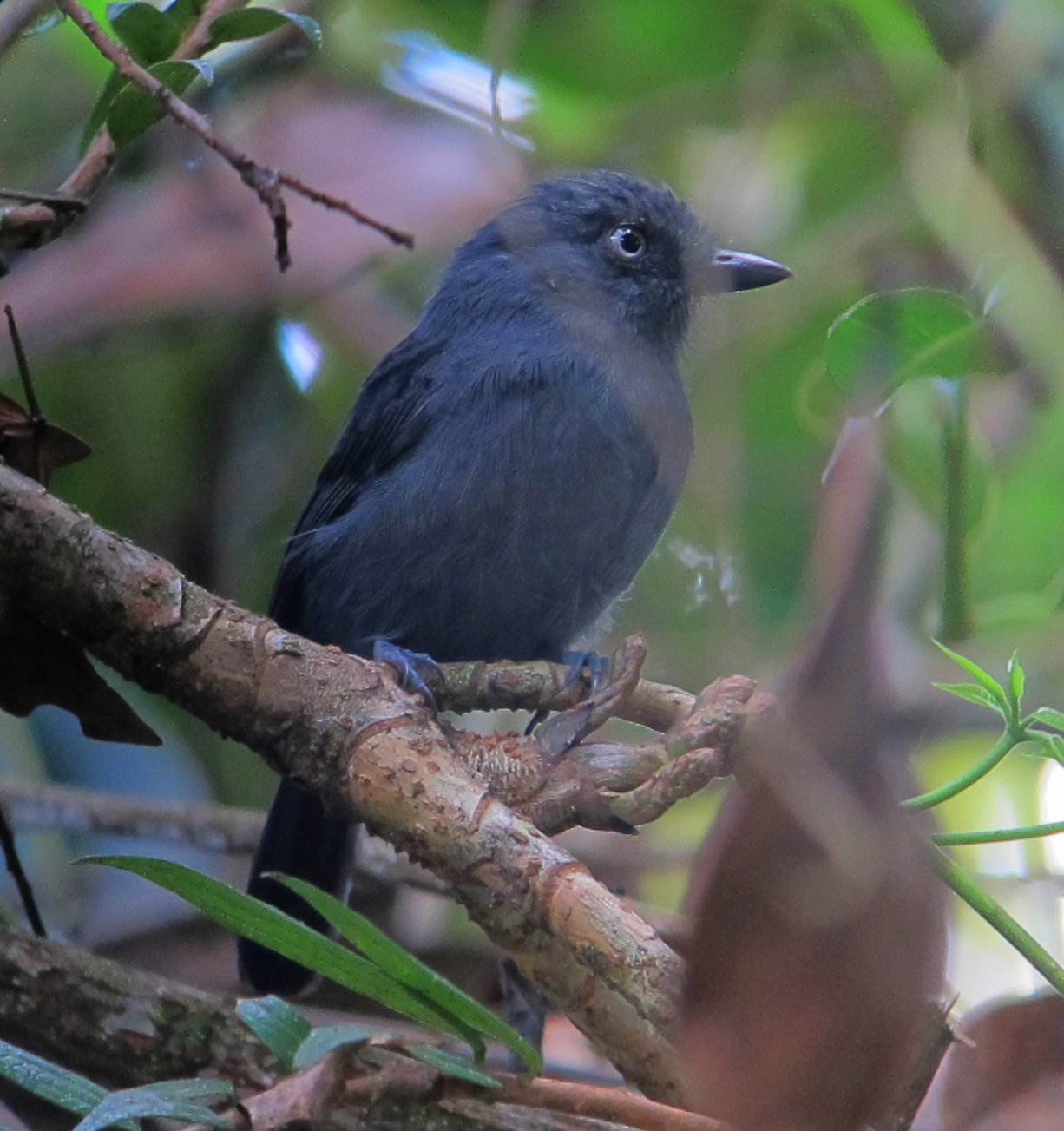
Uniform Antshrike is an antshrike of Andean montane forest, without white spots in the wing. The male is plain dark grey, the female rufous-brown with a grey face; both have a pale grey eye. It lives from Colombia to southern Peru, on both slopes of the Andes.
Voice
The song is a simple short series of usually 3–5 nasal notes, sometimes with a rising inflection, or a slightly accelerating series of 4–8 high, descending notes; higher-pitched in the south. Calls are a rattled karrrr, a descending whine and a throaty, descending kaw.
Recording: Sergio Adrian Garcia-Murcia — CC BY-NC-SA 4.0 · xeno-canto
Identification
15–16 cm (14.5–17 cm), with a heavy, hooked bill. The male is entirely dark slate-grey to blackish grey, sometimes with small white tips to the outer tail feathers. The female has a rufous crown, a grey face, rufous-brown upperparts and pale rufous-brown underparts; birds from the south of the range are darker and more rufous. Both sexes have a greyish-white eye, a black bill and blue-grey legs.
Confusion species
Plain-winged Antshrike Thamnophilus schistaceus lives lower, in the Amazonian lowlands, and has a red eye; the female is more olive-brown, without a grey face. Upland Antshrike Thamnophilus aroyae in south-eastern Peru and Bolivia and Variable Antshrike Thamnophilus caerulescens have white spots on the wing. Dusky-throated Antshrike Thamnomanes ardesiacus lives in the lowlands, perches upright and has a dark eye.
Habitat
Understorey of humid montane forest, especially forest edges and treefall gaps, but also in the forest interior; in Colombia at 1200–2200 m, in Ecuador mostly 1000–2000 m, in Peru 1250–2300 m. It lives in pairs and searches dense vegetation for insects, sometimes in mixed flocks.
Where the bird is most at home, classified by the vegetation units of the Andes and the west coast.


Range and movements
Colombia: in all three Andean ranges. Ecuador: on the west slope along almost its entire length, and on the east slope in the south, from southern Morona-Santiago. Peru: on the east slope, from the north south locally to Cusco. Absent from Bolivia and the Galápagos. Does not occur outside the guide area.
- Resident
- dark = core range, pale = thinly spread
How and when to look
Search forest edges and gaps in montane forest around Mindo in Ecuador or along the road to Manu in Cusco. Listen for a short series of nasal notes from dense vegetation.
Conservation status
Least Concern. The species tolerates forest edges and gaps but depends on montane forest that is cleared locally.
Scientific name
Thamnophilus unicolor | (Sclater, 1859)
Sclater described the species in 1859 as Dysithamnus unicolor; because it was later moved to another genus, the author and year stand in brackets. The genus Thamnophilus was introduced in 1816 by Vieillot. The genus name comes from Greek thamnos, 'bush', and philos, 'loving': bush-lover. The species name comes from Latin unicolor, 'of one colour'. The specimen the first description was based on came from Pallatanga, Ecuador.