All species › Birds of prey › Kites, Old World vultures, eagles and hawks › Harris's Hawk
Harris's Hawk | Parabuteo unicinctus
Woestijnbuizerd | Aguililla rojinegra | Gavião-asa-de-telha
Harris's Hawk is a dark, long-legged hawk of dry, open country with shrubs and scattered trees. It is one of the few raptors that hunt together in small groups. In the guide area it lives mainly along the dry Pacific coast, in dry Andean valleys and in the Chaco.
Voice
A hoarse, harsh, drawn-out call, kraaaah, mainly at the nest and when disturbed.
Recording: Ricardo José Mitidieri — CC BY-NC-SA 4.0 · xeno-canto
Identification
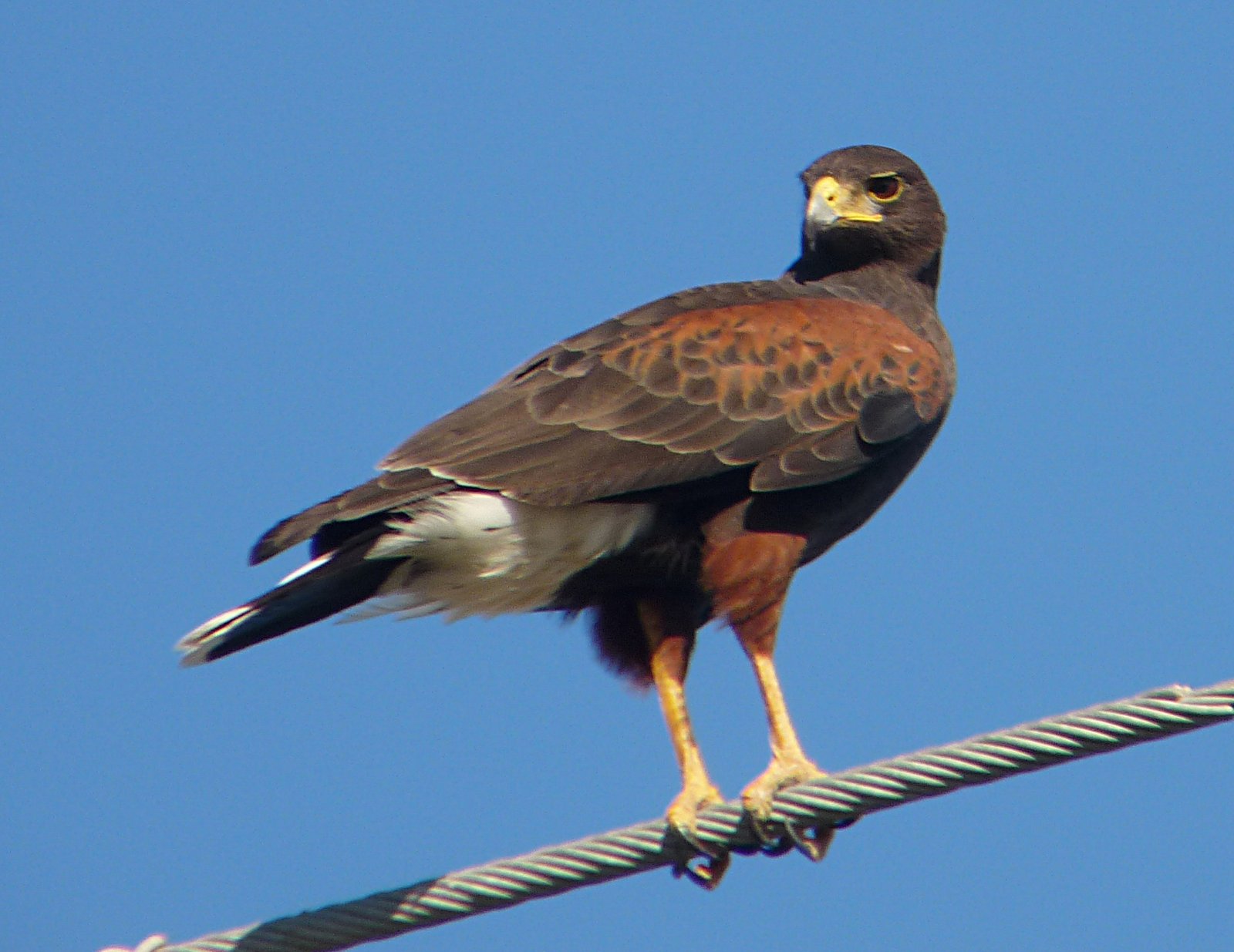
46–56 cm; the female is clearly larger than the male. The adult is dark chocolate brown, with rufous shoulders, underwing coverts and thighs. The tail is black with a white base, white undertail coverts and a broad white terminal band. The cere and long legs are yellow. In flight the rufous underwing coverts contrast with the dark flight feathers. Juveniles are brown with pale streaks on the underparts, less rufous in the wing and a finely barred tail.
Confusion species
Savanna Hawk Buteogallus meridionalis is largely rufous, with very long legs and a black tail with one white band. The dark morph of Variable Hawk Geranoaetus polyosoma lacks rufous shoulders and has a white tail with a black terminal band. White-rumped Hawk Parabuteo leucorrhous is much smaller and lives in montane forest. Juveniles can resemble juvenile Great Black Hawks Buteogallus urubitinga, which have a longer, finely barred tail.
Habitat
Dry open country with shrubs and scattered trees: thorn scrub, dry forest, coastal desert with river valleys, dry Andean valleys, Chaco, and fields, irrigated farmland and marsh edges. From sea level to about 3000 m in dry valleys. It hunts from a post or tree or in small groups for small mammals, birds and reptiles. It often breeds with more than two adults per nest; the nest is a stick nest in a tree, cactus or power pylon.
Where the bird is most at home, classified by the vegetation units of the Andes and the west coast.


Range and movements
In Colombia in the dry Caribbean region and locally in dry inland valleys. In Ecuador in the dry west and in some dry Andean valleys. In Peru along the whole coast, on the west slope of the Andes and in dry Andean valleys such as the Marañón Valley. In Bolivia in the Chaco and in dry Andean valleys. Outside the guide area from the south-western United States to Chile and Argentina.
- Resident
- dark = core range, pale = thinly spread
How and when to look
Search in river valleys and farmland along the Peruvian coast and in the dry west of Ecuador, where the birds often sit on posts and power pylons, sometimes several together.
Conservation status
Least Concern. Widespread and locally common; it also occurs in farmland and on the edges of towns.
Scientific name
Parabuteo unicinctus | (Temminck, 1824)
Temminck described the species in 1824 as Falco unicinctus; because it was later moved to another genus, the author and year stand in brackets. The genus Parabuteo was introduced in 1874 by Ridgway. The genus name combines Greek para, 'beside' or 'resembling', with Latin buteo, a kind of buzzard. The species name comes from Latin uni-, 'once', and cinctus, 'girdled', after the white band at the tail tip. The specimen the first description was based on came from Boa Vista, Brazil.