All species › Birds of prey › Kites, Old World vultures, eagles and hawks › White-rumped Hawk
White-rumped Hawk | Parabuteo leucorrhous
Witstuitbuizerd | Gavilán lomiblanco | Gavião-de-sobre-branco
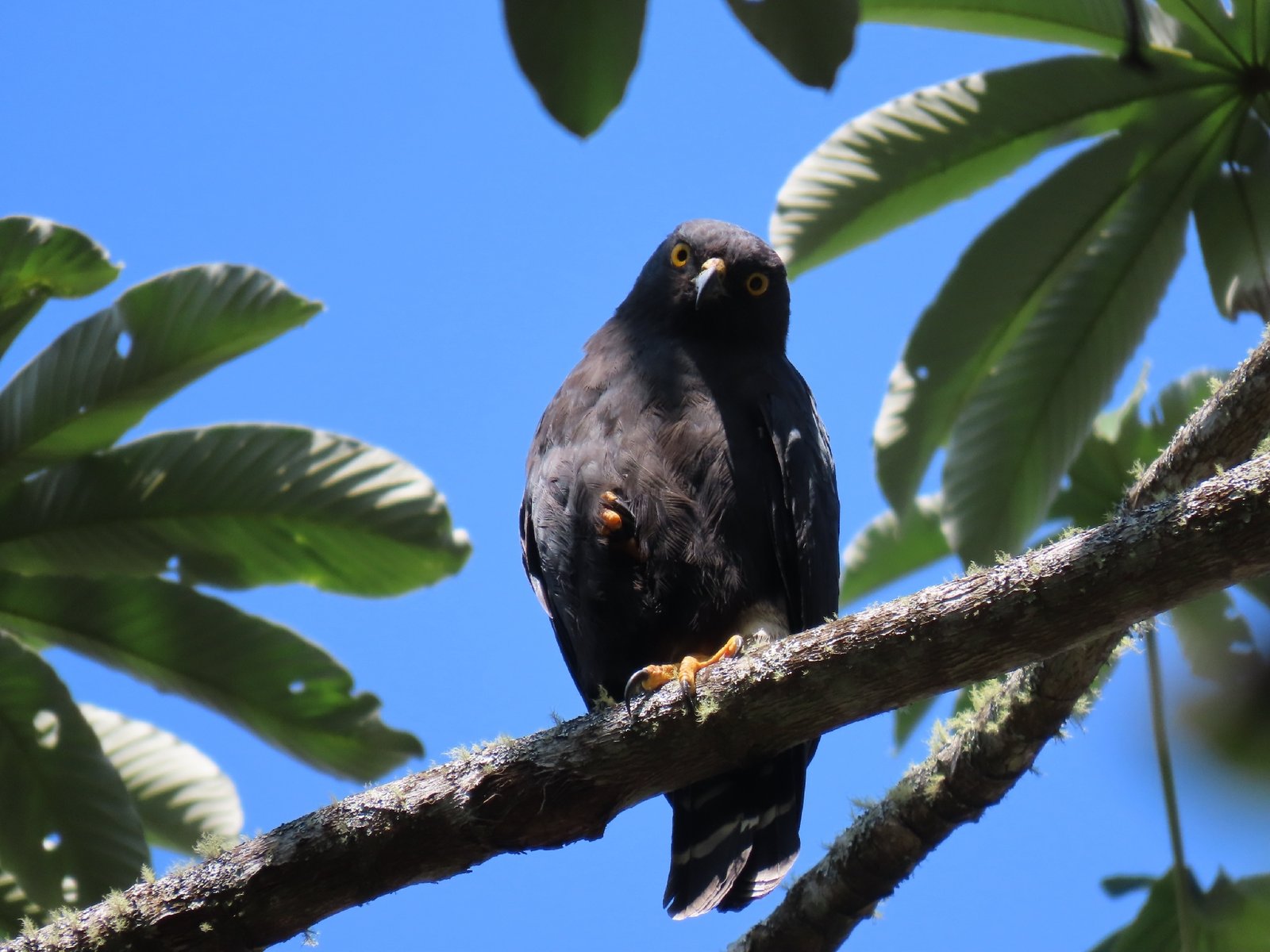
The White-rumped Hawk is a small, blackish hawk of Andean montane forest. It lives concealed in and above the canopy and is usually seen briefly when it soars low over the forest. It occurs in all four countries of the guide area, mainly in cloud forest.
Voice
A high, thin, descending scream, kee-aah, often in flight.
Recording: Fabrice Schmitt — CC BY-NC-SA 4.0 · xeno-canto
Identification
34–40 cm; the female is larger than the male. The adult is largely blackish, with a white rump and white undertail coverts and rufous thighs. The tail is black with one or two narrow pale grey to white bands and a narrow pale tip. The eye is pale yellow, the cere and legs yellow. In flight the whitish underwing coverts contrast with the dark body and the grey, barred flight feathers. Juveniles are dark brown with buff streaks on the head and underparts, and also have a pale rump.
Confusion species
The dark morph of Short-tailed Hawk Buteo brachyurus lacks the white rump and rufous thighs, and has dark underwing coverts. White-throated Hawk Buteo albigula is white below with dark flank patches. Harris's Hawk Parabuteo unicinctus is larger, has rufous shoulders and lives in dry open country. Zone-tailed Hawk Buteo albonotatus is larger, with longer, narrower wings.
Habitat
Humid montane forest and cloud forest, forest edges and clearings, also mosaics of forest and pasture. Mainly between about 1500 and 3500 m. It hunts from the canopy or in a short flight low over the forest for small mammals, birds and reptiles. Little is known about the nest.
Where the bird is most at home, classified by the vegetation units of the Andes and the west coast.


Range and movements
In Colombia in the three Andean ranges. In Ecuador on both slopes of the Andes. In Peru mainly on the east slope of the Andes, locally also in the north-west. In Bolivia on the east slope of the Andes, in the Yungas. Outside the guide area in the Andes of Venezuela and, separately, in south-eastern Brazil, Paraguay and north-eastern Argentina.
- Resident
- dark = core range, pale = thinly spread
How and when to look
Search on sunny mornings along roads through cloud forest, from a point with a view over the canopy. The white rump and white undertail coverts can be seen when the bird glides low over the forest.
Conservation status
Least Concern. Widespread in montane forest, but everywhere in low numbers; locally sensitive to deforestation.
Scientific name
Parabuteo leucorrhous | (Quoy & Gaimard, 1824) (GBIF: Percnohierax leucorrhous)
Quoy & Gaimard described the species in 1824 as Falco Leucorrhous; because it was later moved to another genus, the author and year stand in brackets. The genus Parabuteo was introduced in 1874 by Ridgway. The genus name combines Greek para, 'beside' or 'resembling', with Latin buteo, a kind of buzzard. The species name combines Greek leukos, 'white', with orrhos, 'rump', after the white rump. The specimen the first description was based on came from Rio de Janeiro, Brazil.