All species › Birds of prey › Kites, Old World vultures, eagles and hawks › Roadside Hawk
Roadside Hawk | Rupornis magnirostris
Wegbuizerd | Aguililla caminera | Gavião-carijó
The Roadside Hawk is the most widespread small hawk of the lowlands and lower slopes. It often sits on a post, a wire or a branch along a road or forest edge, and calls loudly and often. It occurs in all four countries of the guide area, on both sides of the Andes.
Voice
A loud, nasal, descending scream, keeeeer, often repeated; also a series of rapid, shrill calls, kee-kee-kee, by pairs.
Recording: Richard E. Webster — CC BY-NC-SA 4.0 · xeno-canto
Identification
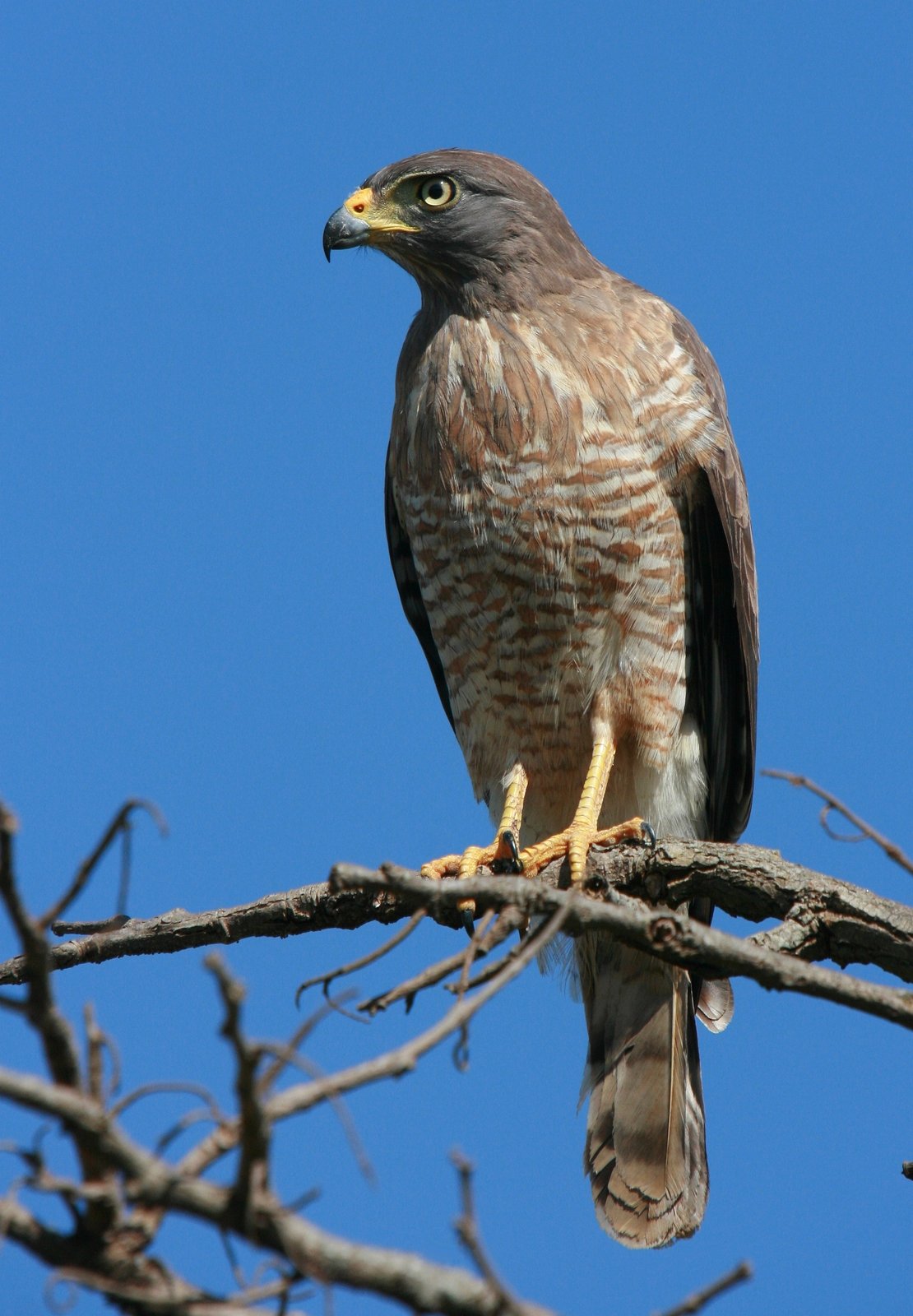
33–41 cm; the female is larger than the male. The adult is grey-brown to grey above, with a grey head and breast. The belly is finely barred rufous and white. The tail is grey with four or five dark bars. The eye is pale yellow, the cere and legs yellow. In flight a rufous panel on the primaries can be seen; the wings are fairly short and rounded. Juveniles are browner, with a pale supercilium, a streaked breast and a barred belly.
Confusion species
Grey-lined Hawk Buteo nitidus is plain grey above, finely barred grey below and has a black tail with white bands, with no rufous in the wing. Broad-winged Hawk Buteo platypterus is a winter visitor with dark eyes, a white underwing with a dark border and broad white tail bands. Short-tailed Hawk Buteo brachyurus has white or entirely dark underparts and is more aerial. In western Ecuador and Peru, Grey-backed Hawk Pseudastur occidentalis resembles it only in size; it is white below.
Habitat
Forest edges, clearings, secondary forest, riverine forest, savannas, pastures and fields with trees, plantations and gardens. From sea level to about 2500 m, locally higher in dry valleys. It hunts from a perch for lizards, large insects, frogs, small mammals and birds. The nest is a small stick nest in a tree.
Where the bird is most at home, classified by the vegetation units of the Andes and the west coast.


Range and movements
In Colombia throughout the lowlands and in the lower parts of the Andean valleys. In Ecuador in the western and eastern lowlands and on the lower slopes. In Peru in the eastern lowlands and on the east slope, and in the north-west. In Bolivia in the lowlands and in the lower Andean valleys. Outside the guide area from Mexico to northern Argentina.
- Resident
- dark = core range, pale = thinly spread
How and when to look
Drive along roads through pasture and forest edge in the lowlands; the species often perches in the open on a post or wire and calls when approached. The rufous wing panel is visible when it flies off.
Conservation status
Least Concern. Common and widespread; it benefits from deforestation and the creation of open, partly wooded country.
Scientific name
Rupornis magnirostris | (Gmelin, 1788)
Gmelin described the species in 1788 as Falco magnirostris; because it was later moved to another genus, the author and year stand in brackets. The genus Rupornis was introduced in 1844 by Kaup. The genus name combines Ancient Greek rhupos, 'dirt' or 'filth', with ornis, 'bird'. The species name combines Latin magnus, 'great', with -rostris, 'billed', thus 'large-billed'. The specimen the first description was based on came from Cayenne, French Guiana.