All species › Birds of prey › Kites, Old World vultures, eagles and hawks › Chaco Eagle
Chaco Eagle | Buteogallus coronatus
Chaco-arend | Águila coronada | Águia-cinzenta
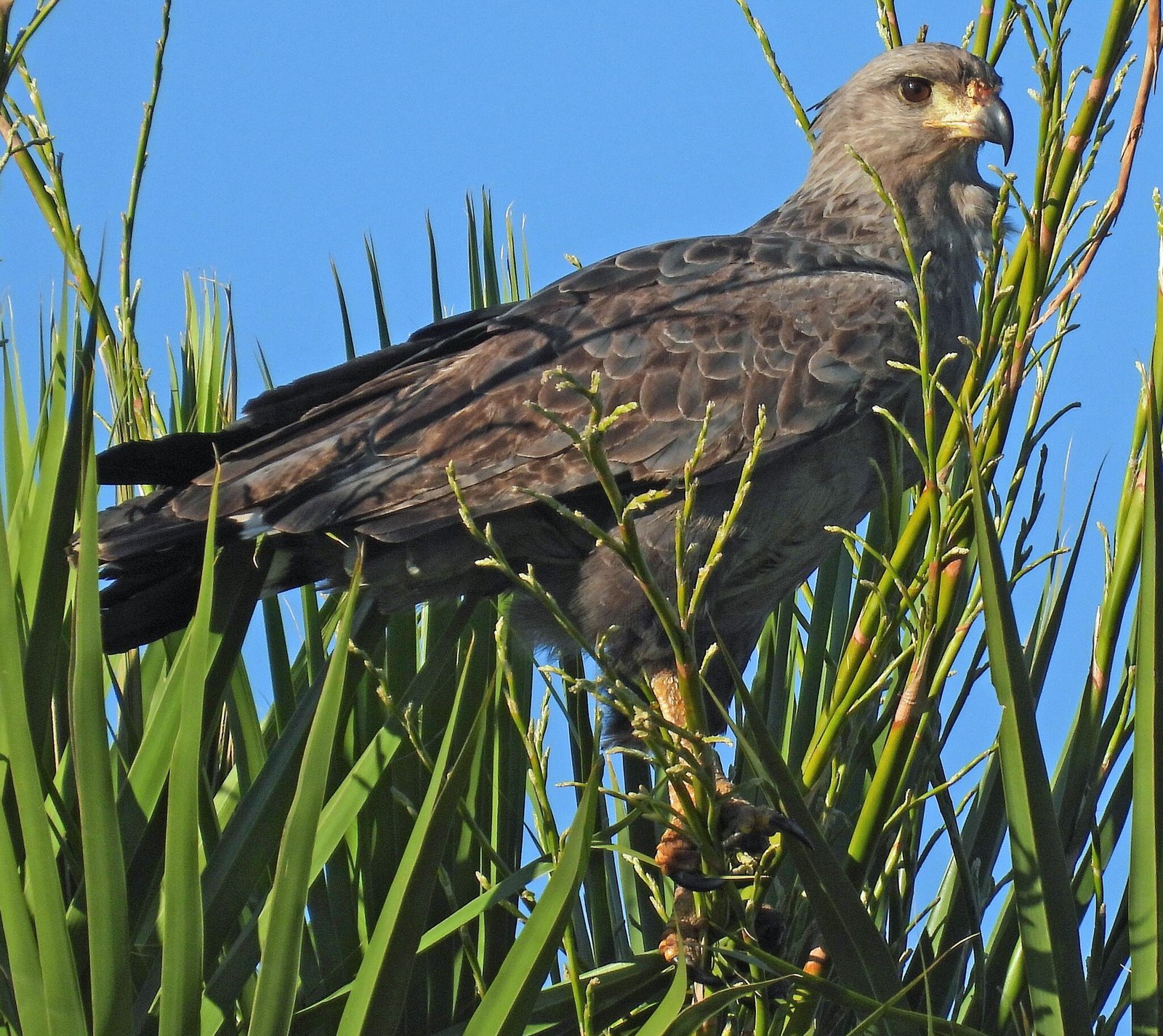
The Chaco Eagle is a large, pale grey eagle with a prominent crest, living in the open dry woodlands and savannas of central South America. It is rare everywhere and the population is small. In the guide area it occurs only in the lowlands of Bolivia.
Voice
A high, long-drawn whistle, often repeated; also a series of short, shrill calls.
Recording: Richard E. Webster — CC BY-NC-SA 4.0 · xeno-canto
Identification
73–79 cm; the female is larger than the male. The adult is uniform pale ash grey to greyish brown, with a long, pointed crest that is often held erect. The flight feathers are darker. The tail is fairly short and black, with one broad white central band and a white tip. The cere and legs are yellow. In flight the wings are long and very broad. Juveniles are brownish above and pale buff below with dark streaks, with a pale head and a barred tail.
Confusion species
Black-chested Buzzard-Eagle Geranoaetus melanoleucus has a dark breast contrasting with a white belly, no crest and a very short, wedge-shaped tail. Solitary Eagle Buteogallus solitarius is darker slate grey, with a short crest, and lives in montane forest. Savanna Hawk Buteogallus meridionalis is smaller and rufous. Crested Eagle Morphnus guianensis has a white belly and a long, barred tail and lives in humid forest.
Habitat
Open dry woodland, Chaco forest, cerrado, savannas with scattered trees and scrub. In the lowlands, up to about 1000 m. It sits for long periods on an exposed perch in a tree or on a post and hunts mainly armadillos and other medium-sized mammals, also snakes and birds, and also takes carrion. The nest is a large stick nest in a tree; one young is raised per clutch.
Where the bird is most at home, classified by the vegetation units of the Andes and the west coast.


Range and movements
In Bolivia scarce in the lowlands of the east and south-east: the Chaco, the Chiquitano dry forest and the eastern savannas. Not in Colombia, Ecuador or Peru. Outside the guide area in central and southern Brazil, Paraguay and northern and central Argentina.
- Resident
- dark = core range, pale = thinly spread
How and when to look
Search in the Bolivian Chaco and the dry forest of Santa Cruz along open roads, where the bird sometimes sits on a dead tree or post. Records are scarce; look for a large grey raptor with a crest and a short tail.
Conservation status
Endangered. The population is small and declining due to persecution, conversion of dry forest and savanna to farmland, road collisions and electrocution on power lines.
Scientific name
Buteogallus coronatus | (Vieillot, 1817) (GBIF: Harpyhaliaetus coronatus)
Vieillot described the species in 1817 as Harpyia coronata; because it was later moved to another genus, the author and year stand in brackets. The genus Buteogallus was introduced in 1830 by Lesson. The genus name combines the genus names Buteo (buzzards) and Gallus (junglefowl, Latin gallus, 'cockerel'). Lesson erected the genus in 1830. The species name is Latin coronatus, 'crowned', after the crest. The specimen the first description was based on came from Paraguay.