All species › Birds of prey › Kites, Old World vultures, eagles and hawks › Solitary Eagle
Solitary Eagle | Buteogallus solitarius
Amerikaanse zwarte arend | Águila solitaria | Águia-solitária
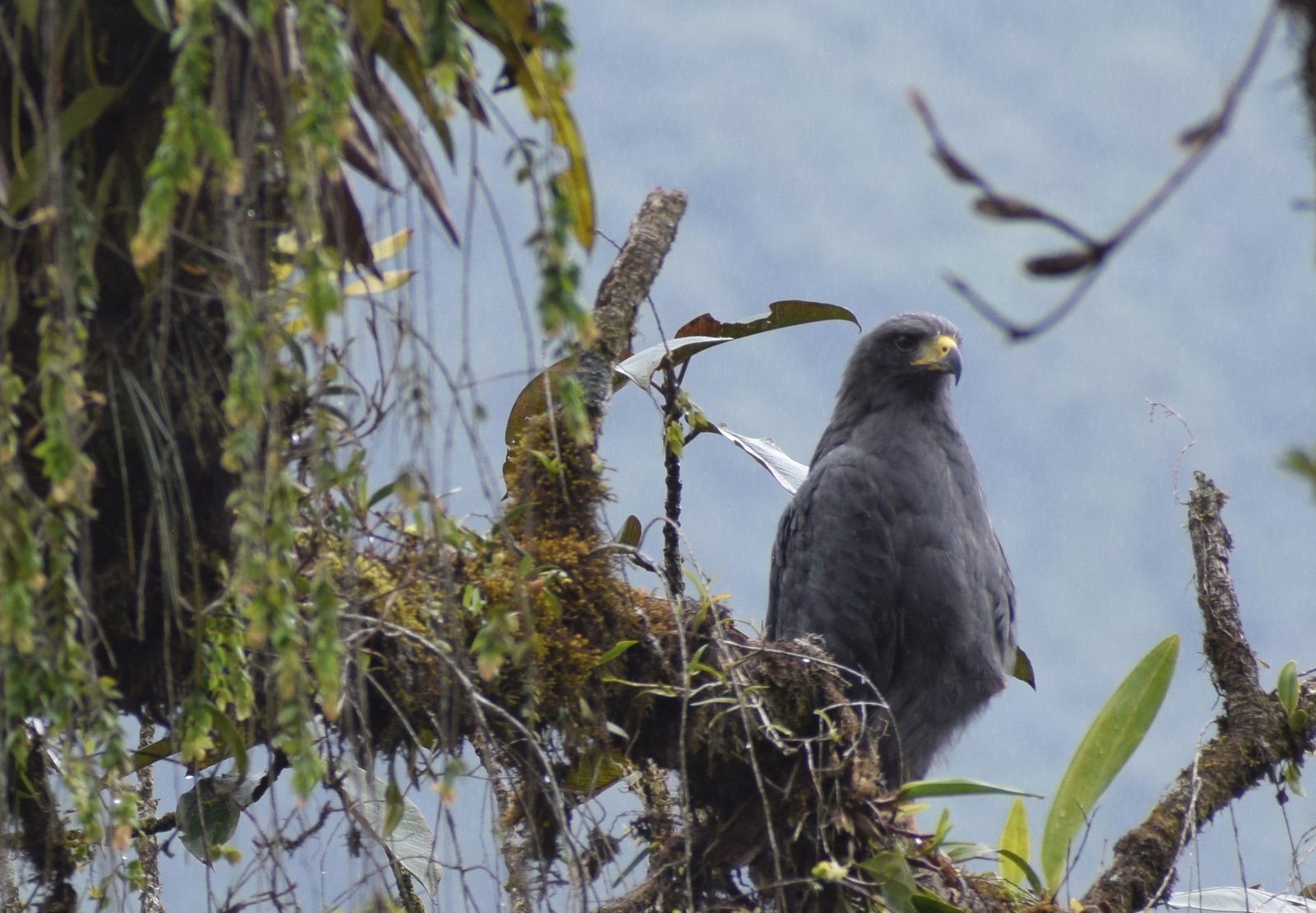
The Solitary Eagle is a large slate-grey eagle of steep forested mountain slopes. It lives at low densities and is usually seen soaring high over montane forest. Despite its name it is closely related to the Great Black Hawk.
Voice
A series of loud, high whistles, pee-pee-pee-pee, mainly in flight over the breeding area.
Recording: Sjoerd Mayer — CC BY-NC-SA 3.0 · xeno-canto
Identification
66–76 cm; the female is larger than the male. The adult is uniform dark slate grey, with a short, rounded crest on the hindcrown. The tail is short and black, with one broad white central band and a narrow white tip. The cere and legs are yellow. In flight the very broad wings and short tail stand out; the bird then looks almost square. Juveniles are dark brown above and buff below with dark streaks and blotches, with dark flanks and thighs and a dark cheek patch; the tail is barred grey-brown.
Confusion species
Great Black Hawk Buteogallus urubitinga is smaller and blacker, with longer legs, a longer tail and white uppertail coverts; it lives mainly in the lowlands. Common Black Hawk Buteogallus anthracinus is much smaller. Juveniles resemble juvenile Black-and-chestnut Eagles Spizaetus isidori and juvenile Great Black Hawks; concentrate on the silhouette with very broad wings and short tail.
Habitat
Montane forest and humid foothill forest on steep slopes, often near ravines. Mainly between about 600 and 2200 m. It soars for long periods over the forest and also perches in the canopy. It feeds mainly on snakes, also lizards, mammals and birds. The nest is a large stick nest in a tall tree.
Where the bird is most at home, classified by the vegetation units of the Andes and the west coast.


Range and movements
In Colombia locally in the three Andean ranges and in the Sierra Nevada de Santa Marta. In Ecuador on both slopes of the Andes. In Peru mainly on the east slope of the Andes. In Bolivia scarce on the east slope of the Andes. Outside the guide area locally from Mexico through Central America to Venezuela and northern Argentina.
- Resident
- dark = core range, pale = thinly spread
How and when to look
Search on a clear morning from a viewpoint over forested slopes, when rising air lifts raptors. Compare the silhouette with that of Black Vultures and other large raptors.
Conservation status
Near Threatened. The species lives at low densities and the population is small; deforestation of mountain slopes and persecution are the main threats.
Scientific name
Buteogallus solitarius | (Tschudi, 1844) (GBIF: Harpyhaliaetus solitarius)
Tschudi described the species in 1844 as Circaetus solitarius; because it was later moved to another genus, the author and year stand in brackets. The genus Buteogallus was introduced in 1830 by Lesson. The genus name combines the genus names Buteo (buzzards) and Gallus (junglefowl, Latin gallus, 'cockerel'). Lesson erected the genus in 1830. The species name is Latin solitarius, 'solitary'. The specimen the first description was based on came from Río Chanchamayo, Junín, Peru.