All species › Birds of prey › Kites, Old World vultures, eagles and hawks › Great Black Hawk
Great Black Hawk | Buteogallus urubitinga
Zwarte arendbuizerd | Aguililla-negra mayor | Gavião-preto
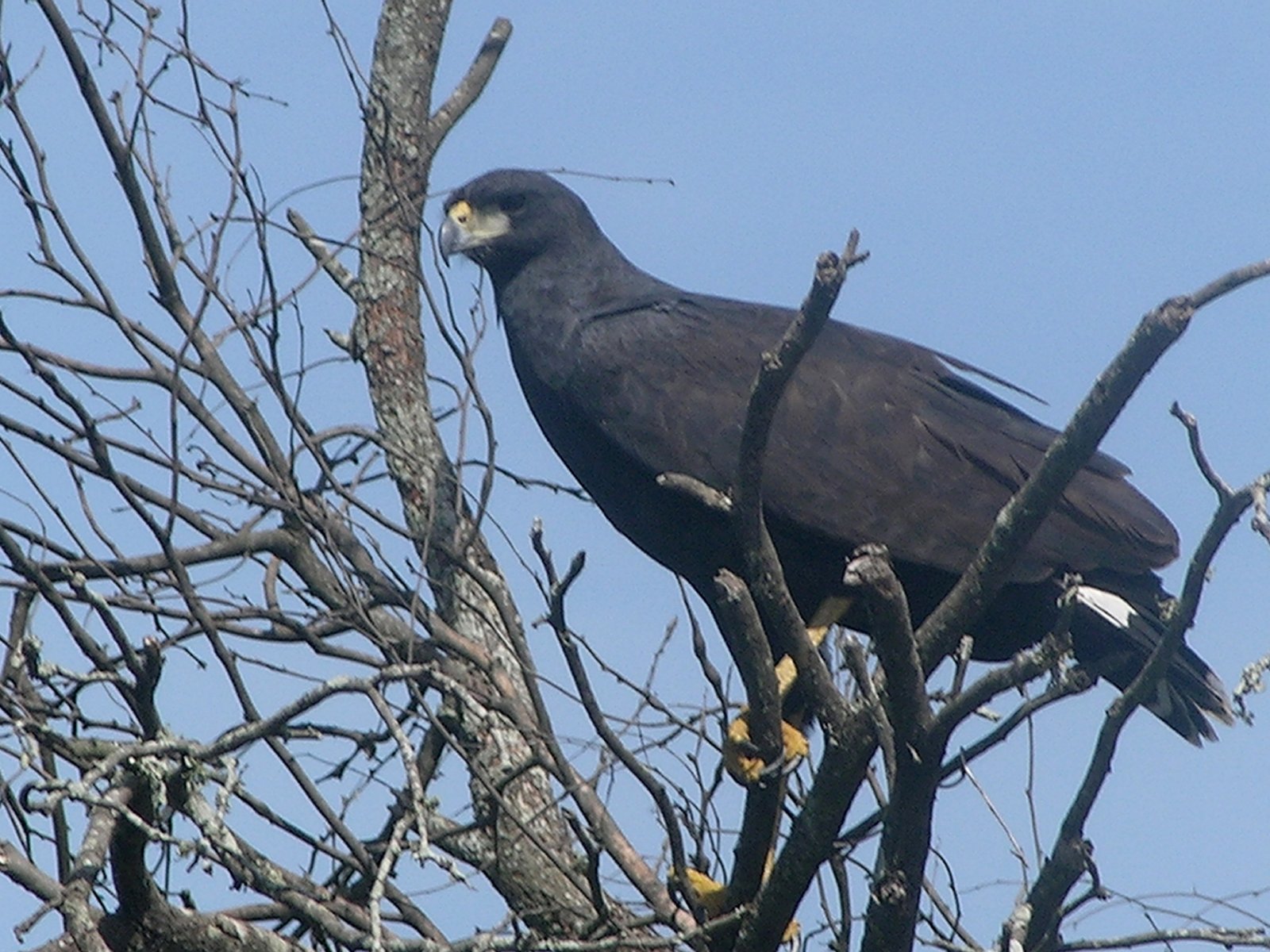
The Great Black Hawk is a large black raptor of forest edges, riverbanks and marshes in the lowlands. With its long yellow legs it often hunts on foot on the ground or in shallow water. It occurs throughout the lowlands of the guide area, on both sides of the Andes.
Voice
A long, high, screaming whistle, weeeeeee, often given in flight or from a perch.
Recording: JAYRSON ARAUJO DE OLIVEIRA — CC BY-NC-SA 4.0 · xeno-canto
Identification
56–64 cm; the female is larger than the male. The adult is entirely black with white uppertail coverts and a white tail base; the tail further has one broad white band and a black terminal band. The cere and long legs are yellow. In flight the wings are broad and the tail fairly long; the flight feathers are sometimes finely barred grey. Juveniles are dark brown above and buff below with dark streaks, with a pale head and a pale tail with many narrow dark bars. Adult plumage is reached after several years.
Confusion species
Common Black Hawk Buteogallus anthracinus is smaller, has shorter legs, no white uppertail coverts and in flight a pale patch at the base of the primaries; in the guide area it lives mainly in mangroves on the Pacific coast. Solitary Eagle Buteogallus solitarius is larger and slate grey, with very broad wings and a short tail, and lives in montane forest. Slate-colored Hawk Buteogallus schistaceus is smaller and slate grey with orange legs. Zone-tailed Hawk Buteo albonotatus has narrower wings and flies with the wings held in a V.
Habitat
Forest edges, riverine forest, várzea, marshes, clearings, savannas with patches of woodland and the edges of rivers and lakes, also mangroves. Mainly below 1000 m, locally to about 1500 m. It often perches on a branch at the edge of a clearing and hunts reptiles, frogs, fish, crabs, small mammals and birds; it also walks on the ground and in shallow water. The nest is a large stick nest high in a tree.
Where the bird is most at home, classified by the vegetation units of the Andes and the west coast.


Range and movements
In Colombia throughout the lowlands: the Caribbean region, the Magdalena Valley, the llanos, Amazonia and the Pacific coast. In Ecuador in the eastern lowlands and locally in the west. In Peru in the eastern lowlands and in the far north-west. In Bolivia in the lowlands of the north and east. Outside the guide area from Mexico to northern Argentina and Uruguay.
- Resident
- dark = core range, pale = thinly spread
How and when to look
Search along rivers and oxbow lakes in Amazonia and along the edges of marshes, where adults often sit on an exposed branch or fly low. Look for the white tail base on a bird taking off.
Conservation status
Least Concern. Widespread and fairly common in suitable habitat, but sensitive to deforestation and locally to persecution.
Scientific name
Buteogallus urubitinga | (Gmelin, 1788)
Gmelin described the species in 1788 as Falco Urubitinga; because it was later moved to another genus, the author and year stand in brackets. The genus Buteogallus was introduced in 1830 by Lesson. The genus name combines the genus names Buteo (buzzards) and Gallus (junglefowl, Latin gallus, 'cockerel'). Lesson erected the genus in 1830. The species name comes from Tupi urubú tinga, 'big black bird', a name for such a raptor. The specimen the first description was based on came from northeastern Brazil.