All species › Birds of prey › Kites, Old World vultures, eagles and hawks › Savanna Hawk
Savanna Hawk | Buteogallus meridionalis
Savannebuizerd | Gavilán sabanero | Gavião-caboclo
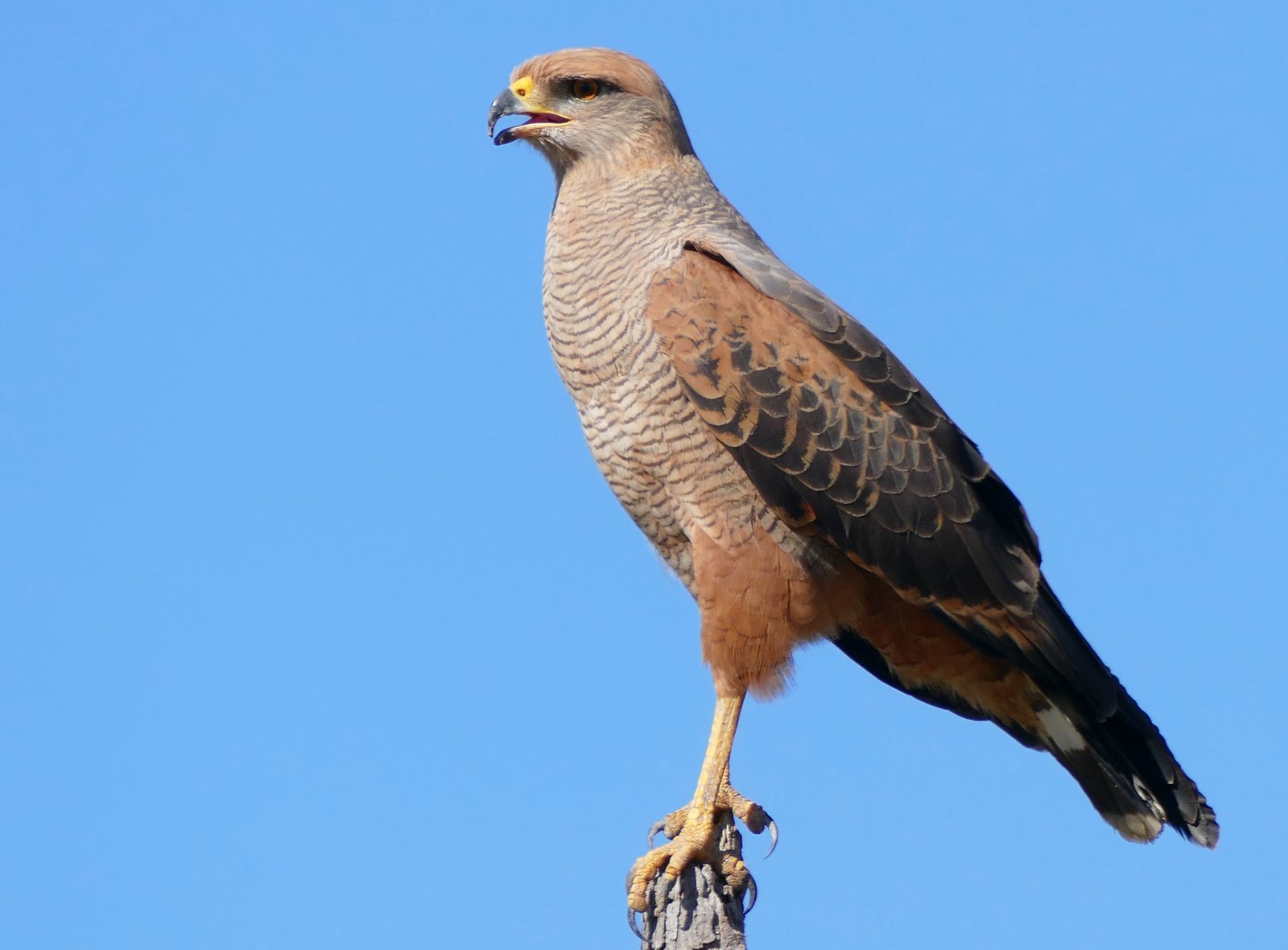
The Savanna Hawk is a long-legged, rufous hawk of open savanna and pasture in the lowlands. It often sits on a post, a bare tree or the ground, and sometimes walks after prey. At grass fires several birds often gather to catch animals fleeing the flames.
Voice
A hoarse, drawn-out scream, keeeeeer, mainly at the nest and in flight.
Recording: Fabrício Grigolin — CC BY-NC-SA 4.0 · xeno-canto
Identification
46–61 cm, with long, broad wings, a short tail and conspicuously long yellow legs. The adult is largely cinnamon-rufous, with a greyish mottled back and fine dark barring on the underparts. In flight the wings are rufous above and below with a broad black trailing edge and black wingtips. The tail is black with a single white band in the middle and a narrow white tip. The sexes are alike; the female is larger. Juveniles are darker and browner, with a pale eyebrow, mottled underparts and a barred tail.
Confusion species
Black-collared Hawk Busarellus nigricollis is rufous with a whitish head, a black breast patch, shorter legs and a black tail without an obvious white band, and stays closer to water. Harris's Hawk Parabuteo unicinctus is dark chocolate brown with rufous shoulders and thighs and a white tail base. Roadside Hawk Rupornis magnirostris is smaller and greyer, with rufous wing panels only in the primaries.
Habitat
Open savanna with scattered trees and palms, wet grassland, marsh edges, pasture and open dry woodland in the lowlands, mainly below 1000 m, locally higher. It hunts from a perch or on foot on the ground for lizards, snakes, small mammals, frogs, crabs and large insects. The nest is a stick nest in an isolated tree or palm.
Where the bird is most at home, classified by the vegetation units of the Andes and the west coast.


Range and movements
In Colombia in the lowlands of the Caribbean region, the Magdalena and Cauca valleys and the llanos. In Ecuador in the western lowlands and rare in the east. In Peru in the northwest and locally in the savannas of the southeast. In Bolivia in the savannas of the Beni and Santa Cruz. Absent from the Galápagos. Outside the guide area from Panama to northern Argentina and Uruguay.
- Resident
- dark = core range, pale = thinly spread
How and when to look
Drive through the savannas of the Beni or the llanos, or the open farmland of western Ecuador, and check posts and isolated trees along the road; several birds often gather at grass fires.
Conservation status
Least Concern. It locally benefits from deforestation and the creation of pasture.
Scientific name
Buteogallus meridionalis | (Latham, 1790)
Latham described the species in 1790 as Falco meridionalis; because it was later moved to another genus, the author and year stand in brackets. The genus Buteogallus was introduced in 1830 by Lesson. The genus name combines the genus names Buteo (buzzards) and Gallus (junglefowl, Latin gallus, 'cockerel'). Lesson erected the genus in 1830. The species name is Latin meridionalis, 'southern'. The specimen the first description was based on came from Cayenne, French Guiana.