All species › Birds of prey › Kites, Old World vultures, eagles and hawks › Common Black Hawk
Common Black Hawk | Buteogallus anthracinus
Zwarte buizerd | Gavilán cangrejero | Gavião-caranguejeiro-negro
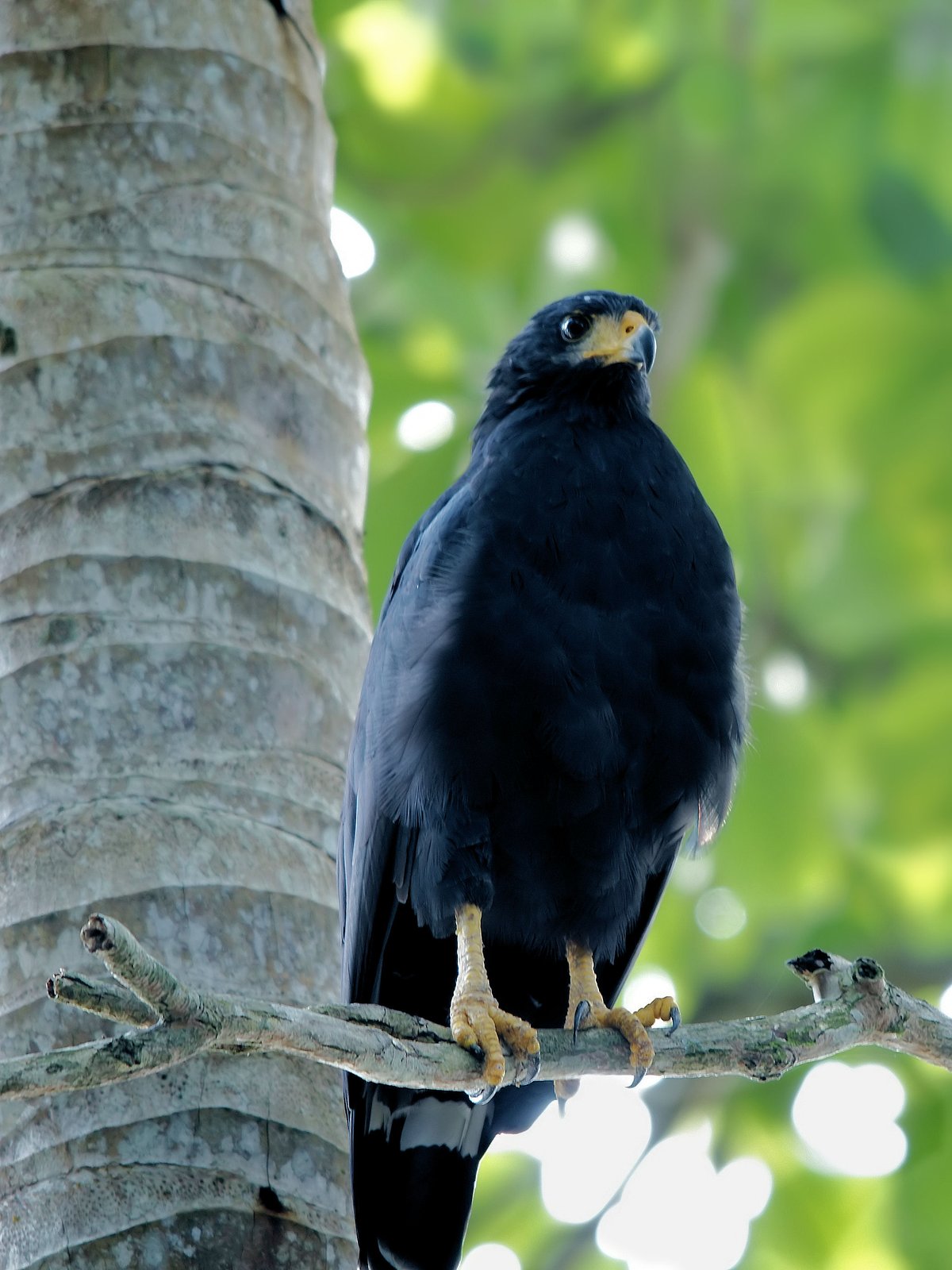
The Common Black Hawk is a stocky, blackish hawk of mangroves and coastal marshes, feeding mainly on crabs. In the guide area it lives along the Caribbean and Pacific coasts; the birds along the Pacific were formerly often treated as a separate species, Mangrove Black Hawk. It perches a lot on branches in the mangroves or walks over mudflats.
Voice
A series of high, whistled notes, kee-kee-kee-kee, swelling and fading; mainly heard in flight.
Recording: Gean Carlo Valdés — CC0 1.0 · xeno-canto
Identification
43–53 cm, with very broad wings and a short tail. The adult is dull blackish. The tail is black with a single broad white band in the middle and a narrow white tip. In flight the wings show a pale patch at the base of the outer primaries. Cere, lores and legs yellow. Birds of the Pacific coast are slightly smaller and often show a brownish tinge on the secondaries. The sexes are alike. Juveniles are dark brown above and buff with dark streaks below, with a pale eyebrow and a tail with many narrow dark bars.
Confusion species
Great Black Hawk Buteogallus urubitinga is larger, with longer legs, white uppertail coverts and a tail with a broader white base; adults lack the pale patch in the primaries. Zone-tailed Hawk Buteo albonotatus has longer, narrower wings with two-toned underwings, several tail bands and flies with the wings in a V like a Turkey Vulture. Solitary Eagle Buteogallus solitarius is much larger and lives in montane forest.
Habitat
Mangroves, estuaries, tidal creeks, coastal lagoons and mudflats, sometimes adjacent marshes and riverside woodland; almost exclusively in the coastal lowlands. It hunts from a branch or on foot over the mud, mainly for crabs, and also for fish, frogs and reptiles. The nest is a stick nest in a mangrove or other tree near water.
Where the bird is most at home, classified by the vegetation units of the Andes and the west coast.


Range and movements
In Colombia along the Caribbean coast and along the Pacific coast. In Ecuador in the coastal mangroves, especially around the Gulf of Guayaquil. In Peru only in the mangroves of Tumbes. Absent from Bolivia and the Galápagos. Outside the guide area from the south-western United States through Central America to northern Venezuela and Trinidad, and on a few Lesser Antilles.
- Resident
- dark = core range, pale = thinly spread
How and when to look
Search the mangroves of Tumbes or around the Gulf of Guayaquil, preferably at low tide, when birds hunt crabs from low branches or on the mud.
Conservation status
Least Concern. Along the Pacific coast sensitive to the loss of mangroves to shrimp farms.
Scientific name
Buteogallus anthracinus | (Deppe, 1830)
Deppe described the species in 1830 as Falco anthracinus; because it was later moved to another genus, the author and year stand in brackets. The genus Buteogallus was introduced in 1830 by Lesson. The genus name combines the genus names Buteo (buzzards) and Gallus (junglefowl, Latin gallus, 'cockerel'). Lesson erected the genus in 1830. The species name is Latin anthracinus, 'coal-black', from Greek anthrax, 'coal'. The specimen the first description was based on came from Veracruz, Mexico.