All species › Birds of prey › Kites, Old World vultures, eagles and hawks › Slate-colored Hawk
Slate-colored Hawk | Buteogallus schistaceus
Leigrijze buizerd | Gavilán pizarroso | Gavião-azul
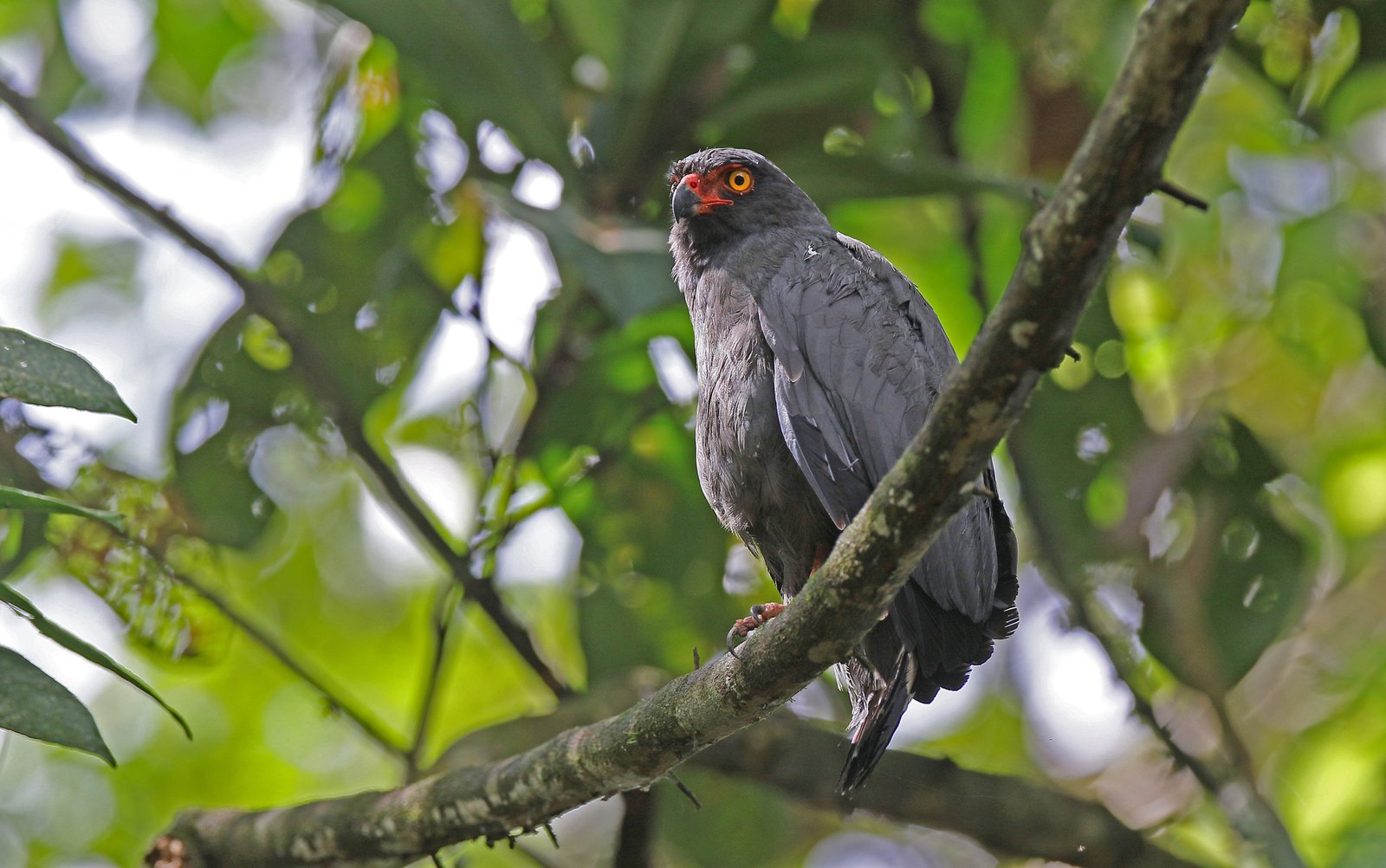
The Slate-colored Hawk is a uniform grey hawk of flooded forest and waterways in Amazonia. It often sits low on a branch over a creek or oxbow lake and drops onto prey from there. It sometimes follows groups of monkeys to catch insects and lizards they flush.
Voice
A loud, whistled, falling scream, keeeeeeuw, often repeated, also from a perch.
Recording: JAYRSON ARAUJO DE OLIVEIRA — CC BY-NC-SA 4.0 · xeno-canto
Identification
41–46 cm, with broad wings and a rather short tail. The adult is entirely dark slate grey. The tail is black with a single narrow white band in the middle and a narrow white tip. Below, the wings show fine white barring on the flight feathers. Cere, lores and legs orange-red; the eyes are pale. The sexes are alike. Juveniles have fine white barring on the belly, thighs and underwings.
Confusion species
Crane Hawk Geranospiza caerulescens is slimmer, with long, orange-red legs, two white tail bands and in flight a white crescent across the primaries. Slender-billed Kite Helicolestes hamatus has a strongly hooked bill and a short tail without a white band in adults. Plumbeous Kite Ictinia plumbea has long, pointed wings with rufous primaries. Great Black Hawk Buteogallus urubitinga is much larger and black, with yellow legs.
Habitat
Várzea, igapó, swamp forest and the banks of creeks, rivers and oxbow lakes in the Amazonian lowlands, mainly below about 600 m. It hunts from a low, shaded branch over the water for snakes, lizards, frogs, crabs, fish and large insects. Little is known about the nest.
Where the bird is most at home, classified by the vegetation units of the Andes and the west coast.


Range and movements
In Colombia in Amazonia in the southeast. In Ecuador in the eastern lowlands. In Peru throughout the Amazonian lowlands. In Bolivia in the north. Absent from the Galápagos. Outside the guide area in southern Venezuela, the Guianas and Brazilian Amazonia.
- Resident
- dark = core range, pale = thinly spread
How and when to look
Boat slowly along creeks and the edges of oxbow lakes and check low branches over the water; birds often stay put as a boat passes and call regularly.
Conservation status
Least Concern. Widespread in the Amazonian lowlands; dependent on forest along water.
Scientific name
Buteogallus schistaceus | (Sundevall, 1850) (GBIF: Leucopternis schistaceus)
Sundevall described the species in 1850 as Asturina schistacea; because it was later moved to another genus, the author and year stand in brackets. The genus Buteogallus was introduced in 1830 by Lesson. The genus name combines the genus names Buteo (buzzards) and Gallus (junglefowl, Latin gallus, 'cockerel'). Lesson erected the genus in 1830. The species name is New Latin schistaceus, 'slate-coloured'. The specimen the first description was based on came from Brazil.