All species › Birds of prey › Kites, Old World vultures, eagles and hawks › Plumbeous Hawk
Plumbeous Hawk | Cryptoleucopteryx plumbea
Donkergrijze buizerd | Gavilán plomizo | Gavião-plúmbeo
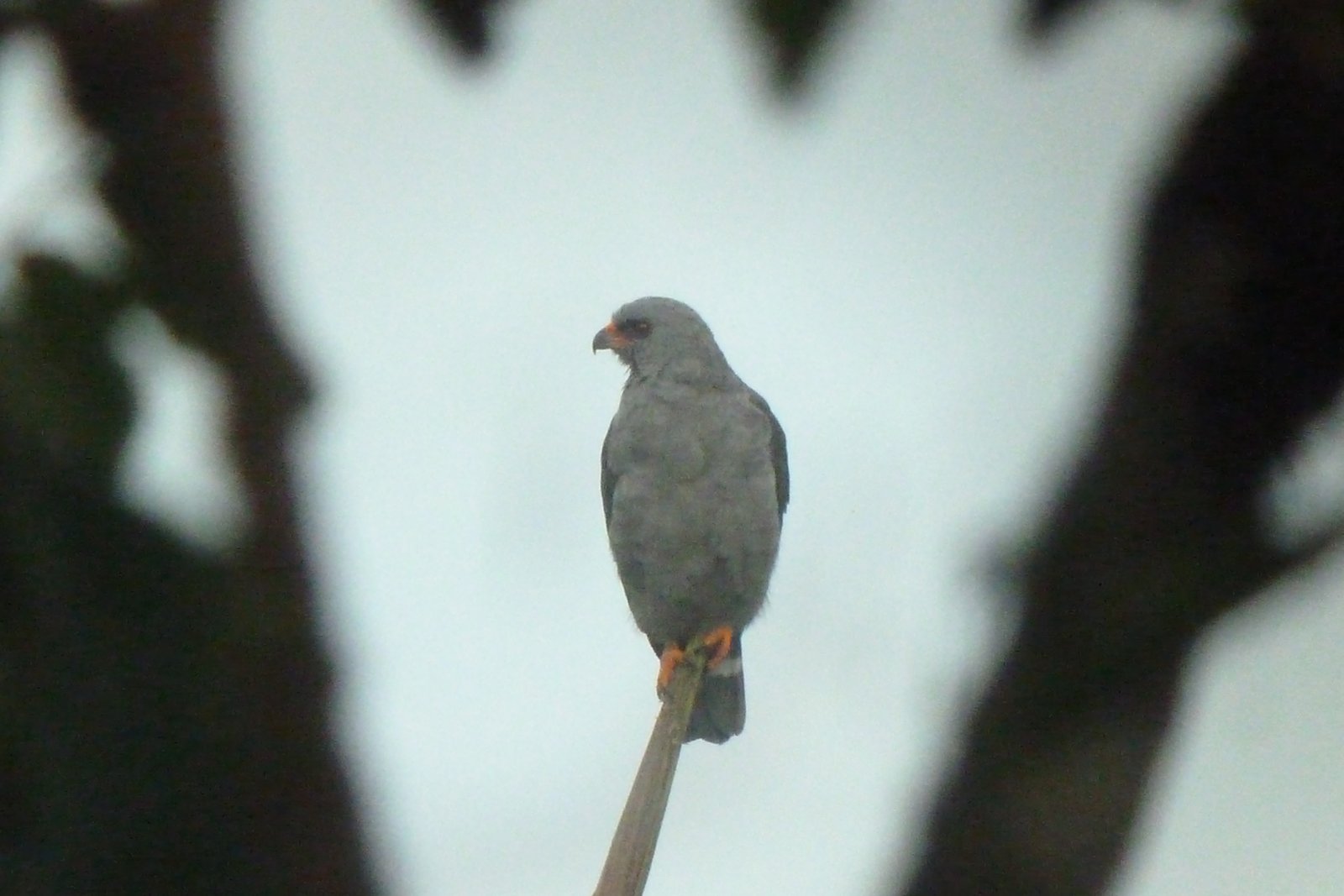
The Plumbeous Hawk is a small, uniform slate-grey hawk of the humid lowland and foothill forest of the Chocó and western Ecuador. It usually sits still on a branch inside the forest and rarely soars above the canopy. Its range is small and threatened by deforestation.
Voice
A thin, drawn-out, slightly falling whistle, wheeeeu; heard fairly rarely.
Recording: Olaf Jahn — CC BY-NC-SA 4.0 · xeno-canto
Identification
33–36 cm, with rather short, rounded wings and a medium-length tail. The adult is entirely slate grey, the wings slightly darker. The tail is black with a single narrow white band in the middle and a narrow pale tip. Below, the underwing coverts are white with fine grey barring, which contrasts in flight with the grey body. Cere and legs orange. The sexes are alike. Juveniles have pale barring on the belly and thighs and pale feather fringes.
Confusion species
Slate-colored Hawk Buteogallus schistaceus is very similar, but is larger and lives only east of the Andes. Semiplumbeous Hawk Leucopternis semiplumbeus has the same build and lives in the same forest, but is bright white below. Plumbeous Kite Ictinia plumbea has long, pointed wings with rufous primaries and hunts on the wing. Crane Hawk Geranospiza caerulescens has long, orange-red legs and two white tail bands.
Habitat
The interior and edges of humid lowland and foothill forest, often near streams and in humid ravines, mainly below 1000 m, locally to about 1400 m. It hunts from a low to mid-level branch for frogs, snakes, lizards, crabs and large insects. Little is known about the nest.
Where the bird is most at home, classified by the vegetation units of the Andes and the west coast.


Range and movements
In Colombia in the Pacific lowlands and the adjacent foothills of the Western Andes. In Ecuador in the western lowlands and foothills, mainly in the north. In Peru only in the far northwest, where very scarce. Absent from Bolivia and the Galápagos. Outside the guide area in eastern Panama.
- Resident
- dark = core range, pale = thinly spread
How and when to look
Search in undisturbed forest in Esmeraldas or in the Colombian Chocó; birds sit still in the forest for long periods and give themselves away mainly by their whistle or when they fly briefly to another branch.
Conservation status
Near Threatened. The small range in the Chocó and western Ecuador is losing forest to logging and conversion to farmland and plantations.
Scientific name
Cryptoleucopteryx plumbea | (Salvin, 1872) (GBIF: Leucopternis plumbeus)
Salvin described the species in 1872 as Leucopternis plumbea; because it was later moved to another genus, the author and year stand in brackets. The genus Cryptoleucopteryx was introduced in 2009 by Amaral, Sheldon, Gamauf, Haring, Riesing, Silveira & Wajntal. The genus name combines Greek kruptos, 'hidden', with leukos, 'white', and pterux, 'wing', possibly for the barely visible white in the wing. The species name comes from Latin plumbeus, 'lead-grey'. The specimen the first description was based on came from Ecuador.