All species › Birds of prey › Kites, Old World vultures, eagles and hawks › Barred Hawk
Barred Hawk | Morphnarchus princeps
Sclaters buizerd | Busardo azoreño | Gavião-barrado
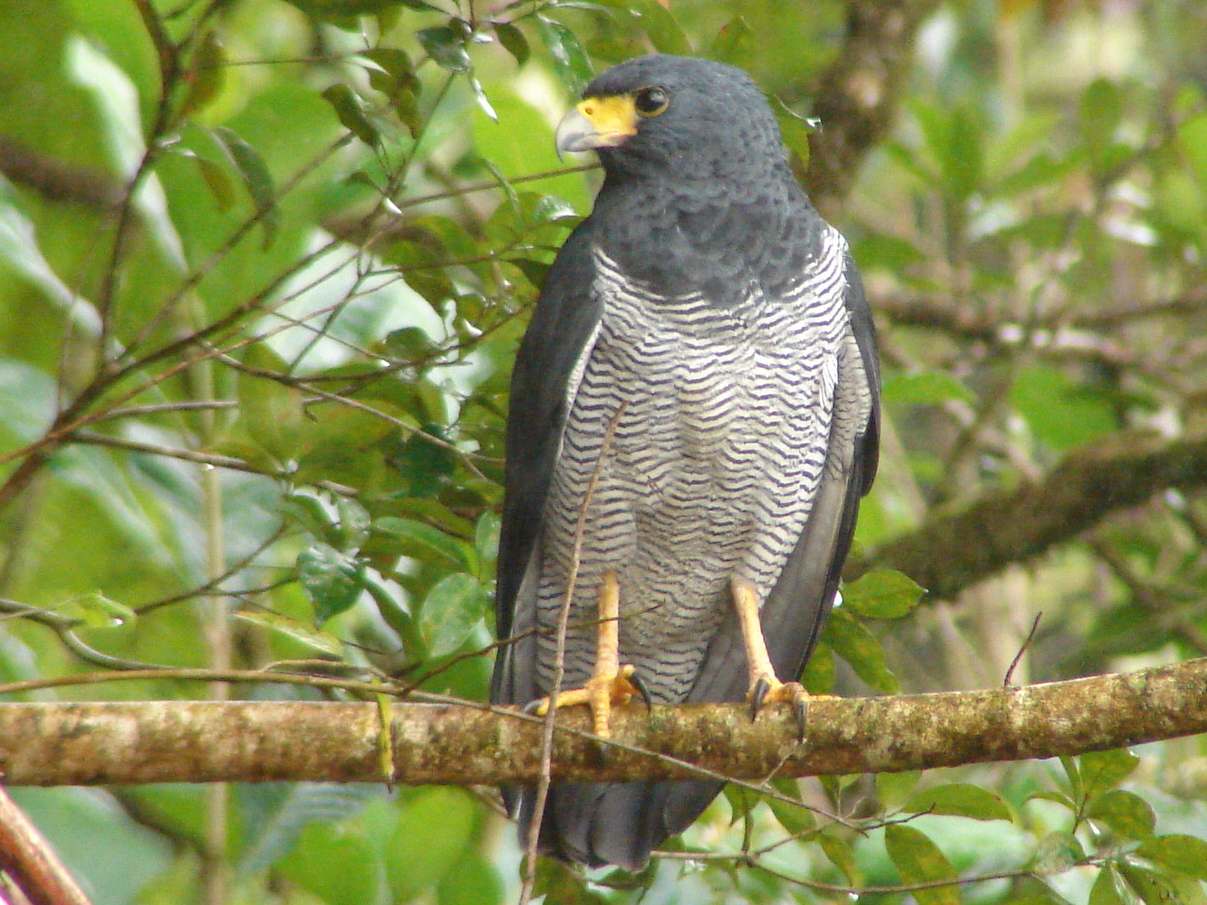
The Barred Hawk is a large, broad-winged hawk of the humid montane forests of the northern Andes and Central America. With its blackish head and breast and finely barred white belly, its plumage recalls that of the Black-chested Buzzard-Eagle. It soars a great deal over forested slopes, calling loudly.
Voice
A loud, high, whistled scream, kleeeer, and shorter calls; often heard while the bird is soaring.
Recording: José María Loaiza B. — CC BY-NC-SA 4.0 · xeno-canto
Identification
51–58 cm, with very broad wings and a short tail. The head, upperparts and breast are blackish slate, forming a dark bib sharply demarcated from the white belly, which is finely barred black, as are the thighs. The tail is black with a single broad white band in the middle. Below, the underwings are white with fine dark barring and a dark trailing edge. Cere and legs yellow to orange-yellow. The sexes are alike; juveniles resemble adults, with paler edges to the feathers of the upperparts.
Confusion species
Grey-backed Hawk Pseudastur occidentalis has a grey back and a white head and underparts without a dark bib. White Hawk Pseudastur albicollis is largely white. Semiplumbeous Hawk Leucopternis semiplumbeus is much smaller, unbarred white below, and lives in the lowlands. Black-chested Buzzard-Eagle Geranoaetus melanoleucus has a similar pattern but a wedge-shaped tail, pale grey wing panels and lives in the open high Andes.
Habitat
Humid foothill and montane forest, cloud forest and forest edges, mainly between about 600 and 2500 m, locally lower. It soars over forested slopes in the morning and otherwise hunts from a perch inside the forest for slow prey: caecilians, snakes, frogs, small mammals and large insects. The nest is a stick nest high in a tree.
Where the bird is most at home, classified by the vegetation units of the Andes and the west coast.


Range and movements
In Colombia along the Andes, especially on the western slope of the Western Andes and locally in the Central Andes. In Ecuador on the western slope of the Andes and locally on the eastern slope. In Peru only a few records in the far north. Absent from Bolivia and the Galápagos. Outside the guide area in Costa Rica and Panama.
- Resident
- dark = core range, pale = thinly spread
How and when to look
Search on sunny mornings over forested slopes in western Ecuador, such as around Mindo, when birds rise and call; the dark bib and single white tail band show well in flight.
Conservation status
Least Concern. Dependent on large continuous forests and therefore locally reduced by deforestation of mountain slopes.
Scientific name
Morphnarchus princeps | (Sclater, 1865) (GBIF: Leucopternis princeps)
Sclater described the species in 1865 as Leucopternis princeps; because it was later moved to another genus, the author and year stand in brackets. The genus Morphnarchus was introduced in 1920 by Ridgway. The genus name combines Greek morphnos, 'dark-coloured', with arkhos, 'leader, chief'. The species name is Latin princeps, 'first' or 'prince'. The specimen the first description was based on came from Costa Rica.