All species › Birds of prey › Kites, Old World vultures, eagles and hawks › Snail Kite
Snail Kite | Rostrhamus sociabilis
Slakkenwouw | Gavilán caracolero | Gavião-caramujeiro
The Snail Kite is a kite of open freshwater marshes that lives almost entirely on apple snails. It flies slowly and floppily low over the marsh, head down, and grabs the snails with one foot. Outside the breeding season it often lives in groups and roosts communally in shrubs or trees.
Voice
A dry, cackling or grating rattle, ka-ka-ka-ka, and a bleating sound; mainly heard around nest and roost.
Recording: José María Loaiza B. — CC BY-NC-SA 4.0 · xeno-canto
Identification
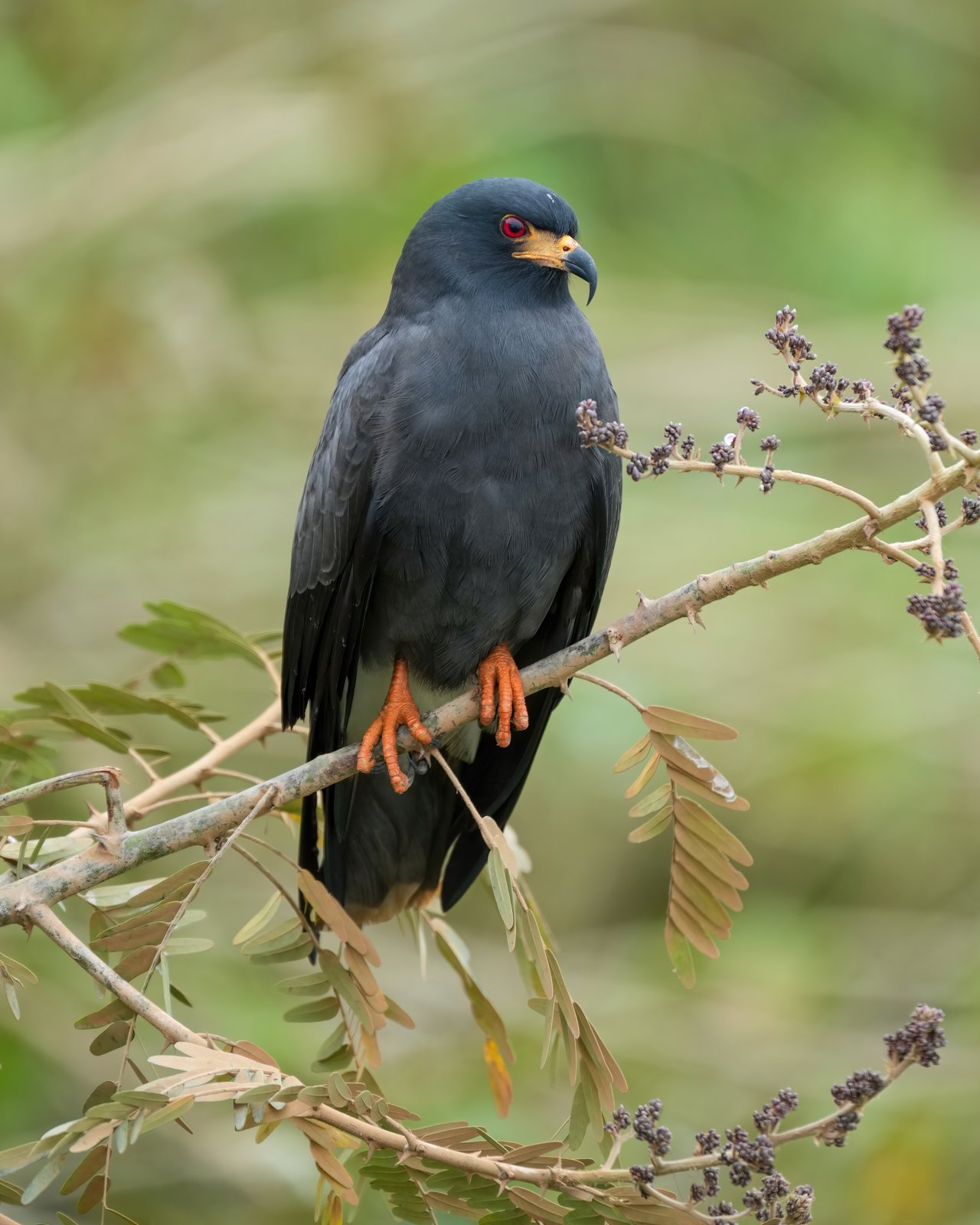
41–46 cm, with broad wings, a rather long, square tail and a thin, strongly hooked black bill. The male is slate grey to blackish, with a white tail base and white undertail coverts; the tail has a broad dark terminal band and a pale tip. The eyes are red, the bare skin around the bill and the legs orange-red. The female is dark brown above and heavily streaked brown on a pale ground below, with a pale eyebrow and throat and the same white tail base. Juveniles resemble the female, with brown eyes.
Confusion species
Slender-billed Kite Helicolestes hamatus has a shorter tail without a white base, yellow-orange eyes and lives in flooded forest. Hook-billed Kite Chondrohierax uncinatus also eats land snails, but has a heavy, hooked bill, a banded tail and lives in forest. In flight females recall Long-winged Harrier Circus buffoni, which has longer, narrower wings and a white rump but no white undertail.
Habitat
Open freshwater marshes with aquatic vegetation, edges of lakes and lagoons, flooded savanna, rice fields and irrigation canals, mainly in the lowlands, locally higher. It feeds almost only on apple snails (Pomacea), extracting them from the shell at a regular perch; piles of empty shells collect beneath such feeding sites. It often breeds in loose colonies; the nest is in a shrub, in reeds or in a low tree over water.
Where the bird is most at home, classified by the vegetation units of the Andes and the west coast.


Range and movements
In Colombia in the lowlands of the Caribbean region, the Magdalena and Cauca valleys, the llanos and locally in Amazonia. In Ecuador in the western lowlands, especially in the Guayas basin, and scarce in the east. In Peru in the Amazonian lowlands and locally in the northwest. In Bolivia in the lowlands, numerous in the Beni. Absent from the Galápagos. Outside the guide area from Florida and Cuba through Central America to Argentina and Uruguay; the southernmost birds migrate.
- Resident
- dark = core range, pale = thinly spread
How and when to look
Search over rice fields and marshes in the Guayas basin of western Ecuador or in the wetlands of the Beni; look for birds flapping slowly low over the water, or for posts with empty snail shells beneath them.
Conservation status
Least Concern. It can spread quickly where rice growing and irrigation create suitable habitat, but is sensitive to drainage and to the loss of apple snails.
Scientific name
Rostrhamus sociabilis | (Vieillot, 1817)
Vieillot described the species in 1817 as Herpetotheres sociabilis; because it was later moved to another genus, the author and year stand in brackets. The genus Rostrhamus was introduced in 1830 by Lesson. The genus name combines Latin rostrum, 'bill', and hamus, 'hook', after the strongly hooked bill. The species name is Latin sociabilis, 'sociable', after its habit of roosting and nesting in groups. The specimen the first description was based on came from Corrientes, Argentina.