All species › Birds of prey › Kites, Old World vultures, eagles and hawks › Slender-billed Kite
Slender-billed Kite | Helicolestes hamatus
Slanksnavelwouw | Caracolero plomizo | Gavião-do-igapó
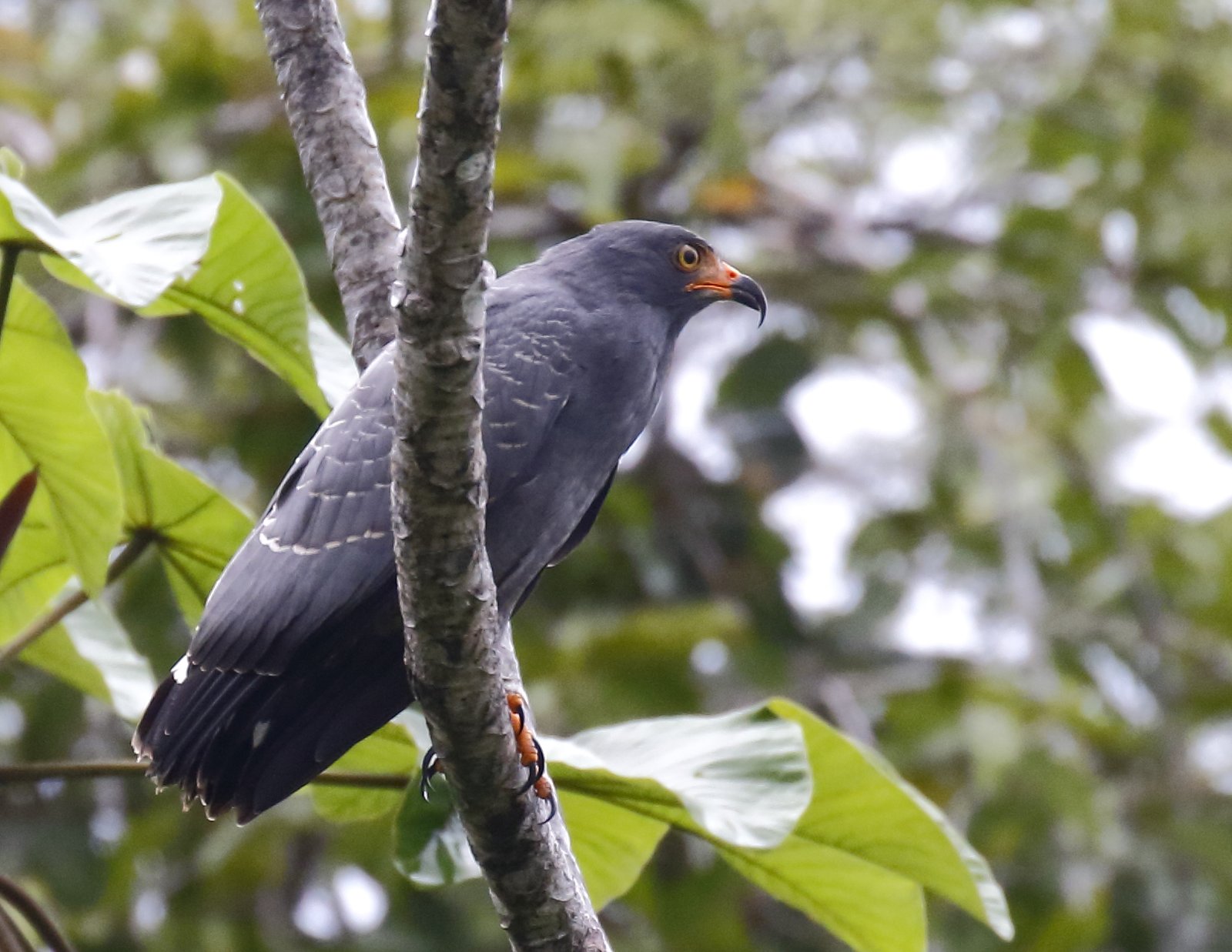
The Slender-billed Kite is a stocky, slate-grey kite of flooded forest in Amazonia, feeding almost exclusively on apple snails. With its thin, strongly hooked bill it pulls the snail from its shell. It is more secretive than the related Snail Kite and usually stays at the forest edge over water.
Voice
A high, plaintive, somewhat nasal squeal or mew, wheeeh, often repeated.
Recording: GABRIEL LEITE — CC BY-NC-SA 4.0 · xeno-canto
Identification
36–41 cm, with broad, paddle-shaped wings and a short, square tail, giving it a stocky silhouette in flight. The adult is uniform slate grey, the wings and tail slightly darker. The bill is thin, black and strongly hooked; the eyes are yellow-orange to orange, the cere and legs orange-red. Adults have no tail bands. The sexes are alike. Juveniles have two narrow white tail bands and pale fringes and barring on the underparts.
Confusion species
Snail Kite Rostrhamus sociabilis has a longer tail with a white base and white undertail coverts, red eyes, and lives in open marshes; females and juveniles are streaked brown. Slate-colored Hawk Buteogallus schistaceus lives in the same habitat, but has a white band across the tail and a less strongly hooked bill. Plumbeous Kite Ictinia plumbea has long, pointed wings with rufous primaries. Crane Hawk Geranospiza caerulescens has long, orange-red legs and white tail bands.
Habitat
Várzea, igapó, swamp forest and palm swamps along oxbow lakes, rivers and creeks in the lowlands, up to about 500 m. It sits at the forest edge or in the lower branches over the water and catches apple snails (Pomacea) at the surface; sometimes also crabs. The nest is a stick nest high in a tree; little is known about its breeding biology.
Where the bird is most at home, classified by the vegetation units of the Andes and the west coast.


Range and movements
In Colombia in Amazonia and locally in the northwest. In Ecuador in the eastern lowlands. In Peru in the Amazonian lowlands. In Bolivia in the north. Absent from the Galápagos. Outside the guide area in eastern Panama, Venezuela, the Guianas and Brazilian Amazonia.
- Resident
- dark = core range, pale = thinly spread
How and when to look
Boat slowly along the edges of oxbow lakes and flooded forest and look for a grey, stocky raptor on a bare branch over the water; birds often fly a short way and perch again.
Conservation status
Least Concern. Rather scarce and local; dependent on flooded forest, which is sensitive to deforestation and changes in water regime.
Scientific name
Helicolestes hamatus | (Temminck, 1821)
Temminck described the species in 1821 as Falco hamatus; because it was later moved to another genus, the author and year stand in brackets. The genus Helicolestes was introduced in 1918 by Bangs & Penard. The genus name comes from Greek helix, 'snail', and lēstēs, 'robber', for its diet of apple snails. The species name comes from Latin hamatus, 'hooked', for the strongly hooked bill. The specimen the first description was based on came from Brazil.