All species › Passerines › Wagtails and pipits › Hellmayr's Pipit
Hellmayr's Pipit | Anthus hellmayri
Hellmayrs pieper | Bisbita pálido | Caminheiro-de-barriga-acanelada
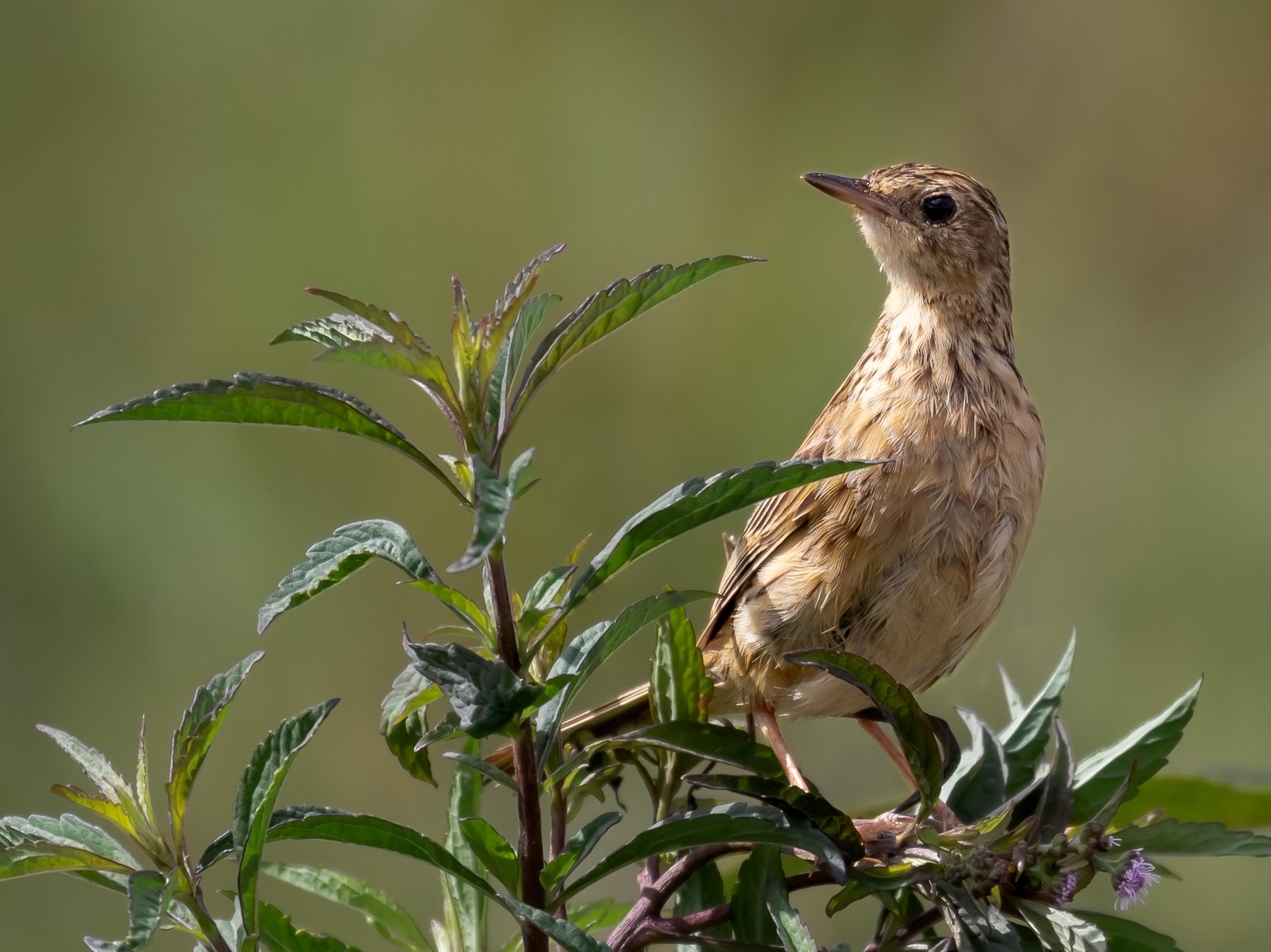
Hellmayr's Pipit is a slender, fairly long-tailed pipit of grassy slopes in the Andes of Bolivia and the far south of Peru, and of the grasslands further south-east. It is more finely streaked and warmer in colour than the other highland pipits. The male often sings from a shrub or rock.
Voice
The song is a short, thin series of high notes ending in a descending, buzzy tsee-tsee-tsrrrr, given from a perch or in a short song flight. The call is a soft tsit.
Recording: Franco Vushurovich — CC BY-NC-SA 4.0 · xeno-canto
Identification
14–15 cm, slender, with a thin bill and a fairly long tail. The upperparts are buffy brown with blackish streaks. The underparts are warm buff to pale ochre, with fine, narrow streaks on the breast and barely streaked flanks. The outer tail feathers are whitish to pale buff, not pure white. The sexes are alike.
Confusion species
Correndera Pipit Anthus correndera is more heavily streaked, with pale stripes on the back and streaked flanks. Puna Pipit Anthus brevirostris is more compact, with a short bill and a dense breast band. Paramo Pipit Anthus bogotensis is sturdier, with a plainer buff breast with few streaks. Yellowish Pipit Anthus chii is smaller, with white outer tail feathers, and lives in the lowlands.
Habitat
Grassy slopes with scattered shrubs and rocks, mountain meadows and open grassland in the Andes, in the guide area mainly between about 1500 and 3500 m, and also low-lying grasslands in the south-east of its range. It searches the ground for insects. The nest is on the ground, hidden in a grass tussock.
Where the bird is most at home, classified by the vegetation units of the Andes and the west coast.


Range and movements
In Peru only very locally in the south-east (Puno). In Bolivia in the Andes from La Paz south to Tarija, on grassy slopes of the eastern slope and in the valleys. Absent from Colombia, Ecuador and the Galápagos. Outside the guide area in north-western Argentina and Chile, and in the grasslands of Paraguay, Uruguay, north-eastern Argentina and southern Brazil.
- Resident
- dark = core range, pale = thinly spread
How and when to look
Search grassy slopes with scattered shrubs in the Andes of Bolivia, for example around Cochabamba, and listen for the thin song from a shrub or rock.
Conservation status
Least Concern. Locally fairly common; overgrazing and conversion of grassland to cropland reduce its habitat locally.
Scientific name
Anthus hellmayri | Hartert, 1909
Hartert described the species in 1909 and placed it straight away in the genus where it still stands. The genus Anthus was introduced in 1805 by Bechstein. The genus name is Latin anthus, a small bird of grasslands mentioned by Pliny the Elder. The species name honours Carl Eduard Hellmayr (1878–1944), Austrian ornithologist who published widely on South American birds. The specimen the first description was based on came from Río Salí, Tucumán, Argentina.